.webp&w=384&q=75)

Loading, please wait...
Loading, please wait...
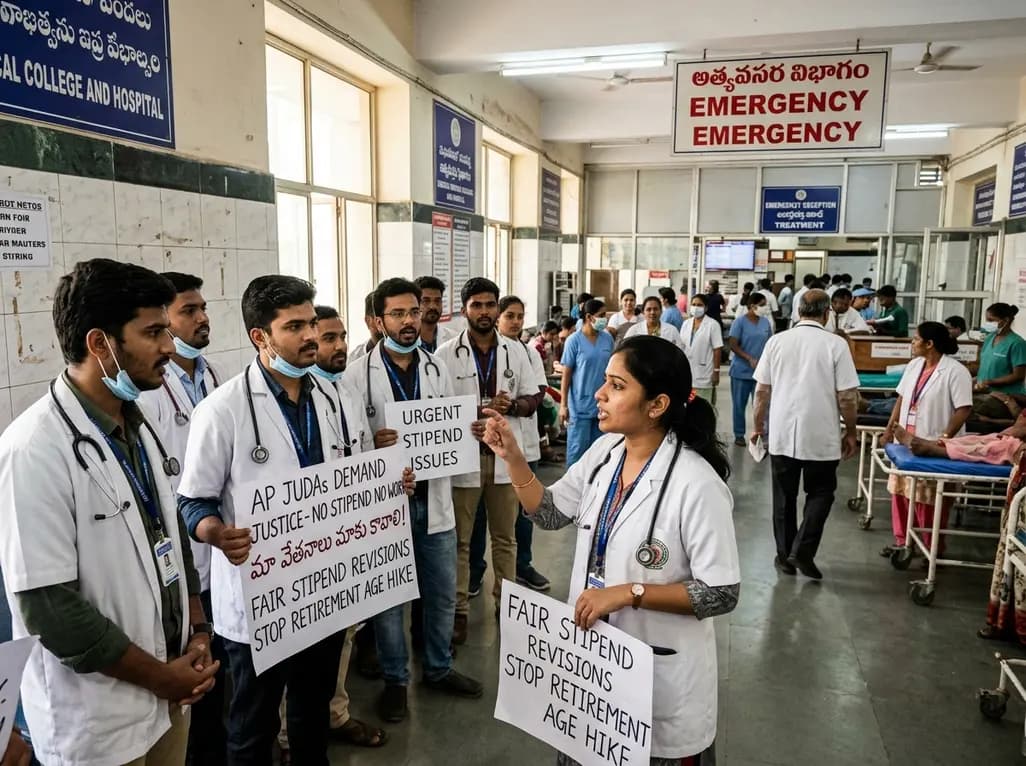
The ongoing Andhra junior doctors protest has entered a critical stage across state medical colleges and tertiary hospitals. After eight consecutive days of agitation, resident doctors escalated their strike by withdrawing from emergency services, casualty units, and intensive care facilities. Consequently, the standoff between the medical fraternity and health authorities has disrupted routine patient management and acute clinical operations throughout Andhra Pradesh.
Initially, resident doctors restricted their collective agitation to elective outpatient clinics, ward rounds, and elective surgeries. However, the lack of administrative consensus during government discussions compelled the Andhra Pradesh Junior Doctors Association (APJUDA) to escalate their action. Consequently, striking medicos enforced a complete boycott of emergency services, intensive care units, and trauma departments. Therefore, critical clinical areas including neonatal intensive care units, pediatric wards, and labor suites faced acute frontline physician shortages. To prevent total institutional paralysis, medical college superintendents and departmental heads activated comprehensive contingency protocols immediately. For example, King George Hospital in Visakhapatnam deployed senior faculty members, associate professors, and civil assistant surgeons to man emergency rosters. In addition, district medical authorities transferred external medical officers from community health centers to reinforce tertiary teaching facilities. Meanwhile, clinical leadership restructured departmental shift rotations to guarantee continuous cardiac monitoring, trauma triage, and acute surgical coverage. Nevertheless, senior clinicians experienced substantial operational strain due to unrelenting patient volumes in tertiary referral centers. This sudden withdrawal clearly illustrates the critical operational dependence of state healthcare infrastructure on resident doctors.
The agitating medical residents have outlined three core demands requiring prompt government resolution. First, the association demands an immediate thirty percent hike in monthly stipends, which has remained pending since January 2026. Under existing statutory government orders, stipend revisions occur periodically to counter ongoing inflation and escalating living expenses for medical trainees. However, health authorities initially proposed minimal adjustments far below requested figures, citing severe fiscal constraints and state budgetary commitments. Second, junior doctors vehemently oppose the state government proposal to increase the retirement age of senior medical professors from 62 to 65 years. The striking doctors contend that extending superannuation ages directly blocks promotional pipelines and eliminates recruitment opportunities for newly qualified specialists. Third, the association insists on strict enforcement of National Medical Commission regulations regarding the recruitment of non-medical MSc and PhD degree holders to assistant professor roles. Striking clinicians emphasize that medical college faculty roles should prioritize medically qualified postgraduates who possess direct patient management experience. Consequently, the ongoing protest encompasses financial remuneration, equitable career advancement opportunities, and national academic standards.
The comprehensive boycott of emergency and intensive care services poses formidable operational hurdles for tertiary healthcare administrations. Typically, postgraduate medical trainees and resident doctors maintain 24-hour frontline care, managing admission triage, nocturnal emergencies, and complex bedside interventions. Therefore, their collective absence forces senior professors and unit chiefs to shoulder round-the-clock basic clinical duties alongside existing administrative obligations. Consequently, elective surgical lists across multiple surgical specialties have been postponed indefinitely to conserve blood bank reserves and critical operating room personnel. Furthermore, maternal and child healthcare divisions have experienced operational delays despite the targeted reassignment of senior obstetricians and pediatric specialists to labor wards. In response, hospital administrators have mobilized general duty medical officers and service postgraduates to process heavy outpatient volumes. Clinical teams have concentrated resources exclusively on unstable trauma admissions, emergency cesarean sections, acute coronary syndromes, and critical ventilator care. Moreover, prolonged industrial actions inevitably increase patient waiting times and create significant diagnostic backlogs across regional healthcare networks. Although these contingency arrangements avert immediate institutional catastrophe, prolonged disruption threatens clinical quality and accelerates occupational exhaustion among senior consultants.
Beyond immediate stipend concerns, the current strike highlights deep systemic anxieties regarding future professional trajectories for young physicians in India. Specifically, the appointment of non-medical graduates to academic positions in clinical and paraclinical departments has triggered considerable apprehension among trainees. Agitating residents argue that hiring MSc and PhD candidates into teaching positions exceeds the statutory ceilings mandated by the National Medical Commission. Furthermore, medical postgraduates dedicate extensive years to rigorous clinical training, yet encounter shrinking recruitment prospects within government healthcare systems. Simultaneously, raising faculty retirement ages prevents the clearance of entry-level assistant professor vacancies across state-run medical colleges. Consequently, emerging specialists face severe employment bottlenecks despite persistent regional physician shortages across rural and semi-urban hospitals. Professional medical associations, including state chapters and national resident bodies, have extended strong solidarity to the striking junior doctors. In addition, healthcare leaders stress that structured career pathways remain essential to prevent brain drain among young medical professionals. Ultimately, addressing these structural staffing dilemmas requires harmonizing state recruitment policies with national educational directives to ensure sustainable physician career progression.
Resolving this escalating healthcare crisis necessitates meaningful dialogue and definitive policy commitments from senior government officials. Although APJUDA leaders participated in multiple preliminary discussion rounds with health department officials, negotiations broke down due to the absence of concrete written assurances. Consequently, the medical association has urged direct intervention from the Chief Minister and Finance Department to reach an enforceable compromise. Meanwhile, state policymakers must reconcile fiscal responsibilities with the statutory entitlements and welfare of junior healthcare professionals. Resident doctors routinely endure grueling weekly work schedules that frequently exceed forty-eight hours, providing indispensable frontline services to underprivileged patient communities. Therefore, instituting an automated, inflation-indexed annual stipend increment system could effectively prevent recurrent strike actions in subsequent years. Additionally, honoring statutory faculty recruitment ratios will maintain high clinical education standards across state institutions. State authorities must also address hospital security, working conditions, and timely infrastructure improvements to restore resident physician morale. Until state authorities and resident leaders achieve mutual agreement, public medical institutions remain vulnerable to severe operational interruptions.
Q1: Why did junior doctors in Andhra Pradesh boycott emergency services?
Junior doctors escalated their agitation to include emergency services and critical care units after eight days of inconclusive discussions with health authorities. The medical residents seek an immediate thirty percent stipend revision overdue since January 2026. Furthermore, they demand the rollback of a proposed retirement age increase to 65 years for senior faculty and insist on strict adherence to National Medical Commission staffing norms for faculty appointments.
Q2: How are government hospitals maintaining emergency care during the strike?
Hospital administrations have activated structured contingency measures to sustain patient care across intensive care units, labor rooms, and casualty wards. Institutional leadership deployed senior professors, associate professors, and civil assistant surgeons to oversee critical beds and surgical emergencies. Additionally, district authorities reassigned medical officers from peripheral healthcare facilities to tertiary medical colleges, ensuring acute resuscitations, obstetric emergencies, and pediatric interventions proceed without interruption.
Q3: What concerns do junior doctors have regarding faculty retirement age increases?
Junior doctors argue that raising the faculty retirement age from 62 to 65 years severely limits job opportunities for graduating postgraduate and super-specialty doctors. Extending senior tenures effectively freezes entry-level assistant professor vacancies across government medical colleges. Consequently, hundreds of qualified postgraduates face acute unemployment or underemployment in public healthcare, creating significant career bottlenecks while clinical posts remain inaccessible to younger doctors.
Disclaimer: This content is for informational and educational purposes only. It does not constitute medical advice or replace professional judgment. Refer to the latest local and national guidelines for clinical practice.
References

Read summarized clinical updates, watch expert medical content, and earn CME certifications right from your smartphone.
Open your smartphone camera to scan and install.





Junior doctors across government medical institutions in Andhra Pradesh have intensified their strike, withdrawing from emergency and intensive care units over pending stipend revisions, faculty recruitment rules, and retirement age policies, prompting state hospitals to initiate urgent contingency measures.
last month

A review of incidental intestinal parasitic infections detected during colonoscopy, highlighting diagnostic morphology, the absence of peripheral eosinophilia, and tailored antihelminthic treatment.
Today
A nationwide South Korean study shows underreporting of smoking among women dropped from 57.4% to 36.4% between 2008 and 2021. However, over one-third of female smokers still conceal their habit, highlighting the critical role of cotinine verification in clinical risk assessment.
Today
PepsiCo and Monster Beverage have challenged the FSSAI ban on the energy drink label in Indian courts. While companies highlight supply disruptions, regulatory actions spotlight severe cardiovascular and metabolic risks associated with excessive caffeine, sugar, and taurine consumption, especially in adolescents.
Today
Persistent and recurrent musculoskeletal pain in youth athletes is often dismissed as simple growing pains. A developmentally informed biopsychosocial framework is essential to guide return-to-sport decisions, addressing biological vulnerabilities, psychological appraisals, and sociocultural expectations.
Today
A Bayesian multilevel meta-analysis reveals that aerobic training combined with moderate carbohydrate restriction modestly lowers HbA1c in type 2 diabetes. However, sparse data and very low certainty leave incremental benefits over exercise or diet alone unproven, highlighting the need for individualized care.
Yesterday
