.webp&w=384&q=75)

Loading, please wait...
Loading, please wait...

Understanding the trajectory of amygdala excitability development provides vital insights into how emotional circuits mature and adapt throughout life. The basolateral amygdala (BLA) plays an essential role in assigning emotional valence to sensory inputs. Consequently, the dynamic regulation of principal neuron excitability within the BLA governs how individuals encode, consolidate, and retrieve emotionally salient memories. During development, physiological mechanisms precisely calibrate this neural firing to support adaptive behavior. However, environmental stressors and genetic vulnerabilities can perturb this delicate balance, predisposing individuals to severe neuropsychiatric conditions.
The basolateral amygdala contains excitatory principal projection neurons that receive extensive sensory information from cortical and thalamic afferents. Intrinsic membrane properties, including voltage-gated ion channels and potassium conductances, tightly regulate the baseline excitability of these principal neurons. Furthermore, local gamma-aminobutyric acid (GABAergic) interneurons exert robust feedforward and feedback inhibition, which prevents uncontrolled firing and limits overall network synchronization. Neuromodulatory systems, such as dopamine, serotonin, and norepinephrine, dynamically fine-tune this excitatory-inhibitory balance in response to salient environmental cues. As a result, only specific subsets of principal neurons reach the threshold necessary to generate action potentials during learning events. This precise physiological gating ensures that emotional memory traces, or engrams, remain distinct, preventing generalized fear responses and promoting flexible emotional regulation across changing environments.
When the basolateral amygdala processes sensory stimuli, it recruits distinct neuronal ensembles to represent specific behavioral states. Highly excitable principal neurons compete for allocation into these functional memory ensembles. Consequently, neurons displaying elevated intrinsic excitability during an experience are selectively incorporated into memory engrams encoding fear, threat, or reward. Moreover, synaptic plasticity mechanisms, such as long-term potentiation and long-term depression, strengthen specific circuit connections while weakening others. This selective recruitment allows the BLA to route information toward downstream targets, including the central amygdala, nucleus accumbens, and prefrontal cortex. Therefore, healthy emotional processing depends directly on the capacity of BLA microcircuits to alternate dynamically between distinct ensemble configurations based on immediate contextual demands.
During postnatal maturation, the basolateral amygdala transitions through several discrete neurodevelopmental phases. In early postnatal life, immature principal neurons exhibit high input resistance and prolonged action potential durations, leading to elevated baseline excitability. Concurrently, GABAergic interneuron networks and perineuronal nets undergo structural maturation, gradually establishing mature inhibitory control. During the juvenile and adolescent stages, corticolimbic connections between the medial prefrontal cortex and the BLA experience extensive synaptic pruning and myelination. Consequently, top-down prefrontal inhibition progressively refines amygdaloid firing patterns, reducing excessive reactivity. These orchestrated developmental stages align with the emergence of complex cognitive abilities, such as contextual fear extinction and sophisticated social interaction, marking the transition into adult emotional maturity.
Early-life stress, including maternal separation, neglect, or environmental trauma, acutely alters neurodevelopmental trajectories. Severe adversity accelerates the structural maturation of BLA circuits while simultaneously disrupting normal prefrontal-amygdala connectivity. Specifically, early stress dampens GABAergic interneuron activity, leading to premature hyperconnectivity and persistent principal neuron hyperexcitability. Furthermore, prolonged exposure to stress hormones, such as glucocorticoids, triggers structural remodeling in dendrites and alters synaptic glutamate receptor subunit composition. As a result, the natural balance between excitation and inhibition breaks down prematurely. These enduring physiological perturbations prevent proper memory ensemble separation, causing excessive baseline fear, persistent hypervigilance, and significant deficits in emotional extinction learning later in adulthood.
Perturbations in amygdala circuit excitability represent a central neurobiological substrate for multiple neurodevelopmental and psychiatric disorders. Indeed, conditions such as autism spectrum disorder, generalized anxiety disorder, major depression, and post-traumatic stress disorder consistently display amygdaloid hyperactivity and defective corticolimbic regulation. In pediatric populations, aberrant excitability often manifests clinically as severe emotional dysregulation, sensory hypersensitivity, and behavioral rigidity. Therefore, tracking biomarkers of corticolimbic dysfunction can enhance early diagnosis and guide targeted therapeutic strategies. Clinicians can utilize focused psychotherapeutic modalities, targeted behavioral interventions, and neuropharmacological agents to stabilize inhibitory neurotransmission, restore circuit equilibrium, and mitigate long-term neuropsychiatric morbidity across vulnerable patient cohorts.
Amygdala excitability dictates which specific principal neurons become allocated into memory engrams during emotional events. Neurons with higher intrinsic excitability readily recruit into active ensembles, strengthening synaptic connections that encode fear or reward associations. Consequently, balanced excitability ensures distinct, accurate memory retrieval without excessive emotional generalization.
The basolateral amygdala undergoes extensive synaptic pruning, myelination, and GABAergic interneuron maturation during early life and adolescence. Early-life stress disrupts these dynamic processes by altering glucocorticoid signaling and impairing inhibitory network integration. Therefore, unbuffered stress exposure during critical windows permanently locks circuits into persistent hyperexcitable states.
Clinically, basolateral amygdala hyperexcitability manifests as heightened anxiety, hypervigilance, impaired fear extinction, and profound emotional dysregulation. In pediatric and psychiatric patients, this persistent circuit imbalance frequently underlies conditions such as post-traumatic stress disorder, autism spectrum disorders, social phobias, and major depressive disorders.
Disclaimer: This content is for informational and educational purposes only. It is not intended to be a substitute for professional medical advice, diagnosis, or treatment. Always seek the advice of your physician or other qualified health provider with any questions you may have regarding a medical condition. Refer to the latest local and national guidelines for clinical practice.
References
Ehrlich I et al. Amygdala excitability across development: mechanisms, environmental influences, and behavioral outcomes. Trends Neurosci. 2026 Aug 28. doi: undefined. PMID: 42665552.
Prager EM, Bergstrom HC, Grunberg NE, Johnson LR. The basolateral amygdala γ-aminobutyric acidergic system in health and disease. J Neurosci Res. 2016;94(6):548-567.
Guadagno A, Kang MS, Devenyi GA, et al. Effects of early life stress on the developing basolateral amygdala-prefrontal cortex circuit: the emerging role of local inhibition and perineuronal nets. Front Hum Neurosci. 2021;15:669120.

Read summarized clinical updates, watch expert medical content, and earn CME certifications right from your smartphone.
Open your smartphone camera to scan and install.





Discover the neurobiological mechanisms underlying basolateral amygdala excitability across development, the impact of early life stress, and implications for neuropsychiatric disorders.
4 weeks back

This clinical review examines the dangerous intersection of climate change and antimicrobial resistance (AMR). It highlights thermal selection, altered transmission pathways, and the imperative for One Health and Planetary Health adaptation frameworks to preserve therapeutic efficacy.
Today
Discover the crucial distinctions between mesonephric and mesonephric-like proliferations of the female genital tract. Learn the key histomorphologic, immunohistochemical, and molecular differences essential for accurate diagnosis and clinical management.
Today
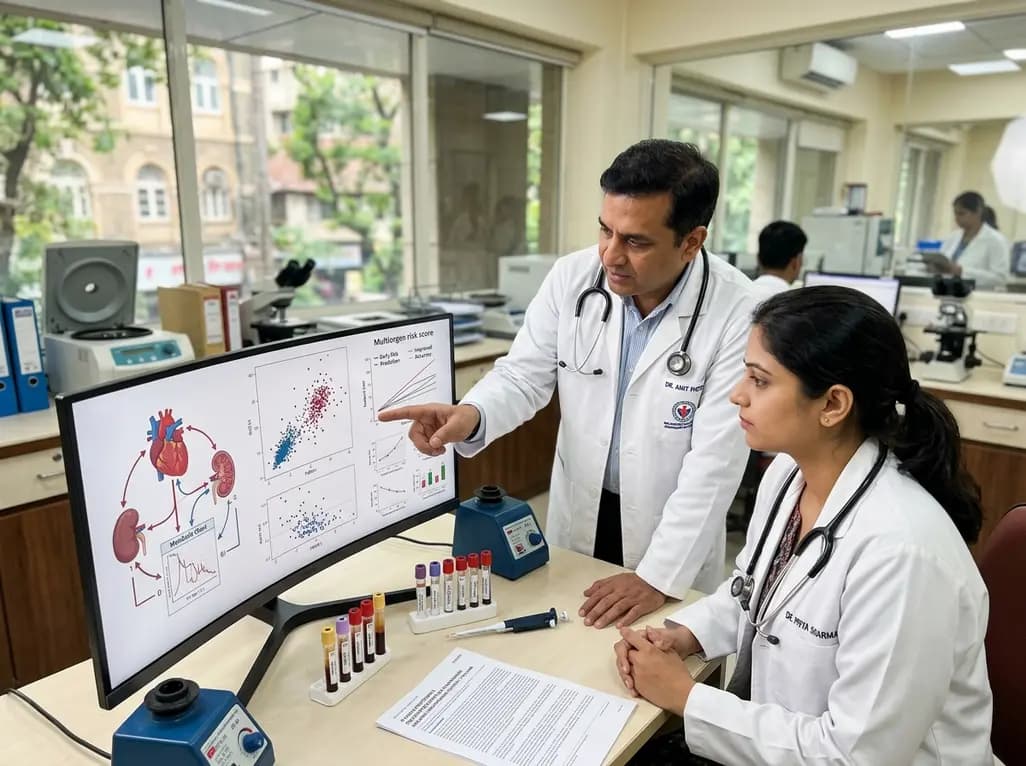
A large UK Biobank study reveals that plasma proteomic signatures capture preclinical organ damage and improve multiorgan risk prediction across early CKM syndrome stages 0 to 2 beyond traditional PREVENT clinical models.
Today

A narrative review investigates whether the articularis genus muscle functions as an independent anatomical entity or blends with the vastus intermedius. We evaluate its morphology, role in retracting the suprapatellar bursa, and direct clinical significance in anterior knee pain and arthroplasty.
Today

A Bayesian multilevel meta-analysis reveals that aerobic training combined with moderate carbohydrate restriction modestly lowers HbA1c in type 2 diabetes. However, sparse data and very low certainty leave incremental benefits over exercise or diet alone unproven, highlighting the need for individualized care.
Today
