.webp&w=384&q=75)

Loading, please wait...
Loading, please wait...
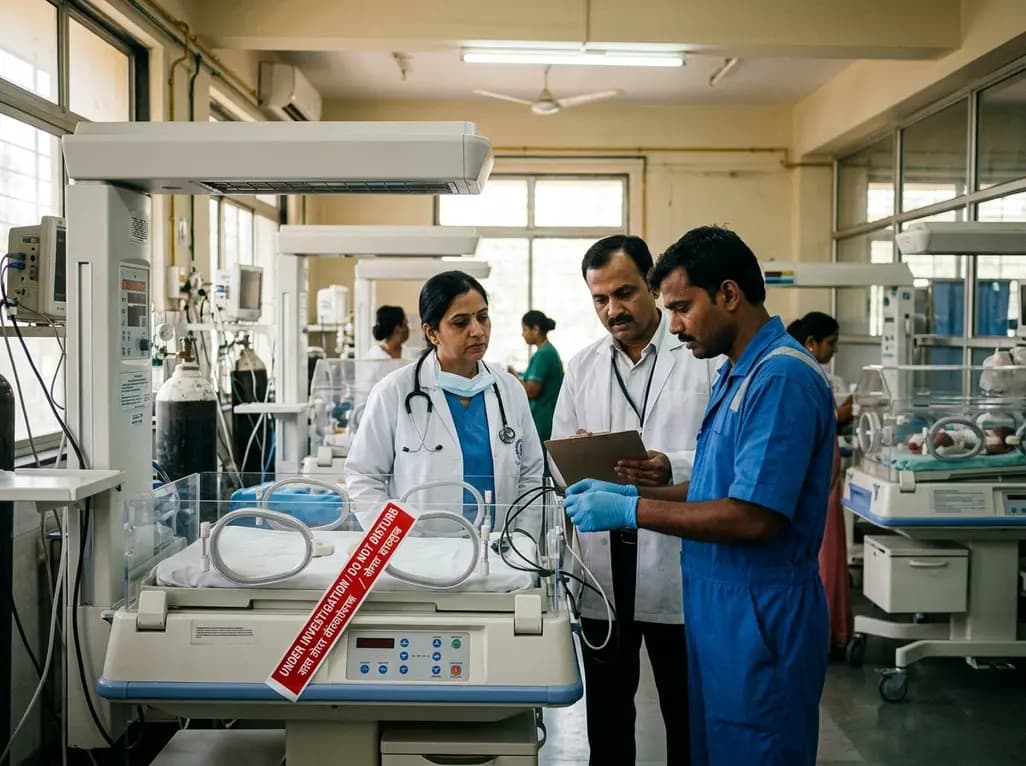
The tragic incident at the District Women’s Hospital in Amravati has once again brought hospital fire safety to the forefront of national healthcare discourse. Following the early morning blaze in the Special Newborn Care Unit (SNCU) that resulted in the loss of three newborn lives due to smoke suffocation, the Maharashtra state government swiftly initiated high-level administrative and regulatory interventions. Public health officials confirmed that a specialized seven-member committee will thoroughly probe the disaster and submit a comprehensive report within eight days. Meanwhile, authorities are conducting emergency reviews across state medical facilities to prevent recurrent failures. This tragedy highlights the critical necessity of maintaining robust electrical infrastructure, continuous equipment monitoring, and rigorous emergency preparedness within high-dependence neonatal environments.
A seven-member probe committee, headed by Public Health Services Commissioner Sanjay Katkar, is leading the official inquiry into the Amravati hospital fire. Consequently, investigators are examining the complete sequence of events that transpired during the early hours of Monday on the third floor of Dufferin Hospital. Preliminary findings suggest that a catastrophic ventilator malfunction or explosion in the outborn section triggered the fire and rapid smoke accumulation. In response, Maharashtra Health Minister Prakash Abitkar announced that the state will initiate strict punitive action against any parties found guilty of procedural lapses or equipment defects. Furthermore, state authorities are scrutinizing the Nagpur-based vendor responsible for supplying the affected life-support equipment, with clear directives to blacklist the company if technical culpability is verified. The investigative team will also review hospital maintenance logs, staff response times, and statutory fire clearances. Additionally, high-level administrative meetings at Mantralaya are reviewing government hospital fire safety audits statewide. Grieving families have received immediate financial compensation, while the government has committed to covering all ongoing medical expenses for the thirty-six surviving newborns shifted to intensive care facilities across the region.
Neonatal intensive care units and Special Newborn Care Units present uniquely severe fire safety hazards compared to standard hospital wards. First, these clinical environments feature high ambient oxygen concentrations resulting from continuous respiratory therapy, which dramatically lowers ignition thresholds and accelerates flame propagation. Second, neonatal units operate an extensive array of electrical life-support machinery, including mechanical ventilators, radiant warmers, phototherapy lamps, and infusion pumps. When these devices run continuously without adequate thermal dissipation or regular biomedical load testing, the risk of overheating and electrical arcing increases substantially. Third, neonatal patients represent an entirely non-ambulatory and highly vulnerable population. Premature infants and critically ill neonates cannot independently escape hazardous environments, nor can they tolerate abrupt disconnection from life-support systems without immediate physiologic deterioration. In addition, toxic smoke inhalation poses an immediate lethal threat to underdeveloped neonatal lungs, often causing rapid asphyxiation before thermal burns occur. Therefore, managing fire risks in pediatric and neonatal departments requires far more than generic workplace safety protocols; it demands specialized biomedical engineering controls and dedicated clinical risk-mitigation strategies.
Executing structured hospital fire safety protocols is essential to safeguarding vulnerable inpatient populations and critical clinical infrastructure. Modern healthcare facility guidelines mandate comprehensive active and passive fire protection systems designed specifically for intensive care environments. For instance, facilities must install addressable smoke detection networks and Very Early Warning Fire Detection (VESDA) systems that detect particulate accumulation before open flames ignite. Moreover, engineering designs must incorporate clean-agent suppression systems, such as Novec 1230 or FM-200, which safely extinguish fires without leaving toxic residues or damaging sensitive electronic life-support equipment. Routine electrical audits conducted by certified engineers are equally vital to ensure that distribution boards, uninterrupted power supply (UPS) units, and wiring conduits can handle heavy continuous medical loads. Furthermore, neonatal units must maintain functional zone isolation valves for medical gas pipelines, enabling staff to instantly isolate piped oxygen during a localized fire event without depriving the rest of the facility. Regular compliance audits must actively test alarm audibility, automatic sprinkler readiness, and fire barrier compartmentation rather than treating statutory certifications as mere administrative paperwork.
When a fire emergency strikes an intensive care ward, rapid clinical evacuation requires structured, pre-rehearsed standard operating procedures. Unlike ordinary municipal buildings where occupants execute rapid vertical evacuation via stairwells, healthcare facilities utilize progressive horizontal evacuation. This tactical approach moves non-ambulatory patients across fire-resistant smoke compartments on the same floor, isolating them from toxic fumes while maintaining essential life support. In neonatal units, nurses and clinical teams must have immediate access to specialized multi-infant evacuation aprons, transport incubators, and portable oxygen cylinders. Healthcare workers in Amravati demonstrated remarkable courage by rapidly evacuating thirty-six vulnerable infants from the smoke-filled SNCU into safer clinical zones. However, relying solely on spontaneous heroism during a crisis reveals systemic deficiencies in disaster architecture. Therefore, hospitals must conduct mandatory quarterly fire drills involving multi-disciplinary clinical staff, paramedics, and security teams. These practical simulation exercises ensure that every bedside caregiver knows precisely how to shut down medical gas valves, operate designated clinical fire extinguishers, and transport critically ill infants safely without causing avoidable respiratory or thermal trauma.
The recurrent nature of neonatal care unit fires across the country has intensified calls for uncompromising regulatory enforcement and administrative accountability. National building codes and healthcare safety guidelines establish unambiguous legal obligations for government and private medical institutions. Hospital administrators must ensure that valid Fire Safety No-Objection Certificates (NOCs) are maintained and updated through periodic third-party safety audits. Furthermore, public procurement policies for biomedical machinery must mandate rigorous conformity with international electrical safety standards, including IEC 60601 certifications. Suppliers and maintenance contractors must undergo stringent vetting, with contractual clauses that enforce severe legal liability for defective medical devices. In addition, state health departments must bridge the gap between audit recommendations and ground-level infrastructure upgrades. Allocating dedicated safety budgets for hospital retrofitting, fire barrier installation, and staff training is non-negotiable. By establishing clear chains of institutional responsibility and enforcing zero-tolerance policies for safety violations, healthcare governing bodies can ensure that hospitals remain sanctuaries of healing rather than sites of preventable disaster.
Q1: What caused the recent fatal fire in the Amravati hospital neonatal unit?
Preliminary investigations indicate that a severe electrical malfunction or sudden explosion in a mechanical ventilator triggered the early morning fire inside the Special Newborn Care Unit. The blaze generated dense toxic smoke within the enclosed ward, leading to fatal suffocation among three premature infants. A dedicated seven-member expert probe committee is currently analyzing hospital maintenance logs, electrical loads, and equipment integrity to pinpoint the exact failure mechanism.
Q2: Why are neonatal intensive care units particularly vulnerable to fire emergencies?
Neonatal care units face heightened fire hazards due to high ambient oxygen concentrations, which significantly lower ignition thresholds and accelerate combustion. Additionally, these wards operate continuous, heavy electrical loads from ventilators, radiant warmers, and monitoring equipment. Because newborn patients are entirely non-ambulatory and depend on life support, traditional evacuation is challenging, making rapid smoke accumulation and toxic inhalation rapidly life-threatening for underdeveloped neonatal respiratory systems.
Q3: What engineering controls are necessary to prevent hospital fires in critical care wards?
Critical care facilities require advanced active and passive fire engineering systems. Key interventions include addressable Very Early Warning Fire Detection systems, clean-agent suppression flooding, and automated medical gas isolation zone valves. Facilities must also execute bi-annual electrical load audits, install fire-resistant smoke compartmentation doors, and ensure regular maintenance of biomedical equipment according to strict IEC safety standards to eliminate potential electrical spark hazards.
Disclaimer: This content is for informational and educational purposes only. It does not constitute medical advice or replace professional judgment. Refer to the latest local and national guidelines for clinical practice.
References

Read summarized clinical updates, watch expert medical content, and earn CME certifications right from your smartphone.
Open your smartphone camera to scan and install.





Following the tragic fire at Amravati District Women's Hospital claiming three infant lives, a high-level committee has launched a probe into equipment failure. Learn how rigorous hospital audits, biomedical maintenance, and specialized neonatal evacuation protocols prevent critical care disasters.
last month

A nationwide multicenter study identified three COPD clinical phenotypes, finding that mild smoking males experience the highest rate of rapid lung function decline. A CatBoost model using six routine clinical and socioeconomic variables accurately stratifies high-risk patients for early therapeutic intervention.
Today
Discover the crucial distinctions between mesonephric and mesonephric-like proliferations of the female genital tract. Learn the key histomorphologic, immunohistochemical, and molecular differences essential for accurate diagnosis and clinical management.
Today
A large UK Biobank study reveals that plasma proteomic signatures capture preclinical organ damage and improve multiorgan risk prediction across early CKM syndrome stages 0 to 2 beyond traditional PREVENT clinical models.
Today
A narrative review investigates whether the articularis genus muscle functions as an independent anatomical entity or blends with the vastus intermedius. We evaluate its morphology, role in retracting the suprapatellar bursa, and direct clinical significance in anterior knee pain and arthroplasty.
Today

A Bayesian multilevel meta-analysis reveals that aerobic training combined with moderate carbohydrate restriction modestly lowers HbA1c in type 2 diabetes. However, sparse data and very low certainty leave incremental benefits over exercise or diet alone unproven, highlighting the need for individualized care.
Today
