.webp&w=384&q=75)

Loading, please wait...
Loading, please wait...
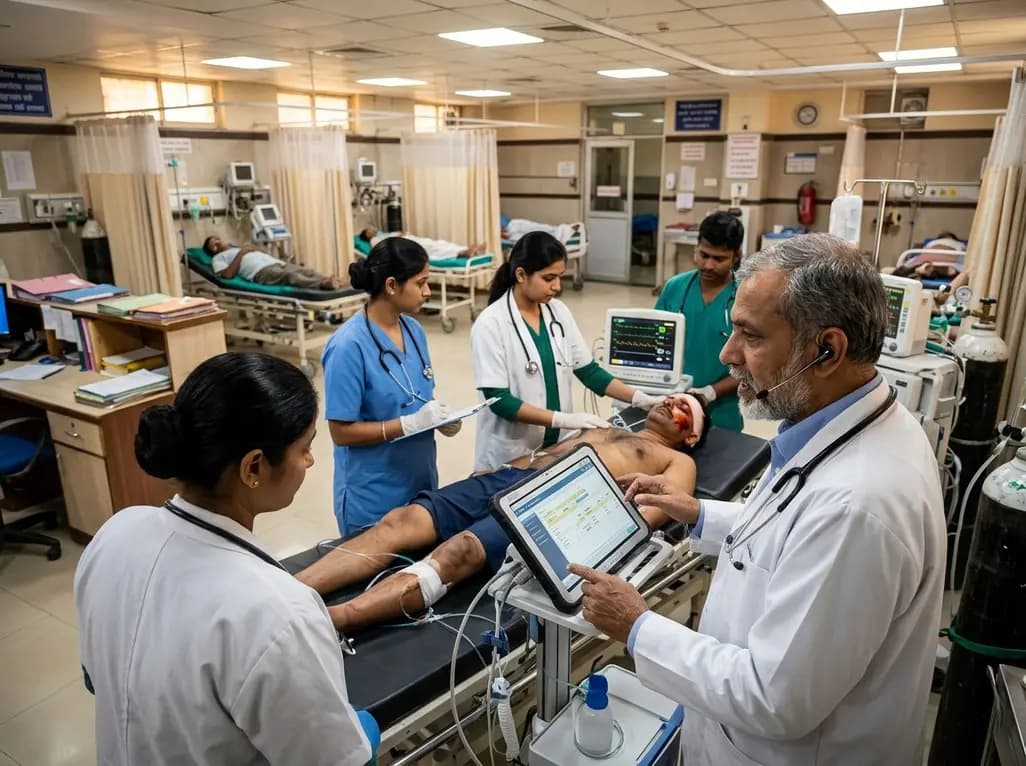
Incomplete prehospital documentation represents a significant barrier to effective patient care and longitudinal data quality. Clinical teams often find manual charting time-consuming and cognitively exhausting, especially during the chaotic moments of trauma resuscitation. AI-assisted speech-based documentation offers a promising solution by allowing real-time data capture without forcing clinicians to stop their life-saving workflows. A recent study published in the Journal of Trauma and Acute Care Surgery evaluated this technology within simulated battlefield injury scenarios to determine its feasibility and accuracy.
Researchers conducted a randomized feasibility study involving eight teams performing trauma scenarios. Each team utilized both AI-assisted and conventional manual documentation methods. Consequently, the study captured forty-four simulations in total. The results indicated that the AI system successfully generated output in 91% of cases. Interestingly, the overall documentation completeness was comparable between the two methods. AI-assisted documentation reached a median completeness of 73.9%, while manual documentation reached 64.8%. Although the difference was not statistically significant, the AI system maintained high standards even under operational stress.
While data accuracy is critical, usability often dictates whether a technology succeeds in a real-world clinical setting. The study revealed that participants significantly favored the AI-assisted approach for overall ease of use and data entry efficiency. Furthermore, current literature on ambient AI scribes suggests that these tools can reduce clinician burnout by offloading the mental burden of memorizing patient details during a crisis. By utilizing natural language processing, these systems transform fragmented speech into structured medical records, such as standard combat casualty cards or electronic health records (EHR).
The integration of such technology could be transformative for emergency medical services and military medicine in India. In high-volume casualty events or remote disaster zones, the ability to document care hands-free ensures that the medical history follows the patient through the evacuation chain. However, experts emphasize that trauma-specific safeguards and human review remain essential to prevent automation bias. As developers refine these AI models for noisy environments, they will likely become standard components of the modern survival chain.
Current research shows that AI-assisted documentation provides comparable completeness to manual methods. While it does not always exceed manual accuracy, it significantly reduces the time and effort required from the clinician to achieve that same level of detail.
Advancements in acoustic modeling and medical language processing are specifically designed to filter background noise and recognize fragmented, high-speed clinical speech. However, real-world evaluation in diverse operational settings is still necessary for full implementation.
Yes, usability ratings frequently favor AI-assisted tools over manual entry. Clinicians report that it simplifies the data entry process and allows them to maintain a better clinical workflow during patient care.
Disclaimer: This content is for informational and educational purposes only and does not constitute medical advice. It is not a substitute for professional judgment. Always consult with a qualified healthcare provider for specific patient care. Refer to the latest local and national guidelines for clinical practice.
References
1. Gelman D et al. Medical documentation using artificial intelligence (AI) for battlefield injury simulations: A comparative study. J Trauma Acute Care Surg. 2026 Jun 01. doi: 10.1097/TA.0000000000005059. PMID: 42224833.
2. Luo X et al. Assessing the Effectiveness of Automatic Speech Recognition Technology in Emergency Medicine Settings: a Comparative Study of Four AI-Powered Engines. JMIR Med Inform. 2025;13:e40726.
3. BMJ Group. Artificial Intelligence documentation in trauma resuscitation: efficiency requires guardrails. Trauma Surg Acute Care Open. 2026;11(1):e001350.
"
Read summarized clinical updates, watch expert medical content, and earn CME certifications right from your smartphone.
Open your smartphone camera to scan and install.





Study shows AI-assisted speech-based documentation in trauma simulations matches manual completeness while significantly improving clinician usability and e...
4 months ago

A retrospective cohort study of 7,716 ICU patients from the MIMIC-IV database demonstrates that Gradient Boosting Decision Trees significantly outperform traditional SOFA scores in predicting in-hospital mortality among patients with sepsis and diabetes, with SHAP analysis providing clinical interpretability.
Today

A prenatal case highlights severe glutaric acidemia type II presenting as bilateral hyperechoic cystic kidneys at 18 weeks. Whole-exome sequencing revealed a novel homozygous ETFDH frameshift variant, demonstrating the power of rapid genetic testing in fetal renal anomalies.
Today
This article reviews the forensic and clinical complexities of acute myocarditis arising on left ventricular hypertrophy in children, highlighting early diagnostic red flags and multidisciplinary postmortem autopsy protocols.
Today

This comparative study evaluates posterior labral tears with and without glenohumeral instability, highlighting distinct demographic patterns, MRI underestimation in stable shoulders, and successful arthroscopic repair outcomes.
Yesterday

A clinical study demonstrates that early intervention with tocilizumab, either as monotherapy or bridged with corticosteroids, achieves significant proptosis reduction and resolves active inflammation in treatment-naive thyroid eye disease.
Yesterday
