.webp&w=384&q=75)

Loading, please wait...
Loading, please wait...

Chronic obstructive pulmonary disease (COPD) remains a leading cause of morbidity and mortality globally, and its impact is particularly profound during acute exacerbations. A significant complication that often goes underdiagnosed during these episodes is the development of pulmonary vascular disease. Specifically, AECOPD with pulmonary hypertension represents a distinct clinical phenotype associated with increased hospital stays, higher healthcare costs, and significantly worse survival rates. While the physiological link between chronic hypoxia and pulmonary vasoconstriction is well-documented, the role of systemic inflammation in driving these vascular changes is a burgeoning area of research. Consequently, identifying reliable peripheral blood biomarkers has become a priority for clinicians seeking to stratify risk more effectively. This search for non-invasive diagnostic tools is especially relevant in resource-limited settings where gold-standard diagnostic procedures, such as right heart catheterization or high-quality echocardiography, may not be immediately available. Therefore, understanding the interplay between inflammatory cytokines and the coagulation cascade is essential for improving patient outcomes.
Recent clinical evidence suggests that the Systemic Immune-Inflammation Index (SII) provides a more comprehensive view of the patient's immune status compared to traditional markers. Calculated using platelet, neutrophil, and lymphocyte counts, the SII integrates three distinct arms of the immune response into a single numerical value. In the context of respiratory medicine, higher SII levels have been consistently linked to more severe airway inflammation and poorer lung function. Moreover, studies now indicate that SII is significantly elevated in patients experiencing an acute exacerbation who also suffer from comorbid pulmonary hypertension. This elevation reflects a state of heightened systemic stress and immune dysregulation that likely contributes to vascular remodeling. Additionally, the SII is easily obtained from a standard complete blood count, making it a cost-effective and accessible tool for daily clinical practice. By utilizing this index, physicians can gain early insights into the inflammatory burden of their patients. Furthermore, the sensitivity of the SII in detecting underlying vascular complications suggests it could serve as a vital screening tool during the initial triage of AECOPD cases.
Beyond inflammation, the prothrombotic state plays a crucial role in the pathogenesis of AECOPD with pulmonary hypertension. During an acute exacerbation, the body undergoes significant hemorheological changes, leading to a hypercoagulable state. Elevated levels of fibrinogen and D-dimer are hallmark signs of this shift. Fibrinogen, in particular, is not only a key component of the coagulation cascade but also an acute-phase reactant that mirrors the severity of systemic inflammation. Research indicates that fibrinogen levels are markedly higher in AECOPD patients with PH compared to those without vascular involvement. This correlation suggests that fibrinogen might be directly involved in the microvascular thrombosis that characterizes pulmonary hypertension in chronic lung disease. Similarly, D-dimer serves as a marker of active fibrinolysis, indicating that the body is attempting to manage an ongoing thrombotic process. Because these biomarkers are often available in emergency departments, they provide immediate data regarding the patient's thrombotic risk. Thus, integrating prothrombotic markers into the diagnostic workup allows for a multi-dimensional assessment of the patient’s clinical status, potentially guiding the use of thromboprophylaxis.
While individual biomarkers provide valuable information, their diagnostic accuracy often improves when they are analyzed in combination. Recent research employing receiver operating characteristic (ROC) curves has demonstrated that combining SII, Interleukin-8 (IL-8), and fibrinogen yields a high area under the curve (AUC) for the diagnosis of pulmonary hypertension in AECOPD patients. Specifically, IL-8 acts as a potent chemoattractant for neutrophils, which are primary drivers of tissue damage in the lungs. When high IL-8 levels coincide with elevated fibrinogen and a high SII, the likelihood of concurrent pulmonary hypertension increases significantly. This synergy highlights the complex relationship between the immune system and the vascular endothelium. Clearly, using a panel of biomarkers allows clinicians to overcome the limitations of any single test. Furthermore, the high sensitivity and specificity observed in these combined models suggest they could eventually reduce the reliance on more invasive or expensive imaging techniques. Consequently, this approach supports the movement toward personalized medicine in pulmonology, where treatment can be tailored based on the specific molecular and cellular profile of the individual patient during an exacerbation.
The transition from simple airway inflammation to permanent vascular changes involves a complex series of biological events. In patients with AECOPD, the presence of chronic hypoxia triggers the release of various cytokines, such as C-reactive protein (CRP) and IL-8, into the systemic circulation. These mediators promote endothelial dysfunction, leading to the narrowing of pulmonary arteries and an increase in pulmonary vascular resistance. Additionally, the recruitment of neutrophils and the activation of platelets create a local environment conducive to oxidative stress. Over time, this persistent inflammatory milieu leads to the hypertrophy of the tunica media and the fibrosis of the intima within the pulmonary vessels. Therefore, the biomarkers we measure in the blood, such as the Pan-Immune-Inflammation Value (PIV) and the Neutrophil-to-Lymphocyte Ratio (NLR), are actually reflections of these deep-seated pathological processes. Understanding these mechanisms is vital for developing new therapeutic strategies that target specific inflammatory pathways. If we can intervene early in the inflammatory cascade, we might be able to slow or even prevent the progression of pulmonary hypertension in this vulnerable population.
Given the strong association between inflammatory markers and pulmonary hypertension, clinicians should consider routine monitoring of SII and fibrinogen in all hospitalized AECOPD patients. Identifying those with a high-risk biomarker profile allows for more intensive monitoring and the early initiation of supportive therapies. For instance, patients with significantly elevated prothrombotic markers may benefit from optimized anticoagulation strategies or closer surveillance for pulmonary embolism. Furthermore, the use of systemic corticosteroids and targeted bronchodilators should be carefully managed to balance the need for reducing inflammation with the potential side effects of treatment. It is also important for physicians to realize that a lack of clinical improvement despite standard therapy may signal underlying pulmonary hypertension. In such cases, the biomarkers discussed can provide the necessary evidence to justify further cardiovascular investigations. Finally, long-term management should focus on reducing chronic systemic inflammation through smoking cessation, pulmonary rehabilitation, and the appropriate use of long-acting inhalers. By adopting a proactive and biomarker-guided approach, healthcare providers can significantly enhance the quality of care and long-term prognosis for patients facing the dual challenge of AECOPD and pulmonary hypertension.
The Systemic Immune-Inflammation Index (SII) is a powerful, cost-effective biomarker that integrates platelet, neutrophil, and lymphocyte counts to assess a patient's overall inflammatory status. In patients with AECOPD, an elevated SII often indicates more severe systemic inflammation and a higher risk of complications like pulmonary hypertension. Because it is derived from a simple blood test, it helps clinicians identify high-risk individuals quickly during hospital admission for better triage and management.
Fibrinogen acts as both a primary clotting factor and a marker of systemic inflammation. In COPD patients, particularly during acute exacerbations, high fibrinogen levels reflect a hypercoagulable state and ongoing vascular stress. This condition promotes microvascular thrombosis and contributes to the structural remodeling of pulmonary arteries. Consequently, elevated fibrinogen is strongly associated with the presence and severity of pulmonary hypertension, serving as a key indicator of vascular involvement in respiratory disease.
Early detection is vital because pulmonary hypertension significantly worsens the prognosis of AECOPD, leading to right heart strain and increased mortality. When clinicians identify vascular complications early through biomarkers like SII and IL-8, they can implement more aggressive monitoring and tailored therapeutic interventions. This proactive approach helps in stabilizing the patient more effectively, reducing the length of hospital stays, and preventing the long-term deterioration of cardiovascular function following a severe respiratory event.
Disclaimer: This content is for informational and educational purposes only. It does not constitute professional medical advice, diagnosis, or treatment. Always seek the advice of your physician or another qualified healthcare provider with any questions you may have regarding a medical condition. The inclusion of biomarkers in clinical practice should be based on a comprehensive assessment of the patient. Refer to the latest local and national guidelines for clinical practice.
References
Wang XB et al. Differences in systemic inflammation and prethrombotic biomarkers between AECOPD patients with and without pulmonary hypertension. J Inflamm (Lond). 2026 Jul 15. doi: 10.1186/s12950-026-00508-7. PMID: 42458500.
Korkmaz A et al. Chronic Obstructive Pulmonary Disease and Pulmonary Hypertension: A Comparative Study of Biomarkers and Clinical Indicators. Pulm Circ. 2026;16(1):e12345. doi: 10.1002/pul2.12345.
Zhu M et al. Systemic Immune-Inflammation Index Is Associated with Adverse Outcomes in Patients Hospitalized for AECOPD: A Multicenter Cohort Study. Respiration. 2025;104(4):312-321. doi: 10.1159/000540000.

Read summarized clinical updates, watch expert medical content, and earn CME certifications right from your smartphone.
Open your smartphone camera to scan and install.





New research highlights how systemic inflammatory markers (SII, IL-8) and prothrombotic markers (Fibrinogen) can effectively predict the presence of pulmonary hypertension in patients experiencing acute exacerbations of COPD, offering a path toward earlier diagnosis and improved clinical management.
3 months ago

Novel glucose-responsive mPEG-PSA nanocarriers deliver insulin aspart on demand, achieving dual postprandial and basal glycemic control without hypoglycemia in diabetic models. This biomaterial breakthrough offers promising clinical implications for physiologic diabetes management.
Today

A novel folate-conjugated tecto-dendrimer nanoplatform successfully delivers siRNA to achieve targeted HK2 silencing, disrupting ovarian cancer glycolysis and suppressing lactate output.
Today
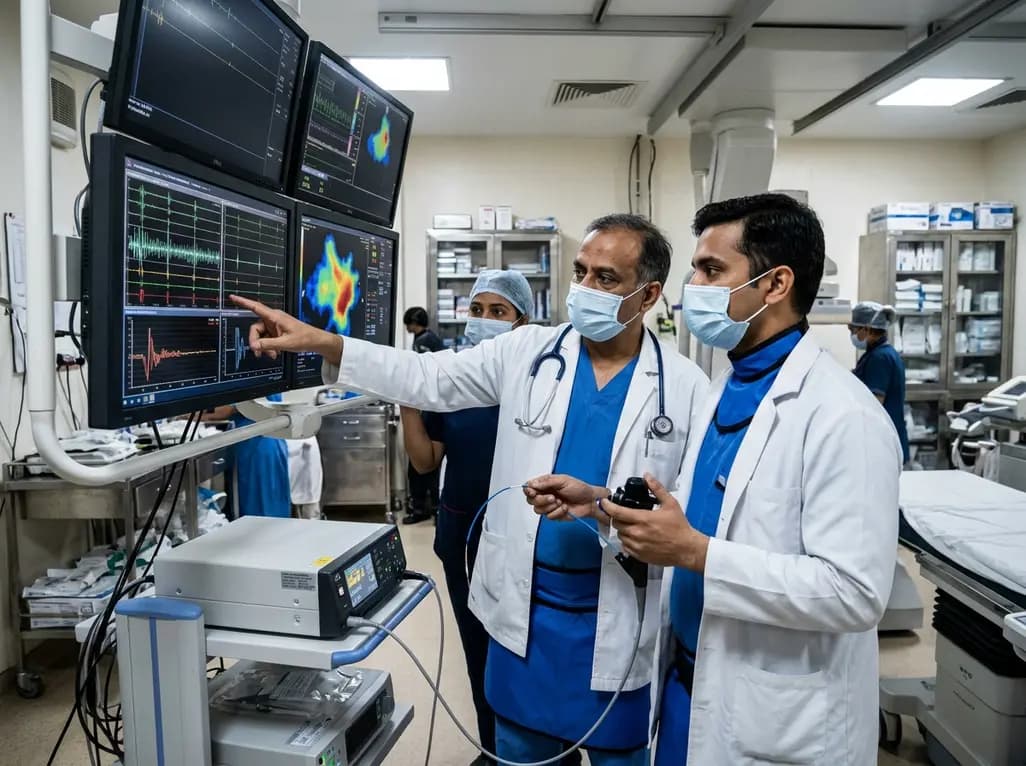
A comparative non-contact study reveals that high-power radiofrequency delivery with the QDOT MICRO catheter induces an artifactual contact force rise. Electrophysiologists must understand this power-dependent thermal and electrical phenomenon to avoid inadvertent catheter withdrawal and ineffective ablation.
Today

A novel proof-of-concept study presents a six-degree-of-freedom articulated manikin neck equipped with linear potentiometers. The system provides real-time kinematic motion feedback during cervical immobilisation, delivering sub-degree tracking accuracy to improve pre-hospital trauma training and patient safety.
Today

A retrospective comparative cohort study evaluated genitourinary safety in HFpEF between dapagliflozin and empagliflozin over six months. Rates of symptomatic UTI and asymptomatic bacteriuria showed no statistically significant differences, supporting comparable safety profiles across both SGLT2 inhibitors.
Today
