.webp&w=384&q=75)

Loading, please wait...
Loading, please wait...
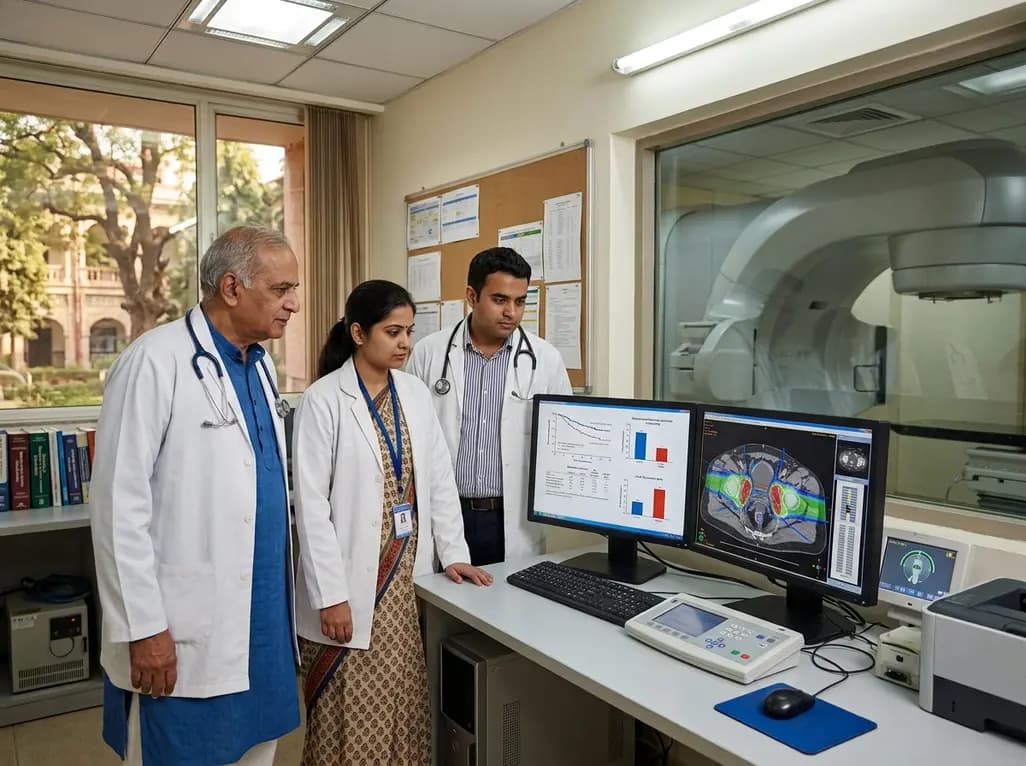
Managing muscle-invasive bladder cancer typically requires aggressive surgery and systemic treatments. However, local relapse remains a major clinical challenge for many patients. Consequently, clinical researchers investigated whether adjuvant pelvic IMRT could prevent this recurrence. This landmark phase-3 trial, published in the Journal of Clinical Oncology, evaluated post-operative outcomes. Ultimately, the study demonstrated that this therapy provides a reliable pathway to better disease control.
Specifically, the Bladder Adjuvant Radiotherapy trial enrolled 153 patients with nonmetastatic muscle-invasive disease. Most participants received perioperative chemotherapy before undergoing a radical cystectomy. Thereafter, the researchers randomized patients into either a radiotherapy group or an observation group. The radiation protocol began within eight weeks of surgery or the last chemotherapy cycle. Notably, after a median follow-up of 47 months, the primary outcomes showed major differences. The two-year locoregional recurrence-free survival reached 87.1 percent in the radiotherapy cohort. In contrast, the observation group achieved only 76 percent survival. Therefore, the clinical data confirms a significant reduction in local recurrence.
Additionally, the investigators analyzed secondary endpoints including disease-free and overall survival. The radiotherapy arm exhibited a disease-free survival rate of 71.6 percent. Furthermore, the overall survival rate in this group reached 70.4 percent. These results surpassed the observation group, which had a 57.4 percent overall survival rate. However, these specific survival secondary endpoints did not achieve statistical significance. Importantly, the addition of pelvic radiation did not increase severe toxicities for the patients. Most adverse events remained mild and manageable during the trial. Thus, the safety profile remains favorable for integration into clinical practices.
Overall, these findings support the use of postoperative radiation for high-risk patients. Indeed, clinicians should consider integrating this treatment to maximize pelvic control. Nevertheless, certain limitations in the study design warrant careful consideration. For instance, fourteen patients in the trial did not receive their assigned radiotherapy. Additionally, the absence of immunotherapy in this trial limits its applicability today. Modern practices frequently combine surgery with immunotherapy in standard regimens. Therefore, future trials must explore how radiation interacts with these novel agents.
Q1: What did the BART trial demonstrate regarding local cancer recurrence?
The trial demonstrated that adjuvant pelvic radiation therapy significantly reduces the risk of local cancer recurrence. Specifically, the two-year locoregional recurrence-free survival rate reached 87.1% in the radiotherapy group versus 76% for observation.
Q2: Did the addition of post-surgery radiotherapy cause severe adverse effects?
No, the study showed that adding adjuvant pelvic IMRT did not cause any additional severe toxicities. Although some patients experienced manageable mild side effects, the overall safety profile remained highly favorable.
Q3: How does the lack of immunotherapy in the trial affect current clinical practices?
Today, immunotherapy is widely used in bladder cancer care. Consequently, the absence of immunotherapy in this trial limits the immediate applicability of the findings. Therefore, clinicians must carefully evaluate how to integrate these results with current treatment regimens.
Disclaimer: This content is for informational and educational purposes only. It does not constitute medical advice or replace professional judgment. Refer to the latest local and national guidelines for clinical practice.
References

Read summarized clinical updates, watch expert medical content, and earn CME certifications right from your smartphone.
Open your smartphone camera to scan and install.





A landmark phase-3 trial shows post-surgery pelvic radiation therapy dramatically reduces local recurrence in muscle-invasive bladder cancer patients....
4 months ago

Following regulatory scrutiny from FSSAI regarding promotional representations and lean muscle preservation claims, Dr. Reddy's Laboratories and Nestlé Health Science are currently reviewing the branding and marketing strategy for their joint nutritional supplement Celevida GLP+.
Today

Demanding exhaustive hormonal profiling can inadvertently discourage clinical studies involving females. Methodological standards must align with the specific scientific question to expand, not restrict, equitable evidence for women.
Today

The Directorate General of Health Services directs Indian states to halt the hazardous reuse and reprocessing of single-use medical devices. Discover regulatory implications under the Drugs and Cosmetics Act, critical infection risks, legal liabilities, and operational changes required across clinical specialties.
Today
A novel calcium polyphosphate coacervate enables injectable bone implants with in situ hierarchical porosity via phase separation and gas foaming, significantly enhancing cell proliferation, energy metabolism, and osteogenic differentiation for minimally invasive bone defect repair.
Today

India is advancing preventive healthcare by integrating genomics, artificial intelligence, and quantum technologies. With the SANGAM programme sequencing one million Indian genomes, clinicians can unlock personalized therapies, detect cardiometabolic risks early, and curb the burden of diabetes and heart disease.
Today
