.webp&w=384&q=75)

Loading, please wait...
Loading, please wait...

Evaluating hoarseness and vocal changes remains a persistent challenge in outpatient clinical practice. Clinicians often rely on subjective auditory-perceptual assessments, which can vary significantly across observers. Consequently, incorporating objective acoustic voice parameters provides a standardized, non-invasive methodology to identify vocal fold pathology early. By combining conventional perturbation measures with advanced cepstral analyses and patient demographic factors, practitioners can improve triage accuracy and optimize specialist referrals.
Dysphonia significantly impacts patient quality of life, communication, and occupational performance. In primary care and general outpatient settings, patients frequently present with persistent voice changes following viral upper respiratory infections, chronic vocal strain, or tobacco exposure. However, distinguishing benign conditions, such as vocal nodules or polyps, from early laryngeal malignancies is impossible through history alone. Therefore, clinicians need accessible diagnostic adjuncts.
Flexible laryngoscopy provides definitive visualization, yet universal specialist referrals can strain healthcare systems and delay care for high-risk patients. When primary care clinicians encounter persistent dysphonia, they must weigh the urgency of secondary care evaluation. In this context, objective vocal assessment bridges the gap between initial presentation and invasive diagnostic procedures, offering quantifiable data to justify prompt laryngeal visualization.
Traditional acoustic evaluation measures cycle-to-cycle variability in the vocal signal during sustained phonation. Fundamental frequency reflects the primary vibration rate of the vocal cords, while jitter captures pitch perturbation and shimmer reflects amplitude perturbation. Additionally, the harmonics-to-noise ratio quantifies the proportion of harmonic energy relative to turbulent noise generated by incomplete glottic closure.
Although perturbation metrics offer valuable baseline data, severe dysphonia can cause tracking errors during pitch extraction. Consequently, modern vocal analysis integrates cepstral peak prominence-smoothed. This cepstral metric evaluates the dominance of harmonic organization against background spectral noise without requiring precise fundamental frequency tracking. Together, these tools provide a robust profile of vocal cord biomechanics and mucosal wave regularity.
Recent investigations confirm that patients with structural vocal fold pathology display marked deviations in perturbation and spectral stability compared to healthy controls. Specifically, elevated jitter and shimmer alongside significantly depressed harmonics-to-noise ratio and cepstral prominence indicate disrupted phonation. Furthermore, the magnitude of these alterations differs substantially between benign mucosal lesions and invasive squamous cell carcinoma.
Malignant laryngeal lesions typically infiltrate the deeper layers of the lamina propria and vocalis muscle. As a result, they cause severe vocal fold stiffness, irregular vibration, and pronounced glottic insufficiency. These structural disruptions manifest acoustically as severe spectral noise and dramatic reductions in cepstral peak prominence. Conversely, benign lesions often preserve partial mucosal wave pliability, producing less pronounced acoustic deterioration. Thus, multiparametric acoustic analysis assists in stratifying lesion severity.
Although acoustic metrics provide essential physiological data, acoustic analysis alone cannot establish a tissue diagnosis. Therefore, integrating patient demographic variables substantially enhances diagnostic precision. Factors such as advanced age, male sex, chronic tobacco use, alcohol exposure, and occupational vocal demands markedly influence the pre-test probability of malignant transformation.
Multivariable diagnostic algorithms that combine acoustic measurements with demographic profiles achieve superior discrimination on receiver operating characteristic curves. For instance, an elderly patient with significant smoking history and severe cepstral peak attenuation warrants immediate, expedited endoscopic assessment. Conversely, an isolated mild acoustic perturbation in a non-smoking voice professional may point toward a benign vocal fold nodule requiring speech therapy and conservative management.
Implementing standardized acoustic screening tools in ambulatory clinics can transform patient triage. Clinicians can record a brief, three-second sustained vowel segment using accessible computer software or dedicated digital health platforms. The software instantly extracts perturbation indices and cepstral values, generating an objective report for the medical record.
This streamlined workflow allows general practitioners, internists, and occupational health physicians to identify high-risk vocal signatures quickly. Moreover, providing objective acoustic data alongside referral documentation gives otolaryngologists valuable baseline measurements to track post-treatment recovery or surgical outcomes. Ultimately, objective voice metrics facilitate timely intervention, preventing diagnostic delays in malignant cases while reducing unnecessary specialist consultations for self-limiting conditions.
Technological advancements are rapidly expanding the accessibility of acoustic voice evaluation. Mobile health applications, automated telehealth screening algorithms, and artificial intelligence models are increasingly capable of analyzing voice signals captured through standard smartphone microphones. As these tools undergo clinical validation, point-of-care voice analysis will become even more practical for routine consultations.
However, clinicians must remember that acoustic screening complements rather than replaces clinical acumen and physical examination. Standardized recording protocols, ambient noise control, and proper patient instruction remain vital to obtain valid acoustic data. By maintaining high procedural standards and staying informed on technological innovations, healthcare providers can harness vocal biomarkers to elevate patient care across diverse healthcare settings.
The primary acoustic parameters include fundamental frequency, jitter, shimmer, harmonics-to-noise ratio, and cepstral peak prominence-smoothed. Fundamental frequency measures vocal fold vibration rate, while jitter and shimmer assess pitch and amplitude stability. Harmonics-to-noise ratio measures signal clarity against turbulent noise, and cepstral peak prominence evaluates overall harmonic structure, offering robust data even in severely dysphonic voices.
Traditional perturbation metrics like jitter and shimmer depend on accurate cycle-to-cycle fundamental frequency tracking, which often fails in severely disordered voices. In contrast, cepstral peak prominence-smoothed analyzes the voice spectrum using Fourier transformation without requiring individual cycle identification. Therefore, it reliably measures vocal quality and breathiness across both mild and severe pathologies, including continuous speech samples.
An abnormal voice analysis should prompt an immediate referral when severe acoustic abnormalities coincide with red-flag symptoms or high-risk demographics. Persistent hoarseness exceeding three weeks, dysphagia, hemoptysis, unexplained weight loss, significant smoking history, or marked cepstral peak reduction warrant urgent visualization. Flexible laryngoscopy remains essential to definitively exclude laryngeal malignancy or other progressive structural lesions.
Disclaimer: This content is for informational and educational purposes only and should not be considered medical advice. Always consult a qualified healthcare provider for diagnosis and treatment decisions. Refer to the latest local and national guidelines for clinical practice.
References
1. Rukiye OE et al. Clinical Utility of Acoustic Voice Parameters and Patient Demographic Variables in Identifying Vocal Fold Pathology and Supporting Referral for Laryngeal Evaluation. J Voice. 2026 Aug 22. doi: undefined. PMID: 42632801.
2. Patel RR, Awan SN, Barkmeier-Kraemer J, et al. Recommended Protocols for Instrumental Assessment of Voice: American Speech-Language-Hearing Association Expert Panel. Am J Speech Lang Pathol. 2018;27(3):887-905.
3. Murton O, Hillman R, Mehta D. Cepstral Peak Prominence Values for Clinical Voice Evaluation. Am J Speech Lang Pathol. 2020;29(3):1596-1607.

Read summarized clinical updates, watch expert medical content, and earn CME certifications right from your smartphone.
Open your smartphone camera to scan and install.





Objective acoustic voice parameters, including perturbation indices and cepstral peak prominence, offer non-invasive methods to identify vocal fold pathology, separate benign lesions from laryngeal malignancy, and guide clinical referrals.
last month

Red blood cell transfusion is critical in sickle cell disease management but brings significant immunological complexity, including alloimmunisation and iron overload. Extended RBC phenotyping and tailored protocols optimize clinical safety.
Today
Discover the crucial distinctions between mesonephric and mesonephric-like proliferations of the female genital tract. Learn the key histomorphologic, immunohistochemical, and molecular differences essential for accurate diagnosis and clinical management.
Today
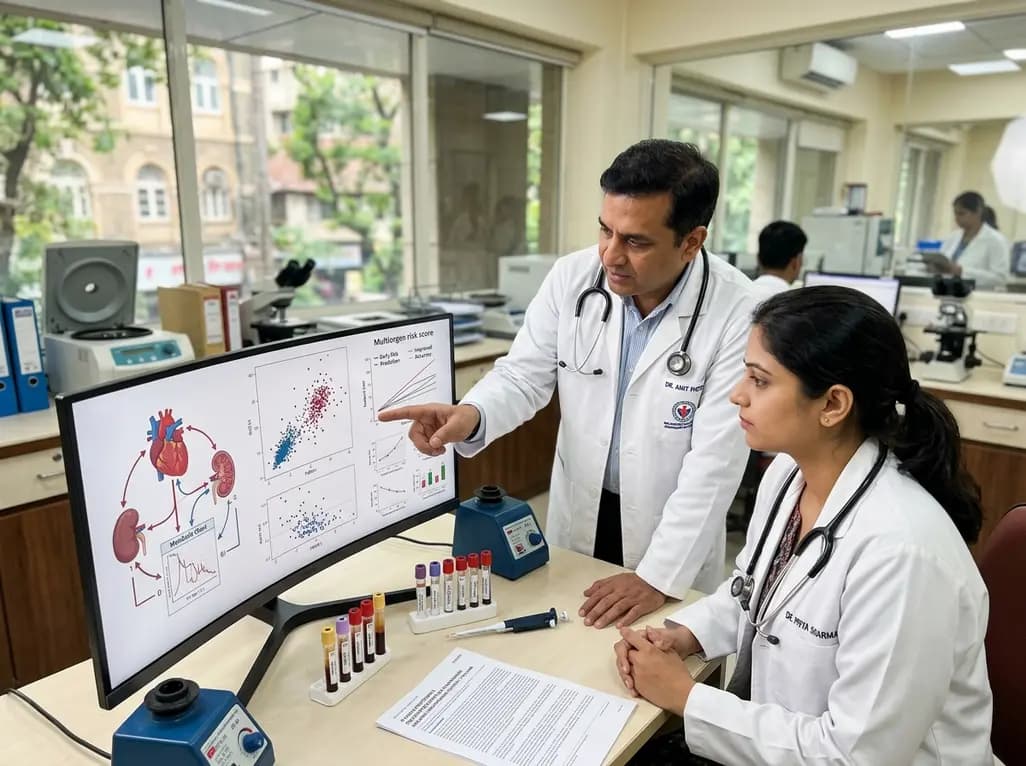
A large UK Biobank study reveals that plasma proteomic signatures capture preclinical organ damage and improve multiorgan risk prediction across early CKM syndrome stages 0 to 2 beyond traditional PREVENT clinical models.
Today

A retrospective CBCT study reveals that superior TMJ space asymmetry correlates moderately with occipital condyle-atlas-axis asymmetry in unilateral TMJ osteoarthritis, highlighting an imaging correlate between jaw biomechanics and upper cervical alignment rather than a standalone diagnostic marker.
Today

A Bayesian multilevel meta-analysis reveals that aerobic training combined with moderate carbohydrate restriction modestly lowers HbA1c in type 2 diabetes. However, sparse data and very low certainty leave incremental benefits over exercise or diet alone unproven, highlighting the need for individualized care.
Today
