.webp&w=384&q=75)

Loading, please wait...
Loading, please wait...
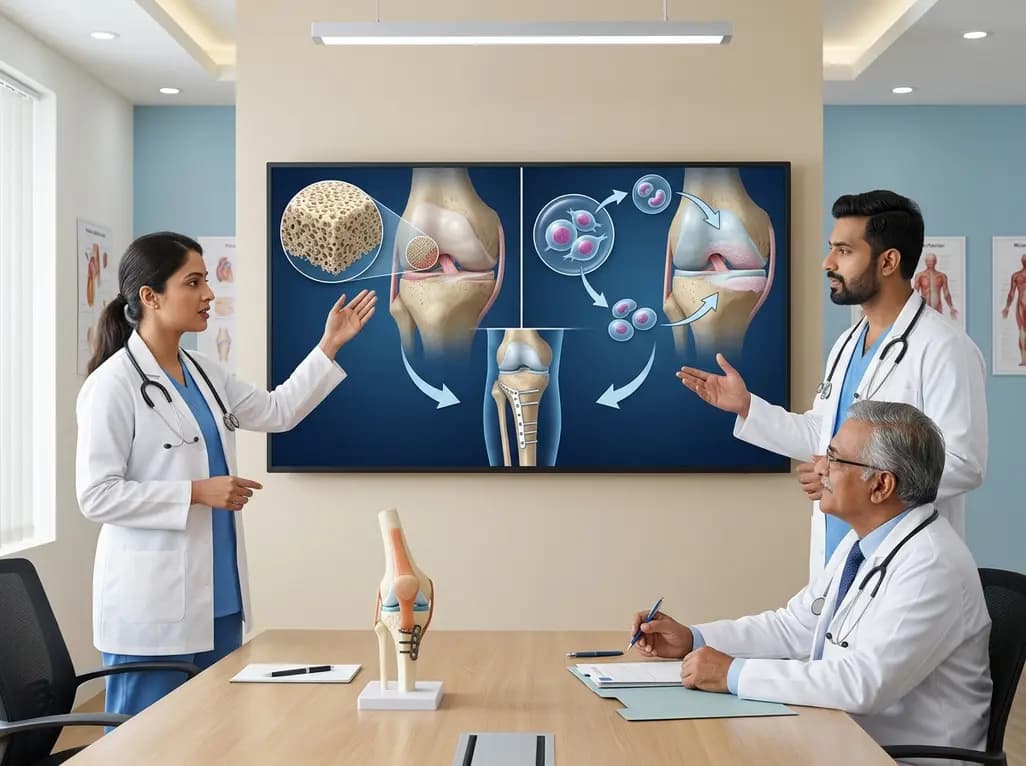
The management of medial compartment knee osteoarthritis has undergone a significant paradigm shift over the last decade. While total knee arthroplasty remains the definitive solution for end-stage disease, clinicians are increasingly focusing on joint-preserving strategies for younger, active patients. Among these interventions, high tibial osteotomy (HTO) stands out as a reliable method to redistribute mechanical load away from the degenerated medial compartment. However, mechanical realignment alone may not address the underlying chondral damage. Consequently, biological adjuncts like ACIC vs MSC therapy have emerged as potential catalysts for cartilage regeneration. In the Indian clinical context, where patients often present with symptomatic varus malalignment at an earlier age, understanding the comparative efficacy of these regenerative techniques is vital. Recent research suggests that both autologous collagen-induced chondrogenesis and mesenchymal stem cell applications can significantly enhance surgical outcomes, offering a dual approach that combines mechanical stability with biological repair.
To optimize the longevity of a high tibial osteotomy, surgeons often integrate cartilage restoration techniques to treat focal or diffuse defects discovered during arthroscopy. Autologous collagen-induced chondrogenesis (ACIC) involves a single-stage procedure where a collagen scaffold—often atelocollagen—is applied to a microfractured defect site. This scaffold stabilizes the blood clot and provides a three-dimensional environment for progenitor cells to differentiate. Conversely, mesenchymal stem cell (MSC) therapy typically utilizes bone marrow aspirate or adipose-derived cells to deliver a concentrated dose of regenerative factors directly to the joint environment. Choosing between ACIC vs MSC therapy often depends on surgeon preference, cost, and the specific architecture of the cartilage lesion. While ACIC provides a physical template for repair, MSC therapy leverages paracrine signaling and immunomodulatory effects to reduce inflammation and stimulate the host's innate healing mechanisms. Both therapies aim to fill the chondral void with hyaline-like tissue rather than suboptimal fibrocartilage.
A recent retrospective analysis evaluated the outcomes of 102 patients who underwent medial opening wedge HTO combined with either ACIC or MSC therapy. The cohort was divided into 70 patients receiving ACIC and 32 patients receiving MSC therapy. The study was rigorous in its evaluation, utilizing both subjective clinical scores and objective radiographic parameters. Preoperative and postoperative assessments included the International Cartilage Repair Society (ICRS) grade and the Kellgren-Lawrence (KL) grade to track structural changes. Additionally, the researchers performed second-look arthroscopy during hardware removal, allowing for a direct visual assessment of the regenerated tissue. This methodology provides a unique perspective on the physiological reality of cartilage repair, moving beyond mere symptomatic improvement. For Indian orthopedic surgeons, such comparative data is essential for selecting the most cost-effective and clinically viable adjunct for their patient population, especially when considering the logistical challenges of cell processing or scaffold availability.
The results of the comparative study revealed that both groups achieved significant improvements across all measured clinical domains. Parameters such as the Western Ontario and McMaster Universities Osteoarthritis Index (WOMAC), Visual Analog Scale (VAS) for pain, and the International Knee Documentation Committee (IKDC) scores showed substantial gains at the final follow-up, which averaged nearly five years. Interestingly, when comparing the outcomes of the two groups, no statistically significant differences were observed in the magnitude of clinical improvement. This suggests that the primary driver of success in these cases may be the mechanical offloading provided by the HTO, with both biological adjuncts providing a sufficient environment for tissue stabilization. Radiographically, the mechanical axis was corrected effectively in both groups, and no significant differences in the change of Kellgren-Lawrence grades were noted. This parity indicates that surgeons may have flexibility in choosing their preferred biological method without compromising the long-term functional recovery of the patient.
One of the most compelling aspects of this research was the use of second-look arthroscopy at an average of 27 months post-surgery. This invasive follow-up revealed that the ICRS grade significantly improved in both the ACIC and MSC groups. Furthermore, the size of the cartilage defects significantly decreased in all patients. While the MSC group showed a slightly better outcome in the reduction of defect size during the arthroscopic evaluation, this did not translate into a superior clinical score at the five-year mark. This discrepancy highlights a common observation in regenerative orthopedics: macroscopic tissue coverage does not always correlate perfectly with patient-reported pain and function. However, the consistent finding of improved cartilage quality in both groups reinforces the value of adding a biological component to the realignment procedure. It demonstrates that the joint environment, once offloaded, is capable of meaningful structural repair when supported by either a collagen scaffold or stem cell therapy.
For healthcare providers in India, these findings offer a reassuring degree of flexibility. The cost of autologous collagen scaffolds and the specialized equipment required for MSC processing can vary significantly across different hospital settings. Knowing that both techniques yield comparable long-term results allows for more personalized treatment planning based on the patient's financial constraints and the surgeon's institutional resources. The study underscores that the combination of high tibial osteotomy with a biological regenerative technique is a potent strategy for delaying total knee arthroplasty. As the demand for joint preservation grows among India's aging but active population, the integration of these advanced therapies into standard practice could redefine the treatment algorithm for medial knee osteoarthritis. Future research should continue to explore the cost-benefit ratio of these interventions and the potential for even more accessible, off-the-shelf biological solutions to further democratize high-quality cartilage repair across the country.
Autologous collagen-induced chondrogenesis (ACIC) uses a collagen-based scaffold to stabilize a microfracture site and guide cell growth. In contrast, mesenchymal stem cell (MSC) therapy involves delivering concentrated regenerative cells, often from bone marrow or fat, directly to the joint. While ACIC provides a structural template, MSC therapy focuses on cellular signaling and biological stimulation to promote the healing of damaged articular cartilage surfaces.
High tibial osteotomy (HTO) realigns the mechanical axis of the leg to shift weight away from the damaged medial compartment. This offloading is crucial because it creates a lower-pressure environment that allows newly repaired cartilage from ACIC or MSC therapy to mature without being subjected to excessive shear forces. Without this mechanical correction, biological repairs are often prone to early failure due to persistent joint overload.
These techniques are most beneficial for relatively young and active patients with isolated medial compartment osteoarthritis and varus malalignment. Ideal candidates usually have a body mass index under 30 and want to avoid or delay total knee arthroplasty. By preserving the natural joint and repairing cartilage, these patients can often return to higher levels of physical activity than those typically allowed following a traditional total joint replacement.
Disclaimer: This content is for informational and educational purposes only. It does not constitute professional medical advice, diagnosis, or treatment. Always seek the advice of your physician or other qualified healthcare provider with any questions you may have regarding a medical condition. Refer to the latest local and national guidelines for clinical practice.
References
Kim YH et al. Autologous collagen-induced chondrogenesis versus mesenchymal stem cell therapy combined with high tibial osteotomy for medial knee osteoarthritis: a retrospective study. Stem Cell Res Ther. 2026 Jul 06. doi: 10.1186/s13287-026-05151-w. PMID: 42410483.
Chahla J, et al. Concentrated Bone Marrow Aspirate for the Treatment of Chondral Injuries and Osteoarthritis of the Knee: A Systematic Review of Outcomes. Orthop J Sports Med. 2016;4(1):2325967115625481.
Lee GW, et al. Comparative Outcomes of Open-Wedge High Tibial Osteotomy With Platelet-Rich Plasma Alone or in Combination With Mesenchymal Stem Cell Treatment. Arthroscopy. 2017;33(10):1847-1854.

Read summarized clinical updates, watch expert medical content, and earn CME certifications right from your smartphone.
Open your smartphone camera to scan and install.





A comparative study evaluates autologous collagen-induced chondrogenesis (ACIC) and mesenchymal stem cell (MSC) therapy combined with high tibial osteotomy for medial knee osteoarthritis, showing significant improvements in both groups with no major clinical differences.
3 months ago

Novel diimide and hydrazone scaffolds, particularly compound #C4, synergistically reactivate latent HIV-1 when combined with JQ1 or PKC activators. Demonstrating donor-matched proviral transcription ex vivo and non-canonical signaling, these findings advance shock and kill strategies toward reservoir eradication.
Today

A comparative cohort study evaluates vNOTES vs TLH hysterectomy for benign conditions, demonstrating shorter operative duration, faster return to daily activities, and equivalent female sexual function scores without increased dyspareunia.
Today

Review how tailored exercise programs benefit frail older patients with heart failure. Explore pathophysiological mechanisms, individualized training prescriptions, and strategies to overcome adherence barriers in clinical practice.
Yesterday

This comparative study evaluates posterior labral tears with and without glenohumeral instability, highlighting distinct demographic patterns, MRI underestimation in stable shoulders, and successful arthroscopic repair outcomes.
Yesterday

A clinical study demonstrates that early intervention with tocilizumab, either as monotherapy or bridged with corticosteroids, achieves significant proptosis reduction and resolves active inflammation in treatment-naive thyroid eye disease.
Today
