.webp&w=384&q=75)

Loading, please wait...
Loading, please wait...
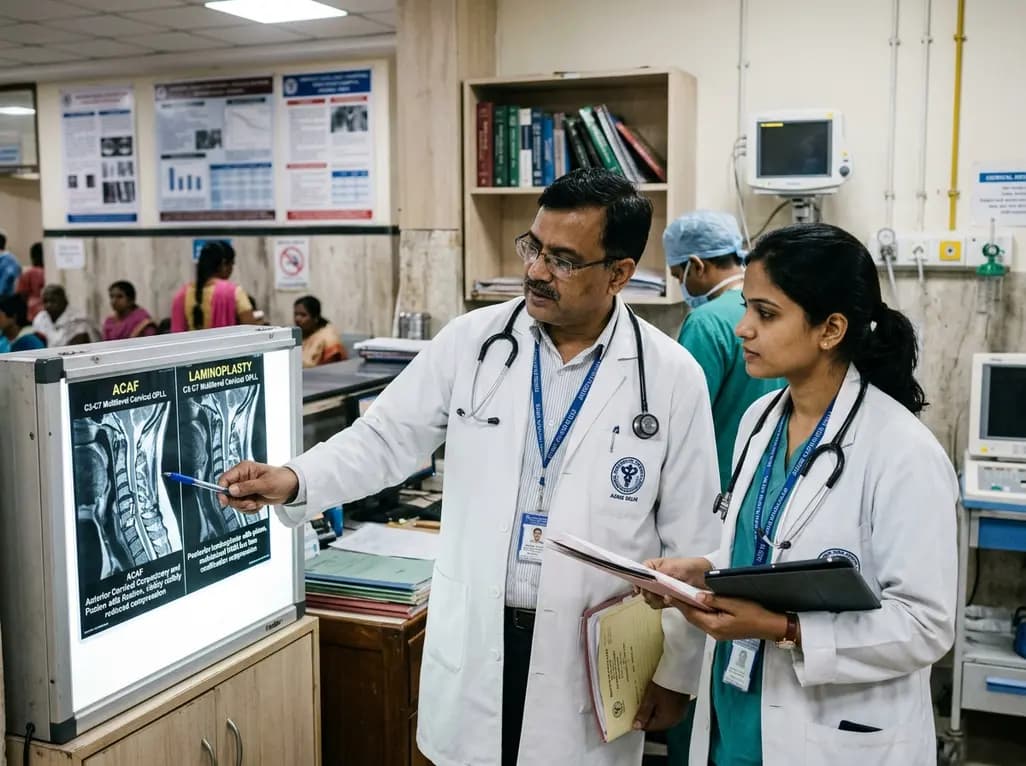
Ossification of the posterior longitudinal ligament (OPLL) is an intractable condition characterized by abnormal ectopic bone formation along the anterior spinal canal. As the ossified mass expands, it compromises the spinal canal diameter, resulting in compressive cervical myelopathy and progressive functional deficits. Selecting an ideal surgical strategy remains a major challenge in modern spine surgery. Surgeons frequently evaluate ACAF versus laminoplasty to balance effective spinal cord decompression against long-term disease progression. While both approaches provide distinct technical merits, selecting the optimal modality requires evaluating individual spinal anatomy, biomechanics, and radiographic characteristics.
Laminoplasty serves as a traditional, motion-preserving posterior technique for multi-segmental cervical stenosis. It expands the spinal canal posteriorly and preserves segment mobility, which reduces operative times and minimizes blood loss. However, persistent segment motion after laminoplasty can stimulate repetitive mechanical stress along the ossified mass. Consequently, retained segmental mobility frequently accelerates the longitudinal and thickness growth of OPLL plaques over time. This continuous ossification progression may eventually cause delayed neurological deterioration, requiring secondary revision procedures in vulnerable patient populations.
Anterior controllable antedisplacement and fusion (ACAF) provides direct ventral decompression combined with rigid anterior stabilization. The surgical technique involves bilateral longitudinal vertebral osteotomies, allowing the surgeon to advance the anterior vertebral body together with the attached OPLL plaque ventrally. Therefore, this approach achieves circumferential space expansion without direct dural excision. Furthermore, the anterior plating and interbody fusion eliminate repetitive segmental motion at the affected levels, directly targeting the primary mechanical trigger of ossification.
Recent comparative evidence underscores marked biomechanical divergence between these two surgical methods. Patients undergoing ACAF exhibit substantial cervical range of motion (ROM) reduction, achieving approximately 7.32 degrees postoperatively compared to 31.45 degrees in laminoplasty cohorts. Biomechanical analyses confirm that dynamic cervical motion strongly correlates with postoperative OPLL thickness expansion. By stabilizing motion segments rigidly, ACAF interrupts local strain vectors and favorable mechanical microenvironments that otherwise drive osteogenic differentiation. Consequently, spinal stabilization acts as a powerful therapeutic barrier against ectopic bone growth.
Radiographic assessment plays an indispensable role in evaluating post-surgical ligamentous fate. Clinical studies classifying OPLL into morphological subtypes (Types 1 through 4) demonstrate that ACAF reliably restricts ectopic bone growth across diverse lesion geometries. Specifically, patients managed with ACAF show significantly smaller thickness increases for Type 1, Type 2, and Type 3 lesions compared to those undergoing posterior laminoplasty. In contrast, massive Type 4 continuous lesions present persistent ossification tendencies across both surgical cohorts due to extensive baseline disease volume.
Remarkably, radiographic regression of the ossified mass occurs in nearly 28.6% of patients treated with ACAF. This biological regression likely stems from devascularization and unloading of continuous mechanical tension following ventral osteotomy and antedisplacement. Conversely, laminoplasty cohorts display persistent, multidirectional OPLL expansion, with documented progression rates reaching up to 40% across extended follow-up intervals. Thus, ACAF provides decisive radiographic advantages by limiting continuous ligamentous ossification and fostering partial morphological involution.
Neurological optimization remains the primary therapeutic benchmark for patients suffering from compressive cervical myelopathy. Long-term functional assessments using the Japanese Orthopaedic Association (JOA) score reveal superior functional outcomes following ACAF. At a mean follow-up of approximately 34 months, patients treated with ACAF achieve an average JOA recovery rate exceeding 70%, compared to roughly 57% in laminoplasty cohorts. Direct ventral decompression alleviates anterior focal tenting on the spinal cord, restoring microvascular perfusion promptly.
Although laminoplasty creates substantial posterior drift of the spinal cord, its indirect decompression mechanism depends heavily on pre-existing cervical lordosis. In patients with negative K-lines or canal occupying ratios exceeding 50% to 60%, posterior cord shift remains restricted by anterior bony ridges. Consequently, indirect decompression often proves insufficient for severe ventral impingement. ACAF overcomes these anatomical limitations by lifting the offending mass away from neural elements directly, thereby ensuring consistent, long-term neurological recovery.
Every cervical spinal intervention presents specific perioperative risks that require careful clinical management. Because ACAF utilizes an anterior prevertebral corridor, patients experience higher incidences of transient dysphagia and hoarseness postoperatively. Retraction of the aerodigestive tract and recurrent laryngeal nerve demands meticulous surgical dissection and gentle soft-tissue retraction. Fortunately, most anterior soft-tissue complaints resolve spontaneously within several weeks to months following surgery under appropriate conservative care.
In contrast, posterior laminoplasty carries elevated risks of postoperative axial neck pain, hinge nonunion, and C5 nerve root palsy. Persistent axial pain occurs frequently due to disruption of posterior cervical musculature and dorsal spinal innervation. Additionally, rapid posterior spinal cord shift can generate tethering forces along the short C5 nerve root, triggering motor weakness. While ACAF involves longer operative durations and demanding osteotomy steps, it bypasses dorsal muscle trauma and dramatically decreases chronic axial symptoms.
Tailoring surgical strategies to patient-specific anatomical characteristics ensures optimal safety and clinical efficacy. Surgeons should reserve laminoplasty for elderly patients presenting with multi-level mild stenosis, preserved cervical lordosis, a positive K-line, and limited canal occupancy. In such cases, motion preservation and shorter operative times provide substantial benefits while minimizing extensive anterior surgical exposure.
Conversely, spine specialists should consider ACAF the preferred modality for younger, active individuals or patients exhibiting severe OPLL with high canal occupancy ratios. Furthermore, cases involving localized kyphosis or progressive segmental mobility strongly favor anterior antedisplacement and rigid fusion. By providing robust ventral decompression and suppressing continuous ectopic bone formation, ACAF preserves long-term neural health and substantially lowers revision surgery rates across multi-segmental cervical disease.
Laminoplasty preserves segmental cervical motion, leaving dynamic mechanical stress and local strain intact across the ossified ligament. These persistent mechanical forces stimulate osteogenic signaling pathways and cellular differentiation, which frequently promotes continued thickness and longitudinal expansion of the ossified mass over long-term follow-up.
ACAF achieves rigid segmental stabilization and interbody fusion, eliminating local mechanical mobility that drives osteogenesis. Additionally, ventral osteotomy and antedisplacement unload mechanical tension and alter the local microenvironment, which not only prevents further ossification growth but can also induce radiographic regression in selected cases.
Patients with severe multilevel OPLL, canal occupying ratios exceeding 50%, negative K-lines, or focal kyphosis benefit most from ACAF. These clinical scenarios prevent adequate indirect cord decompression via posterior approaches, making direct anterior antedisplacement, sagittal realignment, and rigid stabilization the superior therapeutic strategy.
Disclaimer: This content is for informational and educational purposes only and does not constitute medical advice. Healthcare professionals should make clinical decisions based on their independent judgment, patient evaluation, and current medical evidence. Refer to the latest local and national guidelines for clinical practice.
References
1. Wang S et al. Anterior Controllable Antedisplacement and Fusion (ACAF) versus laminoplasty in suppressing the progression of ossification of the posterior longitudinal ligament. Neurosurg Rev. 2026 Aug 25. doi: 10.1007/s10143-026-04444-1. PMID: 42640539.
2. Chen Y, Sun J, Yuan X, Guo Y, Yang H, Chen D, Shi J. Comparison of Anterior Controllable Antedisplacement and Fusion With Posterior Laminoplasty in the Treatment of Multilevel Cervical Ossification of the Posterior Longitudinal Ligament: A Prospective, Randomized, and Control Study With at Least 1-Year Follow Up. Spine (Phila Pa 1976). 2020 Aug 15;45(16):1091-1101. doi: 10.1097/BRS.0000000000003462.
3. Lee CH, Sohn MJ, Lee CH, Rhim SC, Park CW. Are there differences in the progression of ossification of the posterior longitudinal ligament following laminoplasty versus fusion?: a meta-analysis. Spine (Phila Pa 1976). 2017 Jun 15;42(12):887-894. doi: 10.1097/BRS.0000000000001925.

Read summarized clinical updates, watch expert medical content, and earn CME certifications right from your smartphone.
Open your smartphone camera to scan and install.





Explore the clinical comparison of ACAF versus laminoplasty in multilevel cervical OPLL, focusing on radiographic ossification suppression, range of motion reduction, neurological recovery rates, and complication profiles.
last month

A systematic review of 41 preclinical studies reveals that baicalin dampens systemic inflammation, inhibits NF-κB and NLRP3 pathways, and improves organ preservation in sepsis models. However, substantial study heterogeneity and a complete lack of human clinical trials highlight the need for further translational research.
Today
Discover the crucial distinctions between mesonephric and mesonephric-like proliferations of the female genital tract. Learn the key histomorphologic, immunohistochemical, and molecular differences essential for accurate diagnosis and clinical management.
Today
A large UK Biobank study reveals that plasma proteomic signatures capture preclinical organ damage and improve multiorgan risk prediction across early CKM syndrome stages 0 to 2 beyond traditional PREVENT clinical models.
Today
A narrative review investigates whether the articularis genus muscle functions as an independent anatomical entity or blends with the vastus intermedius. We evaluate its morphology, role in retracting the suprapatellar bursa, and direct clinical significance in anterior knee pain and arthroplasty.
Today

A Bayesian multilevel meta-analysis reveals that aerobic training combined with moderate carbohydrate restriction modestly lowers HbA1c in type 2 diabetes. However, sparse data and very low certainty leave incremental benefits over exercise or diet alone unproven, highlighting the need for individualized care.
Today
