.webp&w=384&q=75)

Loading, please wait...
Loading, please wait...
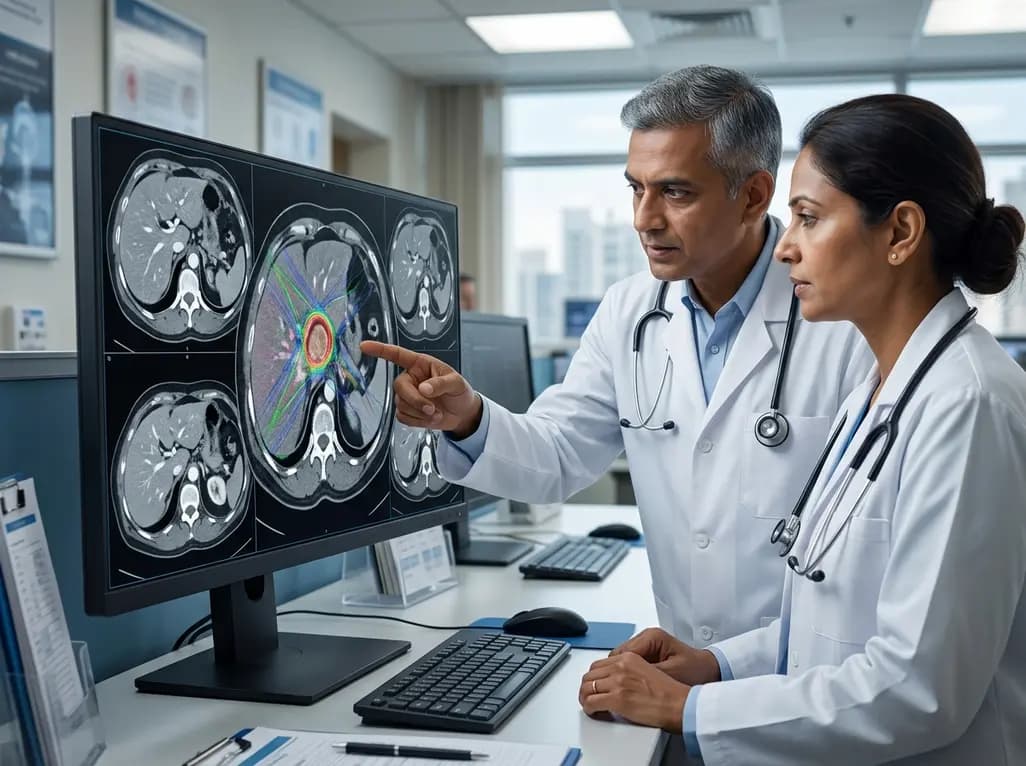
Hepatocellular carcinoma (HCC) remains one of the most significant challenges in oncology, particularly within the Indian clinical landscape where many patients present with advanced or unresectable disease. Historically, surgical resection and liver transplantation have been the gold standards for curative intent. However, many patients are ineligible for surgery due to tumor location or underlying cirrhosis. In recent years, Ablative radiation for HCC has emerged as a formidable alternative, offering high precision and potent tumor destruction without the need for invasive procedures. Centrally located tumors, defined by their proximity to the major biliary and vascular structures, have traditionally been viewed as high-risk for radiation-induced complications. This article explores recent findings regarding the safety and efficacy of ablative external beam radiotherapy (EBRT) in this specific patient population.
Centrally located hepatocellular carcinoma (CL-HCC) is specifically defined by its anatomical relationship with the central hepatobiliary tract (cHBT). In clinical practice, researchers often classify tumors as central if the planning target volume (PTV) overlaps a 1-cm expansion around the portal vein. This proximity is critical because high doses of radiation can potentially damage the delicate biliary epithelium or cause vascular thrombosis. Furthermore, the liver's functional reserve is often already compromised in HCC patients due to chronic hepatitis or cirrhosis. Consequently, clinicians must balance the need for ablative doses with the imperative to spare the central structures from irreversible damage. Modern imaging and motion management techniques have significantly improved our ability to target these lesions. Nevertheless, the risk of biliary strictures or portal vein injury has remained a primary concern for radiation oncologists. This study sought to provide clarity on whether modern modalities can safely navigate these anatomical constraints without sacrificing oncologic outcomes.
The study reviewed 103 patients, among whom 47% had centrally located tumors. The treatment modalities utilized included stereotactic body radiotherapy (SBRT), intensity-modulated radiation therapy (IMRT), and proton therapy. Each of these technologies offers unique advantages for Ablative radiation for HCC. For instance, SBRT allows for the delivery of extremely high doses in a small number of fractions, maximizing the biological effectiveness of the radiation. Proton therapy, on the other hand, utilizes the unique Bragg peak phenomenon to stop the radiation dose within the tumor, thereby sparing the healthy liver tissue beyond the lesion. In this cohort, the median EQD2 (equivalent dose in 2 Gy fractions) reached 82 Gy, which is significantly higher than conventional palliative doses. Interestingly, the distribution of modalities was varied, with proton therapy being the most frequently used for central tumors. This reflects a trend toward using particle therapy when the tumor is in close contact with sensitive structures, although IMRT and SBRT also demonstrated impressive safety profiles.
One of the most valuable markers for assessing liver function after Ablative radiation for HCC is the albumin-bilirubin (ALBI) score. Unlike the Child-Pugh score, which relies on subjective assessments like ascites and encephalopathy, the ALBI score provides a more objective measure of hepatic reserve using only laboratory values. The study found that Grades 1 to 2 ALBI worsening occurred in approximately 52% of the CL-HCC group at six months. While this might seem high, it is important to note that this worsening often reflects a manageable shift in liver function rather than catastrophic failure. For comparison, peripheral tumors saw a 44% incidence of ALBI worsening. Moreover, the risk of high-grade hepatobiliary toxicity remained remarkably low across both groups. This suggests that while minor functional changes are common after high-dose radiation, clinically significant liver failure or life-threatening biliary damage is rare when modern planning constraints are strictly followed. Consequently, the ALBI score remains an essential tool for pre-treatment stratification and post-treatment monitoring.
The primary goal of Ablative radiation for HCC is to achieve durable local control (LC). The results of the study were highly encouraging, with LC rates exceeding 90% for both central and peripheral tumors. This level of control is comparable to surgical resection and superior to traditional transarterial chemoembolization (TACE). However, a difference was observed in overall survival (OS). The median survival for patients with central tumors was 28 months, compared to 42 months for those with peripheral tumors. Although this difference was not statistically significant (P=0.07), it suggests that central tumors might be associated with more aggressive underlying biology or more complex patient factors. Furthermore, there was no significant difference in local progression-free survival between the two groups. This indicates that while the location makes the treatment technically more challenging, it does not necessarily mean the radiation is less effective at destroying the primary tumor. Clinicians should therefore consider central location as a risk factor for survival rather than a contraindication for ablative therapy.
Safety is the paramount concern when administering Ablative radiation for HCC near the hepatic hilum. Remarkably, this retrospective review observed zero EBRT-attributable biliary strictures among the central tumor group. This finding is significant because it contradicts earlier fears that high-dose radiation would inevitably lead to obstructive jaundice or refractory cholangitis. Only one patient developed a possible treatment-related portal vein thrombosis, further underscoring the high safety margin of modern EBRT. Transitioning from older 3D-conformal techniques to IMRT and proton therapy has likely been the key driver of these improved safety outcomes. Additionally, the use of EQD2 conversions allows clinicians to compare dosages across different fractionation schemes more accurately. By adhering to strict dose-volume constraints for the central hepatobiliary tract, oncologists can confidently deliver ablative doses. In conclusion, the evidence strongly supports the use of ablative EBRT for centrally located HCC, providing an effective and safe path for a high-risk population that was previously limited in therapeutic options.
Contrary to traditional concerns, modern ablative radiation techniques show a very low incidence of biliary strictures. In this recent study of 103 patients, no biliary strictures were directly attributed to the radiotherapy. While the central biliary tract is sensitive to high doses, precise planning with modalities like Proton Therapy or SBRT allows for effective tumor ablation while maintaining the integrity of the bile ducts and preventing obstructive complications.
The Albumin-Bilirubin (ALBI) score serves as a critical, objective metric for evaluating liver functional reserve before and after radiation. Unlike other scoring systems, it utilizes only laboratory markers, providing a reliable prediction of toxicity risks. Research indicates that while many patients experience a modest Grade 1 or 2 worsening in ALBI scores following treatment, these changes are generally manageable and do not typically progress to severe, Grade 3 hepatobiliary toxicity.
Proton therapy offers a distinct physical advantage for treating centrally located tumors due to the Bragg peak, which minimizes the exit dose of radiation. This allows the medical team to deliver high, ablative doses to the tumor while sparing the adjacent healthy liver tissue and the central hepatobiliary tract. This precision is particularly beneficial in patients with limited liver reserve, as it reduces the cumulative radiation burden on the non-tumorous portions of the liver.
Disclaimer: This content is for informational and educational purposes only and does not constitute medical advice. It is intended for healthcare professionals. Clinical decisions should be made based on individual patient assessment and the latest local and national guidelines for clinical practice.
References
Feldkamp S et al. Hepatobiliary Toxicity Following Ablative Radiation for Centrally Located Hepatocellular Carcinoma. Am J Clin Oncol. 2026 Jul 10. doi: 10.1097/COC.0000000000001323. PMID: 42430763.
Recent Advances in Ablative Therapies for Hepatocellular Carcinoma. PMC. October 2025.
The role of ALBI score in patients treated with stereotactic body radiotherapy for locally advanced primary liver tumors. PMC. October 2024.

Read summarized clinical updates, watch expert medical content, and earn CME certifications right from your smartphone.
Open your smartphone camera to scan and install.





Centrally located hepatocellular carcinoma (CL-HCC) presents unique therapeutic challenges. This study evaluates the safety and efficacy of ablative external beam radiotherapy for CL-HCC, highlighting high local control rates and low risks of significant hepatobiliary toxicity.
3 months ago

Discover the crucial role of glymphatic dysfunction in stroke, where perivascular clearance failure and neuroinflammation exacerbate cerebral edema and post-stroke brain injury.
Today

A prenatal case highlights severe glutaric acidemia type II presenting as bilateral hyperechoic cystic kidneys at 18 weeks. Whole-exome sequencing revealed a novel homozygous ETFDH frameshift variant, demonstrating the power of rapid genetic testing in fetal renal anomalies.
Today

Review how tailored exercise programs benefit frail older patients with heart failure. Explore pathophysiological mechanisms, individualized training prescriptions, and strategies to overcome adherence barriers in clinical practice.
Yesterday

This comparative study evaluates posterior labral tears with and without glenohumeral instability, highlighting distinct demographic patterns, MRI underestimation in stable shoulders, and successful arthroscopic repair outcomes.
Yesterday

A clinical study demonstrates that early intervention with tocilizumab, either as monotherapy or bridged with corticosteroids, achieves significant proptosis reduction and resolves active inflammation in treatment-naive thyroid eye disease.
Yesterday
