.webp&w=384&q=75)

Loading, please wait...
Loading, please wait...
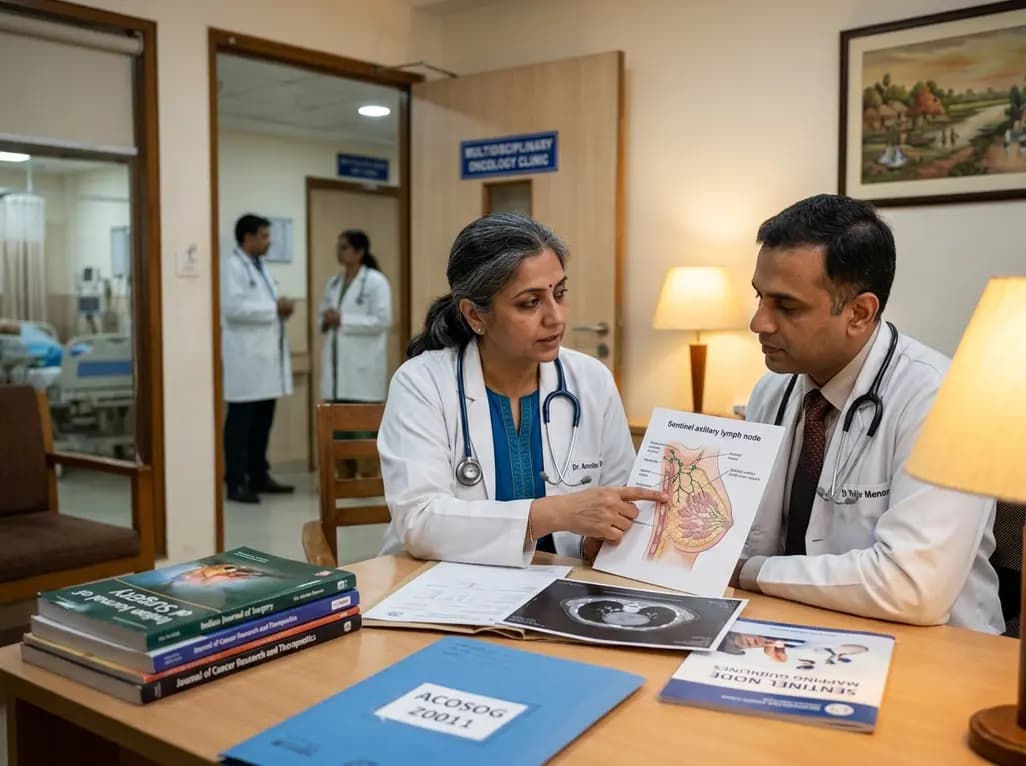
The ACOSOG Z0011 trial changed the surgical management of selected patients with early-stage breast cancer and limited sentinel lymph node involvement. Women undergoing breast-conserving surgery with one or two positive sentinel nodes were randomized to completion axillary lymph node dissection or no further axillary surgery. At long-term follow-up, overall survival and disease-free survival were similar between the strategies. The study supported omission of routine axillary dissection in appropriately selected patients, provided they received breast-conserving treatment and whole-breast radiotherapy within the trial framework. The clinical importance is substantial because axillary lymph node dissection carries a meaningful risk of lymphedema and other morbidity. Avoiding unnecessary surgery can therefore preserve quality of life without compromising oncological outcomes in carefully selected patients. For surgeons, Z0011 is a model of de-escalation based on evidence rather than tradition. The findings should not be extrapolated indiscriminately to every patient with a positive sentinel node; eligibility, surgical context, tumour characteristics and radiotherapy plans matter. The study also illustrates how multidisciplinary care enables surgical de-escalation: breast surgeons, radiologists, pathologists, radiation oncologists and medical oncologists must align around the same treatment strategy.

Read summarized clinical updates, watch expert medical content, and earn CME certifications right from your smartphone.
Open your smartphone camera to scan and install.





The ACOSOG Z0011 trial changed the surgical management of selected patients with early-stage breast cancer and limited sentinel lymph node involvement. Women undergoing breast-conserving surgery with one or two positive sentinel nodes were randomized to completion axillary lymph node dissection or no further axillary surgery. At long-term follow-up, overall survival and disease-free survival were similar between the strategies. The study supported omission of routine axillary dissection in appropriately selected patients, provided they received breast-conserving treatment and whole-breast radiotherapy within the trial framework. The clinical importance is substantial because axillary lymph node dissection carries a meaningful risk of lymphedema and other morbidity. Avoiding unnecessary surgery can therefore preserve quality of life without compromising oncological outcomes in carefully selected patients. For surgeons, Z0011 is a model of de-escalation based on evidence rather than tradition. The findings should not be extrapolated indiscriminately to every patient with a positive sentinel node; eligibility, surgical context, tumour characteristics and radiotherapy plans matter. The study also illustrates how multidisciplinary care enables surgical de-escalation: breast surgeons, radiologists, pathologists, radiation oncologists and medical oncologists must align around the same treatment strategy.
last month

A bioengineered oral nanozyme microsupplement converts pathological ROS into a protective polydopamine hydrogel shield. By curbing neutrophil extracellular traps and balancing T cells, this platform outperforms standard 5-ASA in preclinical colitis models, opening new paths for sustained remission.
5 days back

Recent research reveals that downregulating YAP1/TAZ-TEAD via Hippo signaling triggers spontaneous human trophoblast syncytialization in 3D cultures, illuminating placental biology and preeclampsia.
4 weeks back

Abdominal aortic aneurysm rupture remains a catastrophic vascular emergency. Groundbreaking research reveals that USP53 accelerates aneurysm progression by reprogramming smooth muscle cell metabolism toward aerobic glycolysis, highlighting a promising target beyond conventional diameter-based surveillance.
6 days back

A breakthrough study leverages natural language processing to accurately identify incident medication-related osteonecrosis of the jaw and track antiresorptive drug holidays from clinical narratives in electronic health records, advancing osteoporosis pharmacovigilance and dental safety.
6 days back

Recent research defines ferro-aging as a conserved iron-lipid axis driving organ decline across primates. Age-related iron dyshomeostasis stimulates ACSL4-mediated lipid peroxidation, promoting cellular senescence. Notably, vitamin C directly inhibits ACSL4, suppressing phospholipid oxidation and multi-organ decay.
6 days back
