.webp&w=384&q=75)

Loading, please wait...
Loading, please wait...

This phase 2b randomized clinical trial evaluated liafensine, a triple reuptake inhibitor, in patients with treatment-resistant depression who tested positive for the ANK3 pharmacogenomic biomarker. Of 1,967 patients screened, 189 ANK3-positive participants were randomized to once-daily liafensine 1 mg (n=62), liafensine 2 mg (n=62), or placebo (n=64); 188 received treatment, and 186 had at least one postrandomization efficacy assessment. The primary endpoint was change in MADRS total score from baseline to day 42. At week 6, mean MADRS scores decreased by 15.4 points (SE, 0.9) with the combined liafensine doses compared with 11.0 points (SE, 1.3) with placebo, yielding a treatment difference of −4.4 points (95% CI, −7.6 to −1.3; P=0.006; Cohen d=0.42). The individual doses also significantly improved MADRS scores versus placebo, with a treatment difference of −4.4 points for 1 mg (95% CI, −7.9 to −0.8; P=0.02; Cohen d=0.41) and −4.5 points for 2 mg (95% CI, −8.1 to −0.9; P=0.02; Cohen d=0.44). Secondary outcomes favoured liafensine, including Clinical Global Impression–Severity scores (treatment difference, −0.4; 95% CI, −0.8 to −0.1; nominal P=0.02) and Sheehan Disability Scale scores (difference, −2.4; 95% CI, −4.8 to −0.1; nominal P=0.04). Adverse events leading to treatment discontinuation occurred in 5 liafensine-treated participants (4.0%) and 9 placebo recipients (14.1%). Liafensine significantly improved depressive symptoms in this biomarker-selected population, supporting further investigation of pharmacogenomic approaches to treatment selection; however, independent replication and phase 3 evaluation are needed before routine clinical use

Read summarized clinical updates, watch expert medical content, and earn CME certifications right from your smartphone.
Open your smartphone camera to scan and install.





This phase 2b randomized clinical trial evaluated liafensine, a triple reuptake inhibitor, in patients with treatment-resistant depression who tested positive for the ANK3 pharmacogenomic biomarker. Of 1,967 patients screened, 189 ANK3-positive participants were randomized to once-daily liafensine 1 mg (n=62), liafensine 2 mg (n=62), or placebo (n=64); 188 received treatment, and 186 had at least one postrandomization efficacy assessment. The primary endpoint was change in MADRS total score from baseline to day 42. At week 6, mean MADRS scores decreased by 15.4 points (SE, 0.9) with the combined liafensine doses compared with 11.0 points (SE, 1.3) with placebo, yielding a treatment difference of −4.4 points (95% CI, −7.6 to −1.3; P=0.006; Cohen d=0.42). The individual doses also significantly improved MADRS scores versus placebo, with a treatment difference of −4.4 points for 1 mg (95% CI, −7.9 to −0.8; P=0.02; Cohen d=0.41) and −4.5 points for 2 mg (95% CI, −8.1 to −0.9; P=0.02; Cohen d=0.44). Secondary outcomes favoured liafensine, including Clinical Global Impression–Severity scores (treatment difference, −0.4; 95% CI, −0.8 to −0.1; nominal P=0.02) and Sheehan Disability Scale scores (difference, −2.4; 95% CI, −4.8 to −0.1; nominal P=0.04). Adverse events leading to treatment discontinuation occurred in 5 liafensine-treated participants (4.0%) and 9 placebo recipients (14.1%). Liafensine significantly improved depressive symptoms in this biomarker-selected population, supporting further investigation of pharmacogenomic approaches to treatment selection; however, independent replication and phase 3 evaluation are needed before routine clinical use
Today

A bioengineered oral nanozyme microsupplement converts pathological ROS into a protective polydopamine hydrogel shield. By curbing neutrophil extracellular traps and balancing T cells, this platform outperforms standard 5-ASA in preclinical colitis models, opening new paths for sustained remission.
6 days back
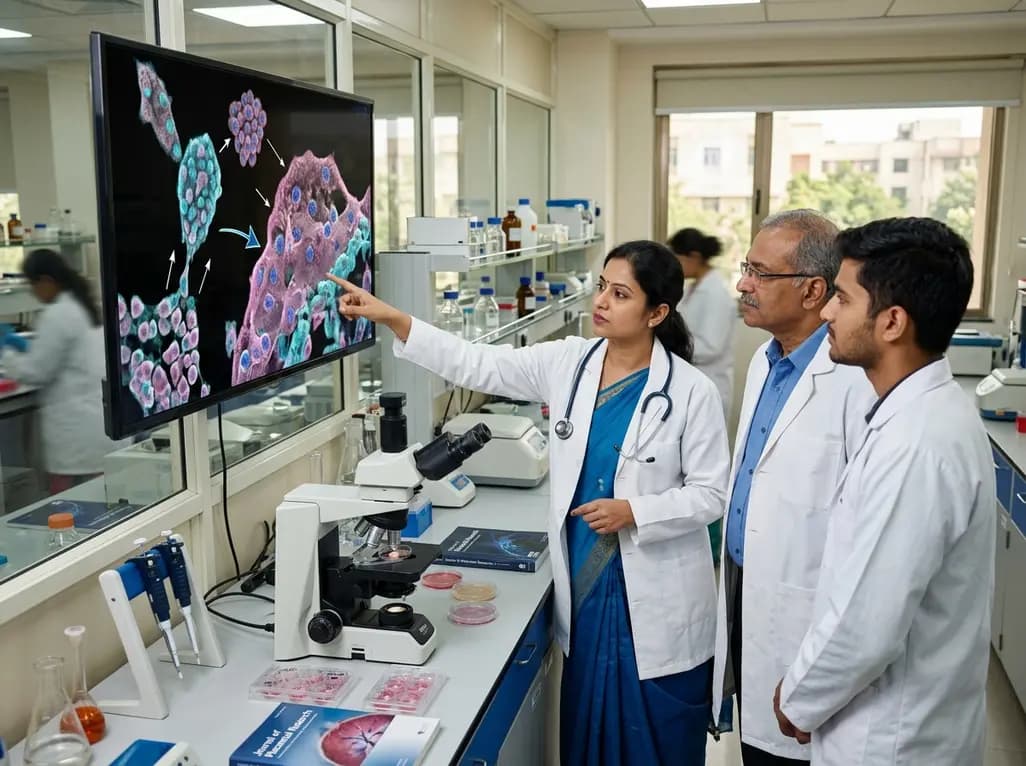
Recent research reveals that downregulating YAP1/TAZ-TEAD via Hippo signaling triggers spontaneous human trophoblast syncytialization in 3D cultures, illuminating placental biology and preeclampsia.
4 weeks back

Abdominal aortic aneurysm rupture remains a catastrophic vascular emergency. Groundbreaking research reveals that USP53 accelerates aneurysm progression by reprogramming smooth muscle cell metabolism toward aerobic glycolysis, highlighting a promising target beyond conventional diameter-based surveillance.
Last week

A breakthrough study leverages natural language processing to accurately identify incident medication-related osteonecrosis of the jaw and track antiresorptive drug holidays from clinical narratives in electronic health records, advancing osteoporosis pharmacovigilance and dental safety.
Last week

Recent research defines ferro-aging as a conserved iron-lipid axis driving organ decline across primates. Age-related iron dyshomeostasis stimulates ACSL4-mediated lipid peroxidation, promoting cellular senescence. Notably, vitamin C directly inhibits ACSL4, suppressing phospholipid oxidation and multi-organ decay.
Last week
