.webp&w=384&q=75)

Loading, please wait...
Loading, please wait...
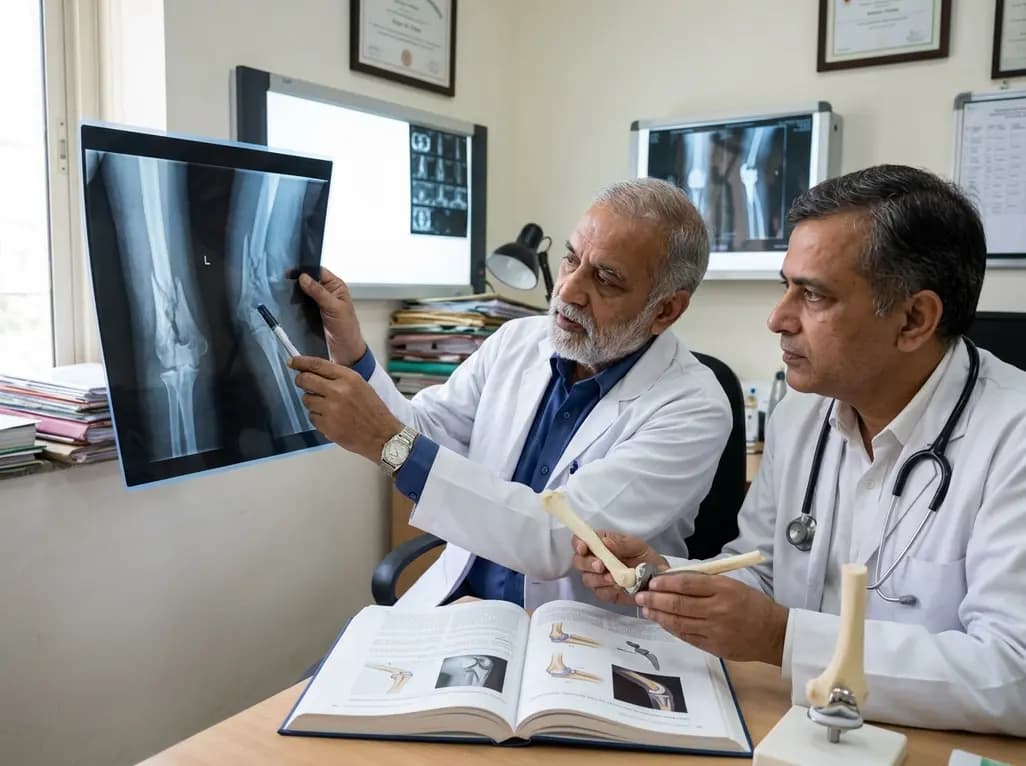
Unreconstructable distal humerus fractures in older adults can be treated with total elbow arthroplasty or elbow hemiarthroplasty, but comparative evidence has been limited. This multicentre randomized trial compared the two approaches in patients aged 60 years or older with fractures that could not be reliably reconstructed. At two years, functional outcomes were good and broadly similar in both groups, including DASH and Mayo Elbow Performance scores. The study suggests that hemiarthroplasty may be a credible alternative to total elbow replacement in carefully selected patients, potentially avoiding some of the constraints associated with a linked total prosthesis. However, implant selection must take into account ligament integrity, fracture pattern, bone stock and the patient's expected activity level. The sample was relatively small, so the findings should not be interpreted as proof that one procedure is always superior. For HCPs, the key practical message is that treatment planning should focus on reconstructability and elbow stability. When fixation cannot provide a reliable construct, arthroplasty becomes reasonable; within arthroplasty, both hemiarthroplasty and total replacement may have a role depending on the anatomy and surgeon expertise.

Read summarized clinical updates, watch expert medical content, and earn CME certifications right from your smartphone.
Open your smartphone camera to scan and install.





Unreconstructable distal humerus fractures in older adults can be treated with total elbow arthroplasty or elbow hemiarthroplasty, but comparative evidence has been limited. This multicentre randomized trial compared the two approaches in patients aged 60 years or older with fractures that could not be reliably reconstructed. At two years, functional outcomes were good and broadly similar in both groups, including DASH and Mayo Elbow Performance scores. The study suggests that hemiarthroplasty may be a credible alternative to total elbow replacement in carefully selected patients, potentially avoiding some of the constraints associated with a linked total prosthesis. However, implant selection must take into account ligament integrity, fracture pattern, bone stock and the patient's expected activity level. The sample was relatively small, so the findings should not be interpreted as proof that one procedure is always superior. For HCPs, the key practical message is that treatment planning should focus on reconstructability and elbow stability. When fixation cannot provide a reliable construct, arthroplasty becomes reasonable; within arthroplasty, both hemiarthroplasty and total replacement may have a role depending on the anatomy and surgeon expertise.
last month

Preclinical findings demonstrate that ginsenoside Ra1 preserves vascular integrity and attenuates multi-organ injury during sepsis by targeting non-muscle myosin heavy chain IIA (NMMHC IIA) and dampening TLR4/NF-κB/NLRP3 inflammatory signaling.
3 days back

An all-printed immunosensing microchip detects urinary sFlt-1 in just 10 minutes with 3.61 pg/mL sensitivity. By leveraging photonic bandgap engineering, this low-cost, cleanroom-free platform provides non-invasive preeclampsia screening, offering substantial benefits for point-of-care obstetric triage.
3 days back

Wearable ultrasound patches are transforming healthcare by shifting medicine from episodic evaluations to continuous monitoring. Discover how flexible acoustic transducers advance cardiovascular tracking, musculoskeletal imaging, neuromodulation, and on-demand closed-loop theranostics.
3 days back

A breakthrough study leverages natural language processing to accurately identify incident medication-related osteonecrosis of the jaw and track antiresorptive drug holidays from clinical narratives in electronic health records, advancing osteoporosis pharmacovigilance and dental safety.
Last week

Recent research defines ferro-aging as a conserved iron-lipid axis driving organ decline across primates. Age-related iron dyshomeostasis stimulates ACSL4-mediated lipid peroxidation, promoting cellular senescence. Notably, vitamin C directly inhibits ACSL4, suppressing phospholipid oxidation and multi-organ decay.
Last week
