.webp&w=384&q=75)

Loading, please wait...
Loading, please wait...
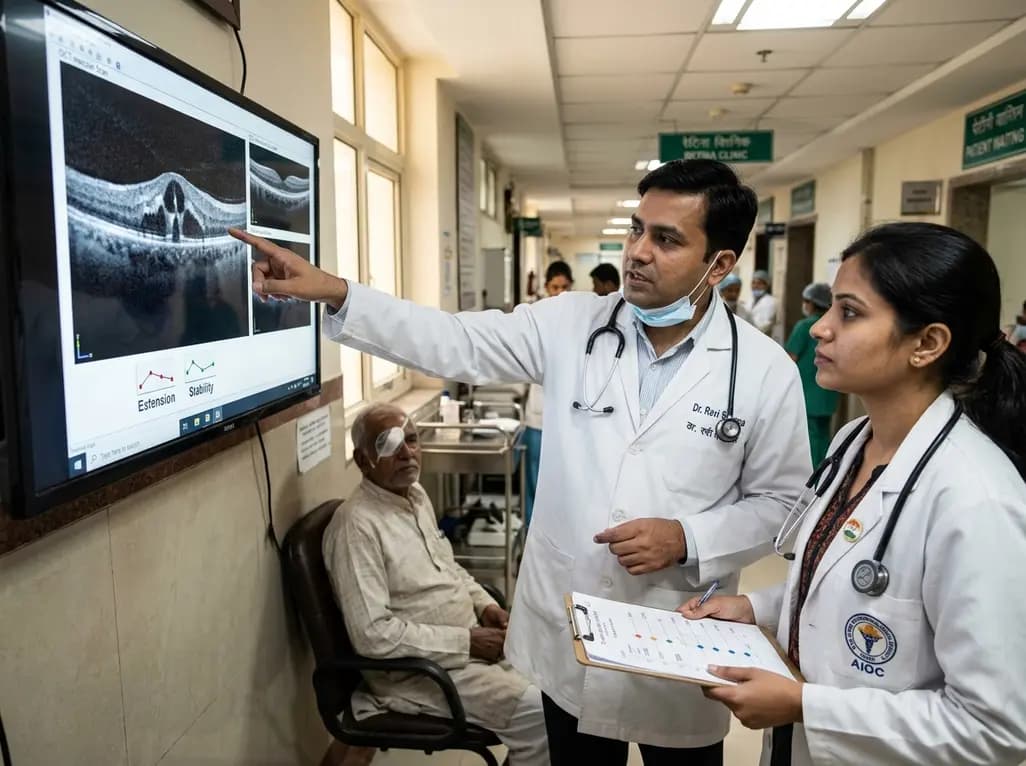
The phase 3 YOSEMITE and RHINE trials compared faricimab with aflibercept in adults with center-involving diabetic macular edema. Faricimab was studied using fixed eight-week dosing and a personalised treat-and-extend regimen, while aflibercept was given every eight weeks. Across the trials, faricimab produced vision gains that were comparable with the active comparator while enabling longer treatment intervals for many patients under the personalised regimen. The results are important because treatment burden remains one of the largest practical challenges in chronic DME care. The personalised approach aims to maintain anatomical and functional control while reducing visit and injection frequency when the eye remains stable. For HCPs, however, treat-and-extend should not be interpreted as automatic interval extension. Decisions remain driven by OCT findings, visual response and disease recurrence. The evidence supports a more individualised approach to anti-VEGF care and is directly relevant to AIOC's retina sessions on DME treatment regimens and imaging-guided management.

Read summarized clinical updates, watch expert medical content, and earn CME certifications right from your smartphone.
Open your smartphone camera to scan and install.





The phase 3 YOSEMITE and RHINE trials compared faricimab with aflibercept in adults with center-involving diabetic macular edema. Faricimab was studied using fixed eight-week dosing and a personalised treat-and-extend regimen, while aflibercept was given every eight weeks. Across the trials, faricimab produced vision gains that were comparable with the active comparator while enabling longer treatment intervals for many patients under the personalised regimen. The results are important because treatment burden remains one of the largest practical challenges in chronic DME care. The personalised approach aims to maintain anatomical and functional control while reducing visit and injection frequency when the eye remains stable. For HCPs, however, treat-and-extend should not be interpreted as automatic interval extension. Decisions remain driven by OCT findings, visual response and disease recurrence. The evidence supports a more individualised approach to anti-VEGF care and is directly relevant to AIOC's retina sessions on DME treatment regimens and imaging-guided management.
4 weeks back

Explore the therapeutic promise of TLR7 and TLR8 inhibitors in managing systemic lupus erythematosus and monogenic autoimmune diseases. Learn how targeting endolysosomal single-stranded RNA sensing and regulatory checkpoints like UNC93B1 and PLD4 offers precision treatment without broad immunosuppression.
2 days back

Recent research reveals that downregulating YAP1/TAZ-TEAD via Hippo signaling triggers spontaneous human trophoblast syncytialization in 3D cultures, illuminating placental biology and preeclampsia.
3 weeks back

Abdominal aortic aneurysm rupture remains a catastrophic vascular emergency. Groundbreaking research reveals that USP53 accelerates aneurysm progression by reprogramming smooth muscle cell metabolism toward aerobic glycolysis, highlighting a promising target beyond conventional diameter-based surveillance.
2 days back

A breakthrough study leverages natural language processing to accurately identify incident medication-related osteonecrosis of the jaw and track antiresorptive drug holidays from clinical narratives in electronic health records, advancing osteoporosis pharmacovigilance and dental safety.
2 days back

Recent research defines ferro-aging as a conserved iron-lipid axis driving organ decline across primates. Age-related iron dyshomeostasis stimulates ACSL4-mediated lipid peroxidation, promoting cellular senescence. Notably, vitamin C directly inhibits ACSL4, suppressing phospholipid oxidation and multi-organ decay.
2 days back
