.webp&w=384&q=75)

Loading, please wait...
Loading, please wait...
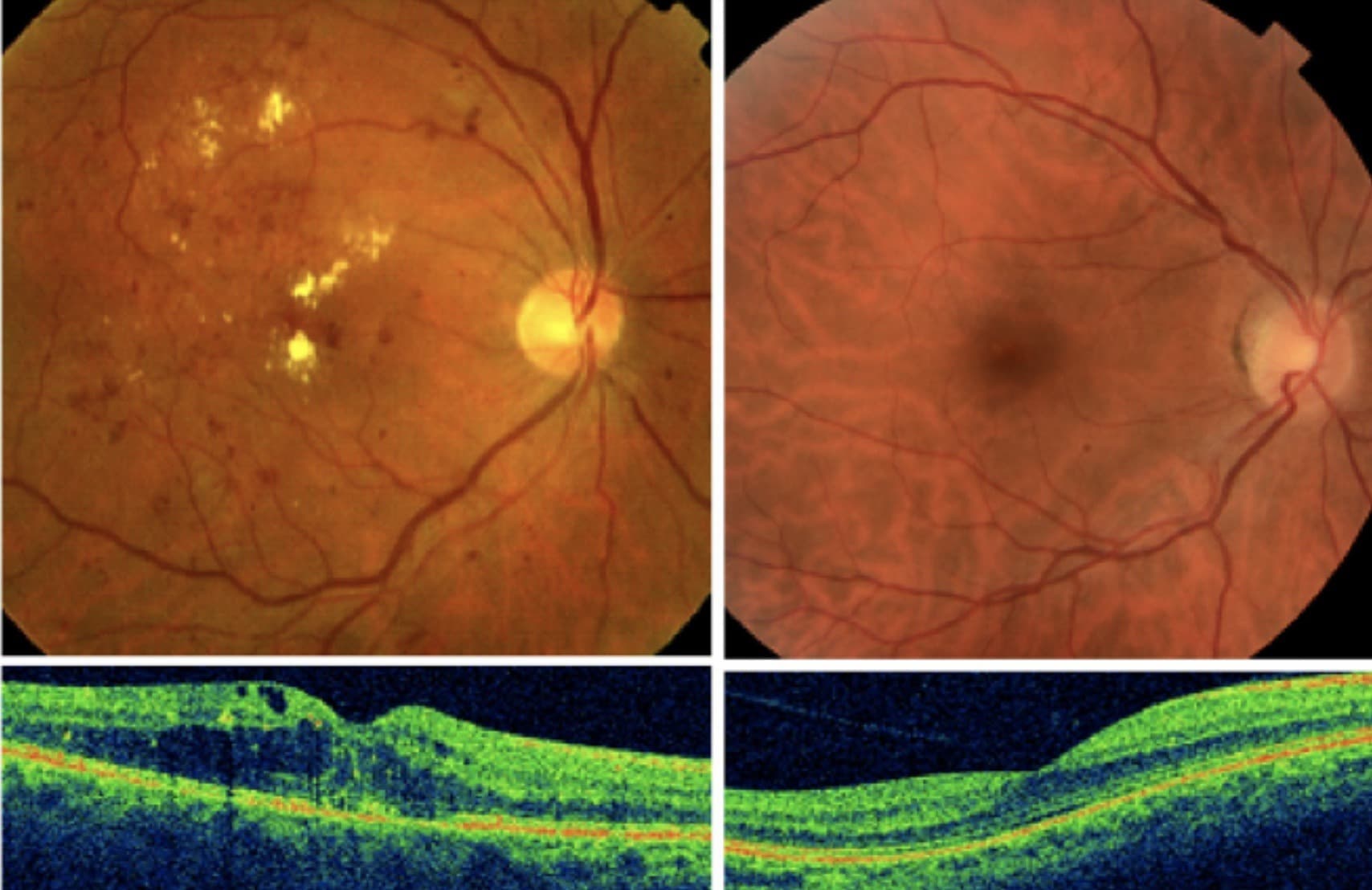
A Bayesian network meta-analysis published in 2025 compared extended-dose aflibercept 8 mg with faricimab 6 mg using treat-and-extend strategies in diabetic macular edema and neovascular age-related macular degeneration. Across six randomized trials, treatment with aflibercept 8 mg was associated with fewer injections over approximately two years than faricimab treat-and-extend, while absolute changes in best-corrected visual acuity and central subfield thickness did not differ significantly between treatments. Because the analysis was indirect, it should not be interpreted as a head-to-head randomized comparison. Nevertheless, it provides clinically useful context for retina practices trying to balance durability, injection frequency, and visual outcomes. For HCPs, the key message is that extended-interval anti-VEGF therapies can broaden the range of feasible treatment pathways, but drug selection still depends on baseline disease characteristics, response durability, safety considerations, access, cost, and local treatment patterns. Network meta-analysis can help frame these choices, but direct comparative trials remain important when deciding between specific agents.

Read summarized clinical updates, watch expert medical content, and earn CME certifications right from your smartphone.
Open your smartphone camera to scan and install.





A Bayesian network meta-analysis published in 2025 compared extended-dose aflibercept 8 mg with faricimab 6 mg using treat-and-extend strategies in diabetic macular edema and neovascular age-related macular degeneration. Across six randomized trials, treatment with aflibercept 8 mg was associated with fewer injections over approximately two years than faricimab treat-and-extend, while absolute changes in best-corrected visual acuity and central subfield thickness did not differ significantly between treatments. Because the analysis was indirect, it should not be interpreted as a head-to-head randomized comparison. Nevertheless, it provides clinically useful context for retina practices trying to balance durability, injection frequency, and visual outcomes. For HCPs, the key message is that extended-interval anti-VEGF therapies can broaden the range of feasible treatment pathways, but drug selection still depends on baseline disease characteristics, response durability, safety considerations, access, cost, and local treatment patterns. Network meta-analysis can help frame these choices, but direct comparative trials remain important when deciding between specific agents.
last month

Preclinical findings demonstrate that ginsenoside Ra1 preserves vascular integrity and attenuates multi-organ injury during sepsis by targeting non-muscle myosin heavy chain IIA (NMMHC IIA) and dampening TLR4/NF-κB/NLRP3 inflammatory signaling.
2 days back

An all-printed immunosensing microchip detects urinary sFlt-1 in just 10 minutes with 3.61 pg/mL sensitivity. By leveraging photonic bandgap engineering, this low-cost, cleanroom-free platform provides non-invasive preeclampsia screening, offering substantial benefits for point-of-care obstetric triage.
3 days back

Wearable ultrasound patches are transforming healthcare by shifting medicine from episodic evaluations to continuous monitoring. Discover how flexible acoustic transducers advance cardiovascular tracking, musculoskeletal imaging, neuromodulation, and on-demand closed-loop theranostics.
3 days back

A breakthrough study leverages natural language processing to accurately identify incident medication-related osteonecrosis of the jaw and track antiresorptive drug holidays from clinical narratives in electronic health records, advancing osteoporosis pharmacovigilance and dental safety.
Last week

Recent research defines ferro-aging as a conserved iron-lipid axis driving organ decline across primates. Age-related iron dyshomeostasis stimulates ACSL4-mediated lipid peroxidation, promoting cellular senescence. Notably, vitamin C directly inhibits ACSL4, suppressing phospholipid oxidation and multi-organ decay.
Last week
