.webp&w=384&q=75)

Loading, please wait...
Loading, please wait...

The National Medical Commission has officially notified the NMC PwBD Guidelines 2026 to reform MBBS course admissions for applicants with benchmark disabilities nationwide. Furthermore, this landmark regulatory update marks a decisive shift from outdated percentage-based disqualification toward individualized, functional competency evaluation. Specifically, the Undergraduate Medical Education Board published these binding guidelines under Sections 10 and 24 of the National Medical Commission Act, 2019. Consequently, candidates applying under the Persons with Benchmark Disabilities category will experience an objective, transparent, and standardized assessment process. Moreover, the updated norms align directly with the Rights of Persons with Disabilities Act, 2016, and recent Supreme Court directives. Therefore, medical assessment boards, state counseling authorities, and medical institutions must adopt these provisions across India immediately to ensure fair opportunity.
Historically, medical admission boards relied heavily on numerical disability percentages recorded on Unique Disability Identity cards to determine candidate eligibility. However, the new framework prioritizes practical functional capability over arbitrary medical thresholds or diagnostic labels. Additionally, evaluators must determine whether a candidate can acquire the essential clinical competencies required by the Competency Based Medical Education curriculum. Therefore, a candidate possessing a benchmark disability of 40% or more cannot be declared ineligible solely based on a medical diagnosis or percentage category recorded on their UDID card.
Instead, medical assessment boards must examine how modern assistive technologies, ergonomic modifications, and environmental accommodations enhance student performance. Furthermore, physical or sensory impairment shall never constitute grounds for exclusion unless demonstrably insurmountable despite reasonable support measures. Consequently, this shift balances substantive equality of opportunity with strict academic standards and patient safety. In addition, candidates will undergo individualized evaluations tailored to their specific medical condition, ensuring fair treatment throughout the selection procedure without reliance on generalized stereotypes.
The NMC PwBD Guidelines 2026 establish clear operational protocols to guarantee non-discrimination during undergraduate medical admissions. First, every candidate must possess a valid Permanent Unique Disability Identity Card issued through the central portal. Second, candidates must submit a self-certified affidavit declaring their specific functional capabilities across communication, dominant hand functionality, mobility, and sensory domains under Schedule-I. Third, designated medical assessment boards will independently conduct objective, evidence-based evaluations.
Furthermore, these assessment boards must issue a reasoned, speaking order whenever declaring any candidate ineligible for admission. Consequently, arbitrary rejections without detailed functional findings are strictly prohibited under the new rules. In addition, prior to declaring any candidate ineligible, the board must explicitly examine whether reasonable accommodation could mitigate learning barriers. Therefore, patient safety and clinical standards remain harmoniously balanced with fundamental candidate rights. Additionally, medical institutions must maintain rigorous medical education standards throughout this comprehensive evaluation process.
Under previous regulations, candidates received generic disability certificates that focused solely on impairment percentages. However, the 2026 guidelines rebrand this document into a specialized Eligibility Certificate issued under Schedule-II. Consequently, this document certifies whether an applicant is fully eligible, eligible with reasonable accommodation, or ineligible based on functional competency assessments. Furthermore, the designated board must document exact clinical findings, recommended assistive devices, and tailored teaching adaptations directly on the certificate.
Moreover, if an assessment board deems a candidate ineligible, it must record detailed scientific justification in writing. Specifically, the board must demonstrate that the candidate cannot acquire mandatory clinical competencies even with reasonable accommodation. Alternatively, it must prove that the disability creates an unmitigable, demonstrable risk to patient safety supported by clinical evidence. Therefore, this structured documentation ensures accountability, transparency, and legal clarity for all medical aspirants across the country.
To ensure nationwide accessibility and administrative uniformity, the Directorate General of Health Services has expanded designated assessment centers significantly. Previously, candidates could only approach 16 designated medical assessment boards across the country. However, the new notification expands this network to 61 designated centers nationwide. Consequently, candidates can access assessment facilities closer to their home states without experiencing excessive travel burdens or administrative delays during counseling.
Furthermore, these expanded boards operate under standardized evaluation criteria established by the Ministry of Social Justice and Empowerment. In addition, candidates retain the explicit right to challenge any adverse finding through a dedicated appellate mechanism. Specifically, aggrieved applicants can submit an appeal to the Appellate Authority constituted under the Directorate General of Health Services within notified timelines. As a result, candidates receive an independent, expert review of their functional capabilities and medical findings, ensuring principles of natural justice are upheld.
Beyond the initial admission phase, every recognized medical college must create a dedicated institutional infrastructure to support admitted students continuously. Specifically, institutions must establish an internal Enabling Unit headed by a designated Nodal Officer. Furthermore, this unit serves as a single point of contact for addressing clinical accommodations, accessible learning environments, and barrier-free campus infrastructure.
Additionally, medical colleges must organize routine sensitization programs for faculty members, administrative staff, and fellow students. Consequently, these initiatives foster an inclusive academic atmosphere while eliminating attitudinal, physical, and communication barriers. Moreover, every institution must maintain a time-bound grievance redressal mechanism to handle complaints regarding accommodation denials or discrimination. Therefore, medical colleges bear a continuous statutory responsibility to support PwBD students from admission through internship completion without compromise.
Medical colleges, counseling authorities, and candidates must immediately align their admission protocols with these binding national regulations. First, admission authorities must verify UDID cards and Schedule-I affidavits thoroughly during counseling rounds. Second, institutions must prepare their teaching hospitals to provide recommended ergonomic, digital, and clinical learning accommodations promptly. Furthermore, state counseling authorities must ensure strict compliance across all government and private seat allocations.
For candidates, preparing accurate documentation remains essential prior to participating in All India or State counseling processes. Specifically, candidates must obtain their Permanent UDID cards and complete category-specific affidavits properly under Schedules I and II. In addition, candidates should review official announcements on the National Medical Commission portal and the Department of Empowerment of Persons with Disabilities platform for updated procedural notifications. Ultimately, these comprehensive reforms create an equitable pathway for aspiring doctors while preserving high standards in healthcare education.
Disclaimer: This content is for informational and educational purposes only and does not constitute official legal or clinical advice. Medical candidates and institutions should refer to official NMC notifications and relevant state authorities for binding operational guidelines. Refer to the latest local and national guidelines for clinical practice.
References

Read summarized clinical updates, watch expert medical content, and earn CME certifications right from your smartphone.
Open your smartphone camera to scan and install.





The National Medical Commission has published comprehensive PwBD Guidelines 2026, introducing functional competency assessments and reasonable accommodation for MBBS admissions across India.
2 months ago
Kenya's confirmation of its eighth Ebola infection highlights the acute risk of secondary transmission in hospital environments. Clinicians must maintain high vigilance, enforce strict infection prevention protocols, and implement rapid triage mechanisms for viral hemorrhagic fevers across healthcare settings.
3 days back
Maternal anaemia contributes to nearly half of pregnancy-related fatalities across India. To prevent complications, Uttar Pradesh has added single-dose parenteral iron to its essential medicines list. This clinical transition aims to restore haemoglobin rapidly and protect high-risk mothers across rural facilities.
Last week

India's food safety authority FSSAI has issued show-cause notices to Gemini Edibles, BigBasket, and Flipkart for unpermitted cardiovascular claims regarding Freedom Rice Bran Oil. This regulatory move highlights the strict enforcement of advertising standards and the clinical necessity of evidence-based lipid care.
5 days back

The state government is deploying helicopter emergency medical services across the Mumbai-Pune Expressway, Samruddhi Mahamarg, and Mumbai-Goa Highway. This initiative establishes unified standard operating procedures to enable rapid triage, advanced prehospital resuscitation, and seamless trauma care transfers.
Last week
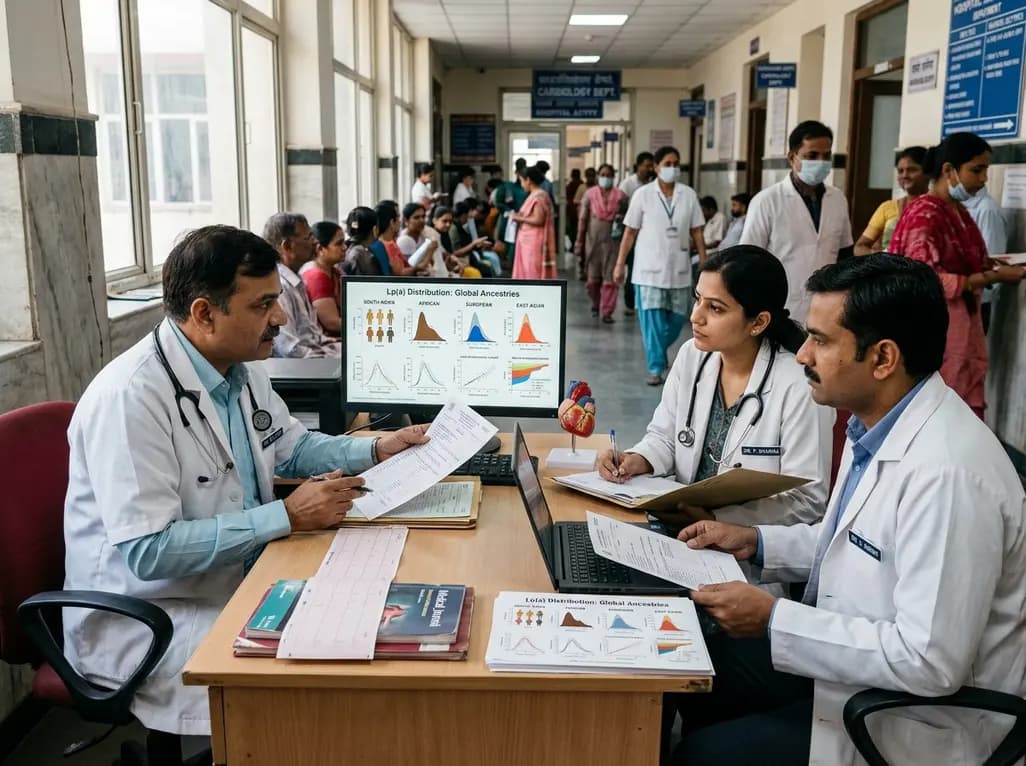
Atherosclerotic cardiovascular disease guidelines often rely on European-derived lipoprotein(a) cutoffs. However, baseline Lp(a) levels vary widely across ancestries, including South Asians and Africans. Clinicians must interpret Lp(a) values within overall absolute cardiovascular risk.
Last week
