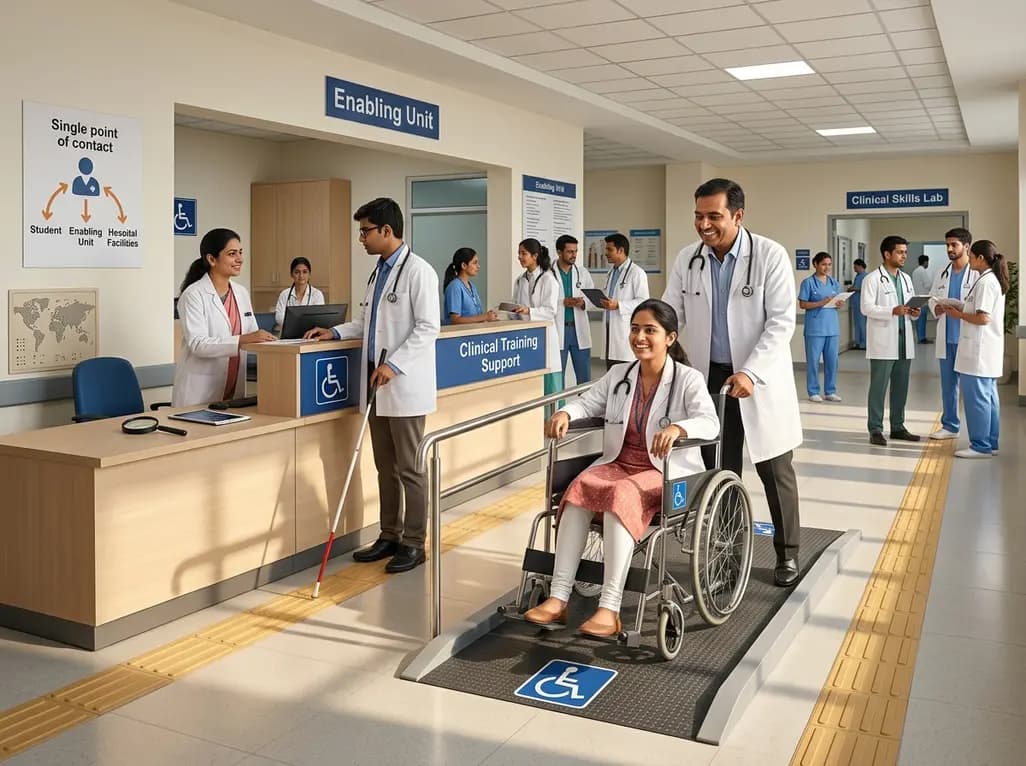
The National Medical Commission has recently mandated the establishment of NMC Enabling Units across all regulated medical colleges in India. Consequently, this crucial regulatory directive ensures that undergraduate and postgraduate medical students with benchmark disabilities receive comprehensive institutional support. Furthermore, this initiative establishes a centralized, single point of contact for reasonable accommodations during academic coursework, laboratory training, and clinical internships. Ultimately, the commission aims to create an inclusive, barrier-free educational environment that upholds equal opportunity, personal dignity, and strict professional standards without compromising patient safety or academic rigor across medical institutions nationwide.
Mandatory Framework for NMC Enabling Units in Medical Colleges
Medical institutions across India must systematically organize these support centers in strict compliance with official regulatory mandates. Consequently, the establishment of NMC Enabling Units marks a pivotal transition toward structured disability rights in medical education. The National Medical Commission circular explicitly directs all deans, principals, and administrative leaders to make these units fully operational without delay. Furthermore, every institution must publish detailed contact information for these units on official notice boards, institutional websites, and admission prospectuses. Therefore, incoming students will receive clear guidance regarding available support systems right at the time of admission. Moreover, the directive mandates that these units operate continuously throughout the academic calendar. As a result, trainees can seek immediate guidance whenever physical, technical, or learning barriers arise during their studies. Additionally, institutional leadership must ensure that these units maintain adequate financial resources, office space, and dedicated staffing levels. In addition, administrative officers must actively monitor the functionality of these support mechanisms to ensure seamless operational workflow. Consequently, medical colleges must eliminate unnecessary bureaucratic delays when evaluating student requests for reasonable accommodations. Indeed, establishing these formal structural units replaces informal, ad hoc arrangements with a standardized, legally bound institutional framework across all medical campuses.
Role and Operational Responsibilities of NMC Enabling Units
The primary function of these specialized support offices centers on providing comprehensive assistance to medical students with disabilities. Specifically, NMC Enabling Units function as the central liaison between disabled trainees, department heads, faculty members, and hospital administration. Additionally, the unit receives formal applications for disability-specific accommodations and evaluates them in a timely, systematic manner. Furthermore, the committee coordinates directly with designated Disability Assessment Boards to verify specific academic requirements and ensure compliance. Consequently, students no longer need to navigate multiple administrative departments independently to request necessary physical or educational adjustments. Moreover, the unit plays a vital role in organizing periodic disability sensitization workshops for teaching staff, healthcare professionals, and administrative personnel. Therefore, these educational training programs help eliminate attitudinal barriers and foster an empathetic educational culture across medical campuses. In addition, the unit oversees regular physical accessibility audits across lecture halls, clinical laboratories, student dormitories, and hospital wards. As a result, institutions can proactively identify structural obstacles and implement required architectural modifications. Consequently, disabled students gain equitable access to all educational facilities and clinical learning resources. Ultimately, these operational responsibilities ensure that every student receives tailored support while pursuing their medical training effectively.
Clinical Accommodations and Reasonable Modifications in Training
Medical education requires intensive hands-on training, bedside clinical rotations, and rigorous technical skill acquisitions across various specialties. Therefore, providing appropriate clinical accommodations represents a crucial operational responsibility for every medical institution. Furthermore, reasonable modifications allow students with benchmark disabilities to participate fully in ward rounds, surgical observations, outpatient clinics, and patient evaluations. Crucially, these customized adjustments do not lower academic standards or jeopardize patient safety in any manner. Instead, accommodations provide assistive technology, adaptive clinical instruments, and flexible schedule arrangements that enable effective clinical learning. For instance, students with mobility impairments may receive ergonomic clinical equipment or height-adjustable workstations during clinical rotations. Similarly, trainees with visual or hearing impairments might utilize specialized electronic amplification tools or digital screen reading software. Consequently, these tailored modifications bridge the gap between individual functional limitations and essential clinical learning objectives. In addition, clinical supervisors must collaborate closely with the support team to evaluate the practical efficacy of provided accommodations. Therefore, ongoing assessments ensure that trainees acquire necessary core competencies while working in safe clinical environments. Ultimately, reasonable modifications empower capable trainees to excel in practical clinical training without facing unnecessary physical hurdles.
Compliance with Supreme Court Rulings and the RPwD Act
The recent NMC circular directly enforces statutory provisions mandated under the Rights of Persons with Disabilities Act of 2016. Specifically, Sections 16 and 17 of the RPwD Act mandate that educational institutions provide inclusive learning environments. Furthermore, recent landmark directives from the Supreme Court of India have reinforced the legal obligation to protect disabled medical aspirants. Consequently, judicial rulings in prominent cases have emphasized that disability support in higher education constitutes a fundamental legal right. Therefore, medical colleges cannot view these accommodations as discretionary measures or acts of charitable goodwill. Instead, providing accessibility and reasonable accommodation represents a binding legal requirement for all recognized medical institutions. In addition, the Supreme Court instructed regulatory bodies to replace rigid percentage-based disability cutoffs with functional competency assessments. As a result, candidates are evaluated based on their actual ability to perform clinical duties using assistive devices. Moreover, the NMC directive aligns Indian medical training policies with international human rights standards regarding disability inclusion. Consequently, medical colleges that fail to establish functional support units face potential regulatory penalties and severe legal scrutiny. Ultimately, strict adherence to these legal mandates guarantees equal opportunities for all qualified medical students.
Institutional Infrastructure and Confidential Record Maintenance
Beyond academic and clinical adjustments, medical institutions must maintain strict administrative protocols regarding student privacy and documentation. Consequently, NMC Enabling Units are required to keep detailed, confidential records of all accommodation requests and provided solutions. Furthermore, institutions must handle student health data and disability certifications with complete non-discrimination and strict privacy safeguards. Therefore, personal medical records must remain protected from unauthorized disclosure or academic prejudice. In addition, colleges must continually inspect physical infrastructure to guarantee barrier-free mobility throughout campus premises. Specifically, institutions must construct tactile pathways, ramp access, accessible restrooms, and wheelchair-friendly elevators in all academic buildings. Moreover, digital learning platforms, online libraries, and institutional portals must adhere to modern web accessibility guidelines. As a result, students with sensory or visual impairments can access educational materials without technical hindrances. Additionally, institutional leaders must regularly evaluate the effectiveness of administrative workflows handling accommodation petitions. Consequently, timely processing prevents administrative delays during crucial examination periods or clinical rotation schedules. Indeed, robust record-keeping combined with accessible infrastructure creates a supportive ecosystem where disabled medical students can thrive professionally.
Frequently Asked Questions
Q1: What is the primary purpose of NMC Enabling Units in medical colleges?
NMC Enabling Units serve as a single point of contact for medical students with benchmark disabilities. Furthermore, these units facilitate access to reasonable academic and clinical accommodations, ensure barrier-free infrastructure, and provide dedicated institutional support throughout medical training. Consequently, they guarantee equal opportunity, non-discrimination, and complete compliance with national disability rights regulations across all recognized medical institutions in India.
Q2: How do clinical accommodations protect patient safety while supporting disabled students?
Clinical accommodations involve reasonable modifications, such as adaptive equipment or flexible scheduling, that allow disabled students to perform clinical tasks effectively. Crucially, these adjustments maintain rigorous academic standards and core clinical competencies. Therefore, patient safety remains completely uncompromised while enabling trainees to participate fully in patient care, diagnostic procedures, and clinical rotation requirements.
Q3: Which legal regulations mandate the establishment of these support units?
The establishment of these units is mandated by the Rights of Persons with Disabilities Act, 2016, specifically Sections 16 and 17. Additionally, recent directives from the Supreme Court of India and official circulars issued by the National Medical Commission legally compel all medical institutions to implement these functional support systems promptly.
Disclaimer: This content is for informational and educational purposes only. It does not constitute medical advice or replace professional judgment. Refer to the latest local and national guidelines for clinical practice.
References
- NMC asks medical colleges to set up support units for students with disabilities - ETHealthworld.
- National Medical Commission. Guidelines on Assessment of Persons with Benchmark Disabilities for Admission to the MBBS Course. NMC Circular, July 2026.
- Rights of Persons with Disabilities Act, 2016. Ministry of Social Justice and Empowerment, Government of India.
.webp&w=384&q=75)