.webp&w=384&q=75)

Loading, please wait...
Loading, please wait...

Endovascular management of wide-necked aneurysms presents a formidable clinical challenge for neurointerventional teams worldwide. Traditionally, operators utilized stent-assisted coiling to prevent coil herniation into parent vessels. However, the introduction of the Woven EndoBridge device offers an innovative intrasaccular approach. In addition, clinicians frequently evaluate the economic viability and technical performance of these two endovascular modalities. Therefore, a recent multicenter investigation provides compelling real-world comparative data regarding implant expenses and procedural efficiency.
The treatment landscape for complex intracranial lesions evolves rapidly. Wide-necked bifurcation aneurysms historically required stent reconstruction combined with extensive coil packing. Although this technique secures the neck, it substantially drives up implant expenditure. Each individual coil increases hospital charges and inventory demands. Furthermore, microcatheter manipulations through deployed stent struts prolong operative duration. Consequently, endovascular specialists seek alternative technologies providing reliable occlusion with fewer hardware components. The Woven EndoBridge system functions as a self-expanding braided nitinol mesh cylinder for intrasaccular flow disruption. In doing so, the device promotes endothelial healing across the neck without entering parent arteries. This single-device philosophy fundamentally alters procedural dynamics. Nevertheless, neurointerventional surgeons require robust comparative financial data before adopting new technologies. Because implant prices vary considerably, establishing definitive device expenditure thresholds remains critical for institutional budgeting and value-based care.
To resolve key questions regarding procedural expenditure, researchers conducted a retrospective analysis across three major tertiary medical centers. The investigators matched seventy-three patients treated with the Woven EndoBridge device against seventy-two patients receiving stent-assisted coiling. Specifically, the study team matched cohorts by aneurysm maximum diameter, anatomical location, and acute rupture status. This rigorous matching strategy successfully minimized baseline confounding variables between groups. Moreover, participating centers tracked clinical metrics, fluoroscopy duration, operative times, and overall hardware utilization. Interventionalists documented all opened devices alongside final deployed implants to capture real-world waste. In addition, the research group implemented linear regression modeling to evaluate cost trends relative to aneurysm dimensions. They modeled two scenarios: real-world practice with device exchanges and ideal single-device deployment. As a result, the authors generated objective, size-dependent financial curves for wide-necked aneurysm interventions. This multicenter methodology provides clinicians with actionable benchmarks to guide endovascular therapy selection.
The multicenter study revealed clear financial divergence between the two endovascular techniques. Overall, the Woven EndoBridge cohort demonstrated significantly lower median implant expenses compared to the stent-assisted coiling cohort. Specifically, median implant costs reached 16,495 dollars for the intrasaccular group versus 20,429 dollars for the stenting group (p = 0.0034). Furthermore, linear regression identified definitive anatomical cutoffs where device savings materialized. In real-world clinical conditions, implant expenses favored the intrasaccular device once aneurysm diameters reached or exceeded nine millimeters. However, under ideal sizing conditions requiring only a single device, the financial threshold dropped to 8.3 millimeters. Larger aneurysms require numerous secondary coils to achieve acceptable packing density during stent-assisted procedures. Consequently, cumulative coil purchases quickly exceed the fixed price of an intrasaccular mesh basket. Therefore, treating moderate-to-large lesions with a single intrasaccular disruptor yields substantial hardware savings. These findings enable specialists to identify anatomical subgroups that maximize cost-effectiveness.
Beyond direct hardware expenditures, procedural duration and radiation exposure represent vital measures of clinical efficiency. In this multicenter investigation, the intrasaccular approach demonstrated superior workflow metrics. Median operative duration was significantly shorter for the intrasaccular group at 194.5 minutes compared to 222 minutes for stent-assisted coiling. Similarly, median fluoroscopy time decreased markedly from 53.3 minutes in the stenting cohort to 37.6 minutes in the intrasaccular cohort. These reductions stemmed directly from streamlined device delivery. Deploying a single intrasaccular basket eliminates repeated microcatheter cannulations required for packing multiple coils. Additionally, operators avoid intricate navigation through deployed stent meshes. Shorter fluoroscopy intervals substantially decrease radiation exposure for patients and catheterization laboratory personnel. Meanwhile, short-term neurological outcomes and occlusion success remained comparable between both treatment arms. The intrasaccular device achieved stable aneurysm exclusion without introducing excess complication rates. Consequently, flow disruption enhances procedural ergonomics while preserving patient safety.
A critical clinical distinction between these modalities involves systemic antiplatelet pharmacotherapy. Stent-assisted coiling inevitably places metallic struts across the parent artery lumen, mandating dual antiplatelet therapy to prevent acute thrombosis. However, administering potent antiplatelet agents during acute aneurysmal subarachnoid hemorrhage introduces severe hemorrhagic hazards. Patients frequently require emergent ventriculostomy or external ventricular drain placement. Under dual antiplatelet therapy, these secondary procedures carry substantial risks of catastrophic intracranial tract hematomas. In contrast, the intrasaccular flow disruptor remains entirely sequestered inside the aneurysm cavity. Because the implant avoids parent vessel endothelium, operators can safely forego aggressive dual antiplatelet regimens. Therefore, neurosurgeons can manage acutely ruptured wide-necked bifurcation aneurysms without increasing hemorrhagic risks during ventricular drainage. Furthermore, avoiding continuous antiplatelet compliance testing simplifies critical care management. Consequently, intrasaccular disruption provides a vital therapeutic option for high-risk patients facing complex hemorrhagic presentations.
Healthcare delivery in India operates within a dual framework of private quaternary centers and resource-constrained public hospitals. Because most neurovascular interventions involve significant out-of-pocket spending, device expenditures directly impact treatment accessibility. For Indian interventional radiologists and neurosurgeons, adopting intrasaccular technology requires deliberate patient selection. When managing smaller bifurcation aneurysms under eight millimeters, standard stent-assisted coiling maintains lower initial hardware costs. Conversely, for wide-necked aneurysms measuring nine millimeters or larger, intrasaccular flow disruption provides undeniable economic advantages by replacing multiple expensive coils. Furthermore, reduced fluoroscopy time translates to shorter catheterization lab occupancy, allowing busy Indian tertiary centers to optimize procedural turnover. Avoiding dual antiplatelet regimens also proves advantageous in regional populations where resistance testing remains inaccessible and compliance monitoring is challenging. Thus, Indian clinicians can strategically utilize lesion diameter thresholds to optimize clinical efficacy and economic sustainability.
Clinicians define wide-necked aneurysms as vascular outpouchings with a neck width of four millimeters or greater, or a dome-to-neck ratio of less than two. These challenging anatomical features often prevent standard coil stability within the aneurysm sac. Consequently, neurointerventionalists require advanced devices like intrasaccular flow disruptors or supportive stents.
The Woven EndoBridge device reduces procedural radiation exposure primarily because operators deploy a single intrasaccular implant rather than multiple coils through a stent. Therefore, interventionalists spend significantly less fluoroscopy time navigating microcatheters and confirming coil pack positioning. This single-device strategy streamlines the intervention and protects patients and clinical staff.
Stent-assisted coiling requires mandatory dual antiplatelet therapy to prevent in-stent thrombosis within parent arteries. In contrast, the WEB device sits entirely inside the aneurysm sac, avoiding permanent metal in parent vessels. Consequently, operators can safely avoid long-term dual antiplatelet therapy, substantially decreasing intracranial hemorrhagic hazards in acutely ruptured cases.
Disclaimer: This content is for informational and educational purposes only... Refer to the latest local and national guidelines for clinical practice.
References

Read summarized clinical updates, watch expert medical content, and earn CME certifications right from your smartphone.
Open your smartphone camera to scan and install.





A multicenter matched study reveals that the Woven EndoBridge device reduces median implant costs compared to stent-assisted coiling for wide-necked aneurysms, particularly at diameters ≥ 9 mm. It also significantly shortens procedural and fluoroscopy times while maintaining equivalent short-term safety and efficacy.
Today
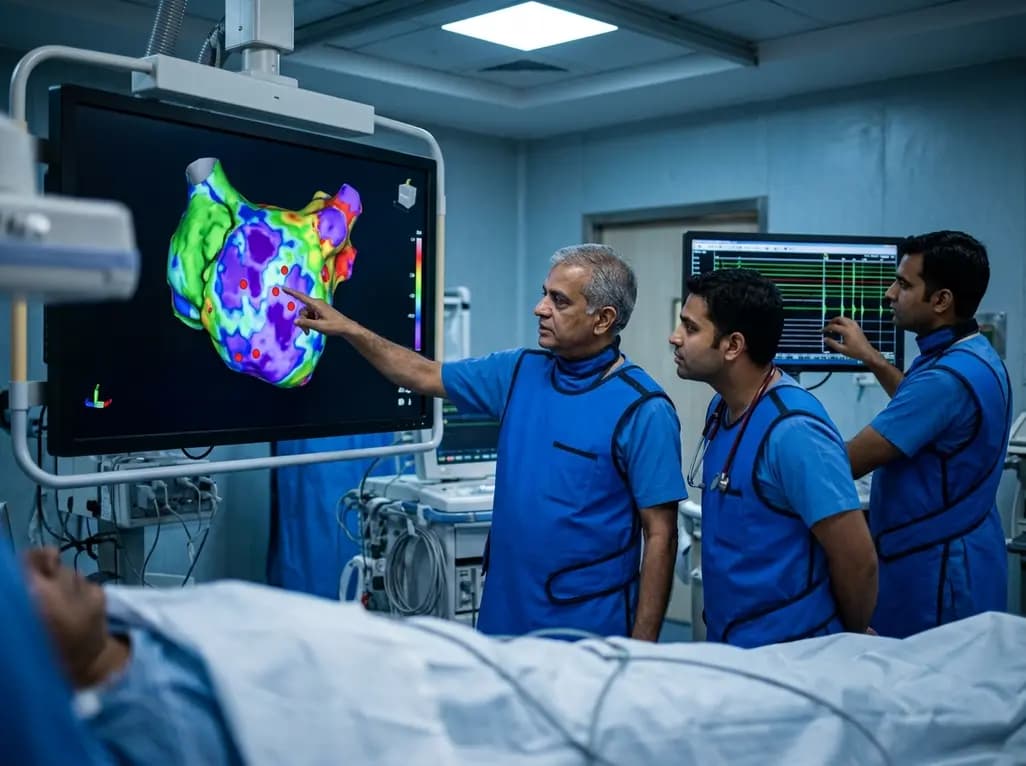
A study of 1,428 AF ablation patients reveals that over 60% of left atrial non-PV triggers arise within low-voltage areas, with anterior and roof triggers colocalizing entirely within fibrotic substrate. Identifying and ablating these sites is critical for long-term arrhythmia freedom.
Today

A comprehensive meta-analysis of over 278,000 women demonstrates that maternal atopic dermatitis significantly increases risks of premature rupture of membranes and low birth weight. Discover essential clinical insights on disease mechanisms, serial antenatal growth monitoring, and safe therapeutic interventions.
Today

A pioneering study highlights the first United States experience using the FARAPOINT focal pulsed-field ablation catheter for refractory ventricular tachycardia. The catheter achieved complete acute non-inducibility across tested patients without procedural complications, marking a milestone in ventricular ablation.
Today

A biomechanical study shows that augmenting thin fascia lata grafts with a reinforced polyester patch doubles ultimate tensile strength and stiffness, matching the performance of thick grafts for superior capsule reconstruction while reducing donor-site morbidity.
Today

A cross-sectional study reveals that elevated METS-IR is independently associated with higher myopia odds in adolescents, showing biological synergy with obesity and highlighting the need for metabolic screening in pediatric eye care.
Today
