

Loading, please wait...
Loading, please wait...

Cardiovascular disease represents the foremost driver of premature mortality across the globe, creating an urgent imperative for continuous physiological tracking. Traditional episodic evaluations in clinics capture only momentary snapshots of complex cardiac dynamics. Consequently, subtle arrhythmias, labile hypertension, and occult hemodynamic deteriorations frequently escape timely detection. Wearable e-textiles offer an unprecedented paradigm shift by embedding sophisticated medical sensors into everyday garments. These functional fabrics eliminate bulky wiring and rigid plastic casings, allowing seamless monitoring across ambulatory environments. By transforming conventional attire into continuous clinical monitors, this technology empowers clinicians to detect cardiovascular crises early and personalize therapeutic regimens effectively.
The functional performance of smart clothing depends entirely on innovative conductive materials that balance electrical performance with mechanical flexibility. Traditional metallic wires often fracture under repeated strain and cause substantial patient discomfort. Therefore, material scientists have engineered flexible metallic fibers, conductive polymers, and carbon nanomaterials that withstand continuous deformation. For instance, silver nanowires and carbon nanotube networks offer high electrical conductivity alongside remarkable elastic resilience. In addition, conducting polymers like PEDOT:PSS provide soft, compliant interfaces that adapt seamlessly to the microscopic contours of human skin. More recently, two-dimensional MXenes have gained prominence due to their hydrophilic nature and high conductivity. These ultrathin sheets form robust percolation networks on porous yarn surfaces. Furthermore, researchers apply protective chemical crosslinkers to shield these nanomaterials from atmospheric oxidation and moisture degradation. As a result, the treated electrodes exhibit low contact impedance and maintain high signal clarity during sweating. Clinicians can therefore anticipate durable sensors that capture precise signals without causing irritant contact dermatitis.
Translating laboratory nanomaterials into commercially viable medical garments requires robust, high-throughput manufacturing methodologies. Fortunately, industrial textile engineering provides mature platforms that adapt readily to conductive threads. Weaving and knitting represent the most practical techniques for embedding sensing yarns into standard textile matrices. For example, circular knitting machines insert conductive tracks into stretchable fabrics without altering their tactile softness. In contrast, automated embroidery allows engineers to stitch intricate circuit layouts and antenna geometries onto preformed garments with precise spatial orientation. Furthermore, screen printing and roll-to-roll inkjet deposition enable rapid patterning of conductive inks onto flexible substrates. Electrospinning also generates ultra-fine nanofibrous membranes that mimic the natural extracellular matrix, optimizing breathability and moisture vapor transmission. Consequently, these integrated fabrics maintain regular airflow, which prevents sweat accumulation beneath the monitoring leads. Standardized interconnection schemes now bridge soft fibrous circuits with miniaturized silicon chips, creating hybrid electronic assemblies. Therefore, scalable manufacturing bridges the historical gap between rigid electronic hardware and comfortable, compliant daily attire.
Modern cardiovascular e-textiles have advanced far beyond rudimentary pulse rate counting. Indeed, current multi-lead textile garments deliver continuous electrocardiography that approaches traditional clinical standards. Conformal dry electrodes consistently detect discrete P-waves, narrow or wide QRS complexes, and subtle ST-segment deviations. Accordingly, clinicians can detect paroxysmal atrial fibrillation, transient myocardial ischemia, and early ventricular ectopy in unmonitored home settings. Additionally, textile engineers integrate optical and piezoresistive sensors to record arterial pulse waves at superficial vascular sites. By tracking continuous pulse transit time and pulse wave velocity, these garments facilitate cuffless, calibration-free blood pressure estimation. Furthermore, impedance plethysmography channels embedded within sleeve fabrics monitor systemic vascular resistance and stroke volume variations. This multimodal hemodynamic profile provides invaluable insight into evolving congestive heart failure decompensation. As a result, cardiology teams receive early alerts regarding volume overload long before clinical dyspnea necessitates emergency hospitalization. Such continuous hemodynamic granularity fundamentally alters chronic cardiovascular disease management.
Despite extraordinary technical progress, widespread clinical adoption faces several engineering challenges. Motion artifacts remain the most formidable barrier during active physical movement. When patients ambulate or alter posture, microscopic shearing between textile electrodes and epidermis introduces severe baseline wander. Moreover, skin impedance fluctuates continuously as ambient temperature and sweat production vary throughout the day. To mitigate these disruptions, engineers implement localized compression structures that maintain uniform sensor contact pressure. Power autonomy represents another critical bottleneck for continuous ambulatory monitoring. Bulky lithium batteries compromise garment drape, add uncomfortable weight, and demand frequent recharging. Therefore, investigators are actively developing self-powered sensing systems that harvest biomechanical energy from body locomotion. Triboelectric nanogenerators and flexible thermoelectric harvesters convert human movement and thermal gradients into functional electrical energy. Additionally, ultra-low-power microcontrollers and optimized wireless telemetry drastically diminish overall system power draw. Consequently, next-generation smart garments operate for extended intervals without requiring intrusive, cumbersome battery packs.
The integration of advanced functional nanomaterials and on-chip artificial intelligence heralds a transformative phase for medical clothing. In particular, MXene-based electrodes deliver remarkable volumetric capacitance and rapid metallic charge transfer, setting a new benchmark for dry biopotential recording. These nanomaterials preserve stable skin-electrode contact even during vigorous physical exertion. Simultaneously, developers are embedding edge artificial intelligence directly into textile microprocessors. Rather than transmitting massive streams of raw physiological waveforms to remote servers, on-body neural networks process data locally in real time. For instance, lightweight machine learning algorithms classify complex cardiac arrhythmias and suppress ambient baseline noise instantly at the garment level. Furthermore, this localized processing approach safeguards sensitive patient telemetry and significantly minimizes wireless transmission power. Clinicians receive prioritized, actionable diagnostic summaries rather than overwhelming oceans of uncurated data. As these innovations mature, smart garments will evolve from passive monitoring tools into autonomous, predictive diagnostic partners.
For smart textiles to transform routine cardiological care, rigorous clinical validation must validate their diagnostic equivalence to standard medical equipment. Clinicians must verify that textile-derived metrics correlate accurately with gold-standard Holter monitors and clinical sphygmomanometers. Moreover, regulatory bodies require exhaustive biocompatibility evaluations to prevent adverse dermatological reactions during multi-week wear. Interoperability with hospital electronic health record platforms represents another vital prerequisite for widespread adoption. Doctors require clean, synthesized dashboards that integrate into existing outpatient workflows without inducing alert fatigue. In resource-constrained settings like rural India, these washable, reusable garments offer immense promise for extending specialized cardiac surveillance beyond metropolitan medical centers. Patients recovering from myocardial infarction or coronary revascularization can participate in comprehensive tele-rehabilitation programs from home. Furthermore, longitudinal data streams allow physicians to optimize antihypertensive and antiarrhythmic pharmacotherapy with unprecedented precision. Consequently, smart garments bridge the long-standing divide between intermittent hospital visits and continuous, preventive cardiovascular wellness.
Engineers protect delicate electronic fibers through specialized encapsulation layers and resilient polymer coatings. For instance, fluoropolymer barriers and thermoplastic polyurethane films shield conductive pathways against aggressive mechanical agitation and water ingress during laundering. Additionally, researchers synthesize robust metal-polymer composites that maintain stable electrical percolation networks despite repeated wetting. Consequently, properly treated garments preserve impedance thresholds and conductive pathways across dozens of standard domestic washing cycles without degrading diagnostic fidelity.
Recent clinical investigations confirm that modern textile dry electrodes deliver biopotential clarity comparable to standard silver-silver chloride gel systems. Specifically, advanced knitted metallic yarns and MXene coatings reduce contact impedance while contouring directly to uneven anatomical surfaces. Moreover, flexible conductive substrates eliminate skin irritation and signal degradation caused by gel drying over prolonged observation intervals. Therefore, these specialized garments successfully capture accurate P-waves, QRS complexes, and repolarization intervals during routine ambulatory monitoring protocols.
Textile systems counter dynamic baseline wander by pairing form-fitting elastomeric garments with localized contact pressure. In addition, developers position conformal sensors over low-displacement anatomical landmarks to diminish relative displacement between skin and fabric. Furthermore, on-body edge processors apply adaptive filtering algorithms that rapidly isolate cardiac biopotentials from mechanical noise. As a result, the integrated system preserves baseline stability and provides dependable physiological waveform morphology even while patients walk, exercise, or transition between postural states.
Disclaimer: This content is for informational and educational purposes only... Refer to the latest local and national guidelines for clinical practice.
References
Khan B et al. Wearable E-Textiles for Cardiovascular Monitoring: Materials, Devices, and Integrated Systems. Adv Sci (Weinh). 2026 Nov 04. doi: undefined. PMID: 42982737.
Turakhia MP, Desai M, Hedlin H, et al. Rationale and design of a large-scale, app-based study to identify cardiac arrhythmias using a smartwatch: The Apple Heart Study. Am Heart J. 2019;207:66–75.
Popa C, Popa V, et al. Applications of Smart Textiles for Ambulatory Electrocardiogram Monitoring: Scoping Review of the Literature. JMIR Cardio. 2026;10:e74261.

Read summarized clinical updates, watch expert medical content, and earn CME certifications right from your smartphone.
Open your smartphone camera to scan and install.





Wearable e-textiles transform cardiovascular monitoring by integrating flexible conductive sensors into everyday clothing. This advance enables continuous, non-invasive assessment of ECG, pulse waves, and hemodynamics, bridging the gap between hospital diagnostics and home healthcare.
Today

A preclinical study reveals that cinnamic acid counters D-galactose-induced premature ovarian failure in mice. By enhancing total antioxidant capacity and upregulating protective genes like Nrf2 and Foxo3a, cinnamic acid improved estrous cyclicity and follicular reserve, offering new insights into ovarian health.
Today
A study at the Abidjan Heart Institute evaluated hypertensive men with erectile dysfunction using penile pharmacologic Doppler ultrasound. Findings revealed that veno-occlusive dysfunction was the predominant vascular abnormality (55.9%), guiding tailored hemodynamic interventions.
Today

An 8-week functional restoration program provides sustained psychological benefits at six-month follow-up for workers' compensation patients. The multidisciplinary intervention significantly improved pain self-efficacy, reduced anxiety and depression, and progressively resolved chronic insomnia severity.
Today
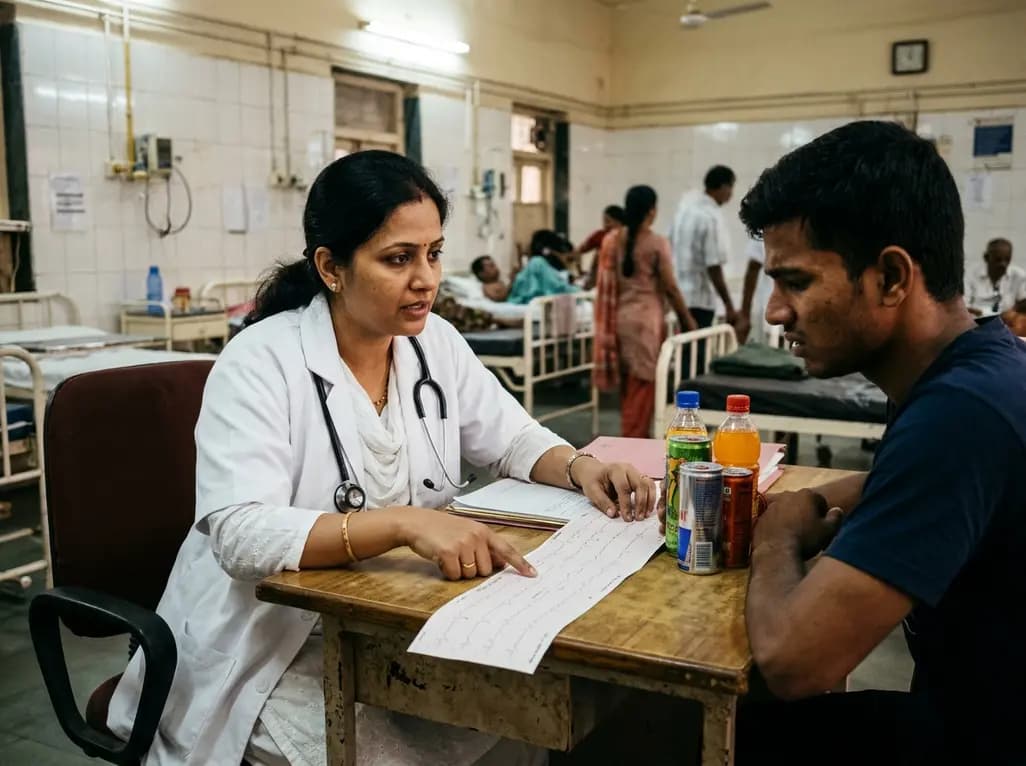
India's food safety authority is taking aggressive action against major beverage companies for marketing high-caffeine products as energy drinks. This clinical analysis examines the cardiovascular complications, metabolic risks, and pediatric concerns behind the regulator's push for truthful beverage standards.
Today
