

Loading, please wait...
Loading, please wait...

Maximal safe resection forms the cornerstone of modern neurosurgical oncology for diffuse gliomas. However, achieving an optimal balance between cytoreduction and functional preservation depends entirely on tumor eloquence assessment. When a neoplasm encroaches upon critical neural circuitry, neurosurgeons face complex dilemmas regarding resectability. A landmark international survey evaluated how practicing neurosurgeons interpret functional anatomy and navigate operative strategy.
Historically, neurosurgeons categorized brain areas as eloquent if their surgical disruption caused irreversible neurological deficits. Traditional paradigms focused heavily on speech centers and primary motor cortices. Nevertheless, modern connectomics demonstrates that functional networks span far beyond classic topographic boundaries. Consequently, subjective clinical judgment often replaces objective anatomical criteria during preoperative consultations.
The lack of a standardized lexicon creates significant treatment discrepancies across medical centers. For instance, two surgical teams evaluating identical MRI studies might recommend radically divergent interventions. One neurosurgeon may advise a conservative subtotal resection or open biopsy. Conversely, another expert may pursue aggressive gross total resection utilizing awake craniotomy. Therefore, establishing reproducible definitions represents a crucial imperative for global neurosurgical practice.
To address this clinical dilemma, an international survey engaged 157 neurosurgeons across 25 countries. The cohort represented specialized academic institutions and high-volume neuro-oncology programs. Remarkably, 68% of respondents strongly advocated for a standardized definition of eloquence. However, only 23% routinely incorporated validated eloquence grading scales into their daily clinical workflows.
Furthermore, participants reviewed 12 distinct clinical cases involving diffuse gliomas and glioblastomas. The investigators identified pronounced divergence across four pivotal surgical decision-making levels. First, surgeons disagreed on the baseline degree of eloquence. Second, their preferred surgical modality varied widely between biopsy, subtotal debulking, and supratotal excision. Third, clinicians demonstrated differing thresholds for deploying intraoperative monitoring. Fourth, substantial discordance existed regarding whether to perform awake mapping or asleep mapping under general anesthesia.
Surgeons showed consistent agreement regarding primary cortical landmarks, such as the precentral gyrus and speech cortices. However, deep subcortical white matter tracts triggered the highest degrees of controversy. Specifically, neurosurgeons exhibited extreme variability when evaluating the corona radiata, the uncinate fasciculus, and the superior longitudinal fasciculus.
This anatomical discrepancy has profound surgical implications. Subcortical white matter pathways maintain essential neurocognitive, linguistic, and executive networks. Injury to these subcortical corridors frequently causes permanent functional debilitation. Moreover, surgeons hold differing beliefs regarding neuroplastic compensation within deep association bundles. Because reliable non-invasive metrics are scarce, clinicians often interpret the risk profile of subcortical tumors through personal experience rather than uniform evidence.
The absence of clear nomenclature directly jeopardizes comparative oncology research. When investigators classify clinical trial cohorts without standardized criteria, eloquence confounding skews progression-free and overall survival data. Consequently, multicenter trials struggle to evaluate whether technological adjuncts truly improve surgical radicality.
Additionally, subjective terminology directly impacts patient counseling and operative expectations. If clinicians communicate divergent risks, patients cannot provide properly informed consent. Furthermore, surgeons who overestimate functional risk may perform unnecessarily restrictive resections. Conversely, underestimating anatomical eloquence exposes patients to debilitating post-operative deficits. Therefore, unifying tumor eloquence assessment metrics will protect patient autonomy while ensuring optimal functional and oncological balance.
To overcome current limitations, the neurosurgical community must develop objective, data-driven assessment frameworks. Advanced diffusion tensor imaging and resting-state functional MRI offer valuable non-invasive white matter mapping. Nevertheless, non-invasive imaging alone cannot replace dynamic functional testing. True eloquence is ultimately functional, not purely anatomical.
Accordingly, future diagnostic models must integrate machine learning algorithms trained on direct intraoperative stimulation data. By linking preoperative connectomic imaging directly to cortical stimulation results, researchers can construct probabilistic functional atlases. These refined platforms will empower neurosurgeons to calculate precise functional injury risks prior to skin incision. Ultimately, objective frameworks will standardize surgical indications, elevate international oncological trials, and protect neurological longevity.
An eloquent brain region refers to cortical or subcortical tissue controlling essential neurological functions such as language, motor control, or sensory processing. Surgical injury to these regions results in permanent, disabling neurological deficits. However, exact clinical criteria and tract boundaries remain inconsistent across global neurosurgical centers.
Awake craniotomy with direct cortical and subcortical stimulation provides real-time functional assessment of language, cognition, and motor pathways. This dynamic intraoperative feedback allows surgeons to maximize glioma resection margins while safely identifying and preserving functional boundaries that structural imaging modalities cannot reliably delineate.
Subcortical association tracts like the superior longitudinal fasciculus lack obvious visual landmarks under operative microscopes. Because neurosurgeons hold conflicting views regarding tract eloquence and neuroplasticity, surgical aggressive debulking versus preservation varies widely, significantly impacting both functional outcomes and oncological extent of resection.
Disclaimer: This content is for informational and educational purposes only and does not constitute medical advice, diagnosis, or treatment. Healthcare professionals must exercise their independent clinical judgment. Consult qualified healthcare providers for specific medical conditions. Refer to the latest local and national guidelines for clinical practice.
References
Rammeloo E et al. Preoperative assessment of tumor eloquence and resectability: an international survey. J Neurooncol. 2025 Oct. doi: 10.1007/s11060-025-05067-0. PMID: 40397319.
Rammeloo E, Schouten JW, Krikour K, et al. Preoperative assessment of eloquence in neurosurgery: a systematic review. J Neurooncol. 2024;166(2):223-238.
Duffau H. The error of eloquent areas: toward a connectomal neurosurgery. World Neurosurg. 2020;140:426-430.

Read summarized clinical updates, watch expert medical content, and earn CME certifications right from your smartphone.
Open your smartphone camera to scan and install.





An international survey reveals substantial disagreement among neurosurgeons regarding brain tumor eloquence and surgical decision-making, underscoring the urgent need for standardized, objective definitions in glioma resectability.
Today

A new study reveals that internalized HIV stigma directly impairs self-rated health by diminishing healthcare empowerment among people living with HIV. Clinicians must actively cultivate patient agency and self-advocacy to interrupt this negative psychosocial pathway and optimize long-term clinical outcomes.
Today

A qualitative study highlights the unaddressed emotional hurdles and role uncertainty faced by men during the transition to fatherhood, calling for father-inclusive perinatal care and tailored digital health support.
Yesterday

A patient-based simulation study reveals that conventional 10% bias in mean normal prothrombin time causes up to 19.2% clinical reclassification in warfarin therapy. Restricting bias to ±2.5% eliminates major INR discrepancies, urging diagnostic laboratories to tighten analytical verification thresholds.
Today
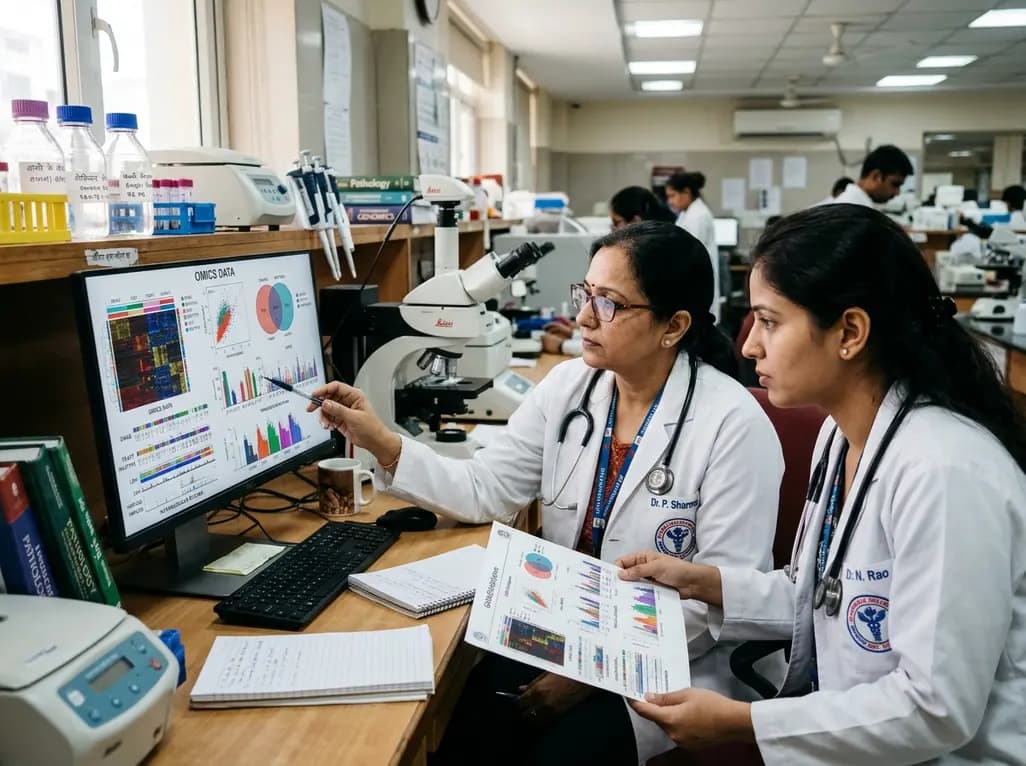
A multi-omic analysis reveals sporadic intramuscular myxoma comprises two molecularly distinct subtypes. GNAS-mutated lesions frequently carry TRAF7 mutations, whereas GNAS-wildtype tumors demonstrate striking genomic instability, loss of heterozygosity, and near-haploid features resembling DNHFN.
Today

Recent physiological findings demonstrate that myoglobin acts beyond oxygen transport, significantly regulating skeletal muscle glucose metabolism and mitochondrial bioenergetics. Understanding these intracellular metabolic shifts offers fresh insights into metabolic health and exercise physiology.
Today
