.webp&w=384&q=75)

Loading, please wait...
Loading, please wait...
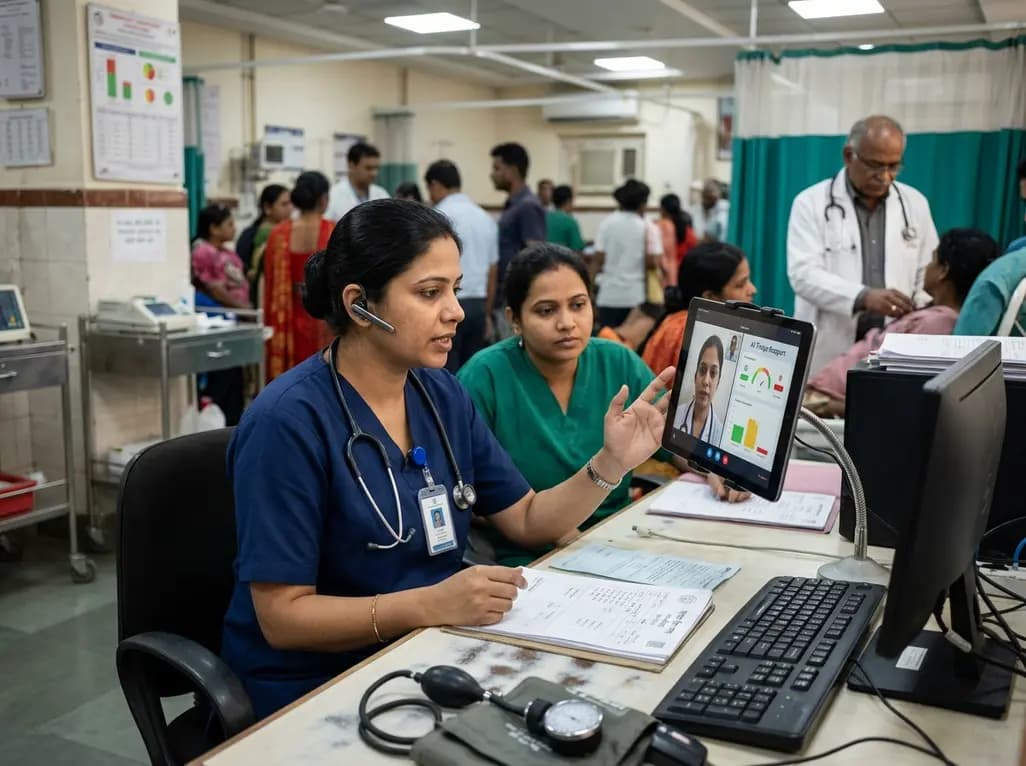
Emergency dispatch centers serve as the critical frontline of acute medical systems, managing millions of urgent calls each year. Historically, emergency dispatchers relied entirely on audio communication, which often obscured visual clinical nuances. Today, digital transformation is revolutionizing how dispatchers evaluate acute emergencies before an ambulance arrives. Emerging telecommunication tools and algorithmic systems now offer unprecedented clinical support. Specifically, modern prehospital triage protocols increasingly integrate real-time teleassistance and artificial intelligence to enhance diagnostic precision, optimize hospital bed utilization, and safeguard clinical outcomes.
Prehospital emergency medical services face increasing pressure from population aging, system overcrowding, and staffing shortages worldwide. In European dispatch centres, such as emergency services operating under 112 and 118, registered emergency nurses routinely conduct remote telephone assessments. These clinicians must rapidly determine patient acuity, dispatch appropriate mobile resources, and advise callers during terrifying crises. However, traditional voice-only conversations restrict the clinician's ability to observe subtle neurological deficits, respiratory patterns, or hemorrhagic wounds.
To address these limitations, modern health authorities are investing in teleassistance platforms and automated decision-support software. These technological solutions bridge the sensory gap inherent in conventional telephone triage. Furthermore, dispatch centres worldwide, including high-volume ambulance services across Asia and North America, confront similar operational bottlenecks. Implementing evidence-based remote triage protocols helps healthcare networks prioritize critically ill patients while redirecting stable callers toward community care. Consequently, prehospital triage is rapidly evolving from an isolated telephone interview into an interconnected, multi-modal clinical assessment hub.
Recent clinical investigations confirm that video-enabled teleassistance delivers substantial operational and clinical advantages. By introducing real-time live video streaming between callers and emergency nurses, dispatch operators obtain immediate visual verification of patient status. For instance, nurses can objectively evaluate skin perfusion, chest wall excursion, and gross neurological asymmetry within seconds. Therefore, clinicians no longer rely entirely on subjective, panic-induced descriptions from distressed bystanders.
Crucially, experimental studies demonstrate that video teleassistance significantly decreases inappropriate emergency department transfers. When nurses visually verify that a presentation is non-emergent, they safely coordinate outpatient referrals or local community resources instead of dispatching advanced life support units. In addition, video teleassistance markedly elevates professional confidence among dispatch nurses. Clinicians report greater reassurance when making high-stakes decisions remotely, knowing their visual appraisal aligns with clinical realities. As a result, emergency services experience enhanced resource conservation, preventing ambulance gridlock while simultaneously delivering prompt reassurance to families during stressful medical events.
Parallel to video communication, artificial intelligence systems are transforming emergency dispatch decision-making. Machine learning algorithms can parse electronic medical histories, analyze vital parameter trends, and synthesize caller statements in real time. Observational studies demonstrate that digital triage algorithms substantially improve triage consistency across diverse dispatch teams. Human dispatchers frequently experience fatigue and cognitive biases during peak call volumes; conversely, algorithmic models apply standardized risk stratification criteria uniformly to every encounter.
Moreover, artificial intelligence models accelerate decision timeliness. Predictive analytics can detect subtle linguistic markers or vocal acoustic properties that signal impending cardiovascular collapse or catastrophic respiratory failure. By highlighting high-risk patterns early, algorithmic systems enable nurses to dispatch resuscitation teams several minutes faster than conventional protocols allow. Nevertheless, clinical evidence emphasizes that artificial intelligence must remain a supportive tool rather than an autonomous decision-maker. Machine learning software augments nursing expertise, allowing clinicians to focus their cognitive attention on delicate communicative nuances, therapeutic de-escalation, and complex diagnostic synthesis.
Despite technological innovations, remote triage remains an inherently demanding cognitive task for emergency nurses. Qualitative research reveals that telephone and digital triage requires sophisticated mental modeling under extreme temporal constraints. Emergency dispatchers must continuously process ambiguous information, interpret heightened caller emotions, and filter distracting ambient background noise. Furthermore, clinicians must constantly anticipate rapid physiological deterioration while simultaneously guiding callers through critical first-aid maneuvers.
Introducing artificial intelligence and live video feeds can alleviate some diagnostic uncertainty, but technology also introduces distinct cognitive burdens. Dispatch nurses must manage complex split-screen interfaces, verify data integrity, and resolve discrepancies between algorithmic predictions and direct caller observations. If software systems generate excessive false alarms or confusing prompts, alert fatigue can quickly overwhelm staff. Therefore, healthcare leaders must recognize that technological tools do not automatically simplify clinical practice. Instead, successful implementation requires an acute understanding of human factors engineering, dispatch ergonomics, and workflow streamlining to prevent cognitive overload among frontline triage nurses.
The successful integration of teleassistance and artificial intelligence into prehospital triage demands robust clinical governance and standardized training. Healthcare administrators cannot deploy sophisticated algorithms without establishing transparent validation benchmarks and rigorous data privacy protections. Because prehospital algorithms process sensitive medical disclosures under urgent circumstances, data encryption and regulatory compliance remain paramount. Additionally, emergency dispatch networks must institute continuous quality improvement audits to monitor diagnostic accuracy and prevent systemic algorithmic bias.
Furthermore, structured professional education represents an indispensable pillar of digital triage transformation. Dispatch nurses require targeted simulation training to navigate video communication barriers and effectively challenge inconsistent artificial intelligence recommendations. Clinicians must maintain sharp critical thinking skills to prevent over-reliance on automated tools. Finally, academic healthcare institutions must conduct prospective, nurse-led clinical trials to evaluate patient-centred outcomes, cost-effectiveness, and long-term safety. By pairing cutting-edge computational tools with rigorous human oversight and specialized education, emergency medical systems can establish resilient, responsive, and equitable prehospital care pathways for all communities.
Video teleassistance allows emergency nurses to directly visualize the patient, evaluate respiratory effort, inspect cutaneous signs, and appraise the immediate surroundings in real time. Consequently, this direct visual confirmation replaces uncertain caller narratives with actionable clinical data. Emergency dispatchers can therefore differentiate minor ailments from acute life threats more accurately. As a result, nurses safely redirect low-acuity cases to community primary care centres, which significantly reduces avoidable ambulance dispatches and hospital emergency transfers.
No, artificial intelligence cannot replace human clinical judgment in emergency settings. Although machine learning algorithms rapidly process vast physiological inputs and predict patient deterioration, they lack situational awareness and contextual empathy. Furthermore, remote callers often provide incomplete or emotional descriptions that algorithms cannot reliably decode alone. Therefore, expert consensus designates artificial intelligence as an assistive augmentative tool. Licensed emergency nurses must retain ultimate supervisory authority over all dispatch priorities, destination selections, and final clinical decisions.
Healthcare systems deploying digital triage solutions must establish comprehensive clinical governance frameworks to ensure patient safety. First, leaders must implement rigorous algorithm validation protocols using diverse demographic datasets to avoid demographic bias. Additionally, emergency dispatch services must establish clear medicolegal liability guidelines and continuous data auditing mechanisms. Finally, dispatch networks should deliver standardized simulation training programs, ensuring that emergency nursing personnel develop robust technical competency while maintaining disciplined human oversight across all high-stakes emergency dispatch encounters.
Disclaimer: This content is for informational and educational purposes only and does not constitute medical advice or establish a doctor-patient relationship. Qualified healthcare professionals must exercise independent clinical judgement when evaluating and treating patients. While every effort has been made to verify accuracy, clinical practices and guidelines evolve rapidly. Refer to the latest local and national guidelines for clinical practice.
References

Read summarized clinical updates, watch expert medical content, and earn CME certifications right from your smartphone.
Open your smartphone camera to scan and install.





A comprehensive scoping review reveals how video teleassistance and artificial intelligence empower emergency nurses during prehospital triage. These digital tools improve triage consistency, accelerate clinical decisions, reduce unnecessary transfers, and highlight the necessity of structured governance.
Today

Transcatheter edge-to-edge repair (TEER) successfully treated severe mitral regurgitation from a posterior leaflet perforation. Guided by 3D multiplanar reconstruction, operators sandwiched the defect using two MitraClip devices, providing safe hemodynamic recovery without requiring open-heart surgery.
Today

A 32-year-old gravida at 38 weeks with anterior STEMI underwent emergent IVUS-guided PCI and successful cesarean delivery under uninterrupted DAPT, highlighting cardio-obstetric care.
Today

A systematic review and meta-analysis of 5,406 participants reveals that tirzepatide significantly reduces hsCRP by 34.3%, improves cardiorenal biomarkers, and enhances functional capacity and exercise endurance in patients with heart failure.
Today

A landmark biomechanical study demonstrates that sports bra support and running shoe cushioning interact significantly to influence tibial acceleration, breast motion, and comfort in female runners, providing crucial insights for clinical counseling in sports medicine and women's health.
Yesterday

New ADIPO-CKD study findings demonstrate that both GLP-1 receptor agonists and SGLT2 inhibitors significantly reduce perirenal adipose tissue thickness in chronic kidney disease patients, with GLP-1 therapy achieving greater reductions, highlighting a novel mechanism for cardiorenal metabolic protection.
Today
