.webp&w=384&q=75)

Loading, please wait...
Loading, please wait...
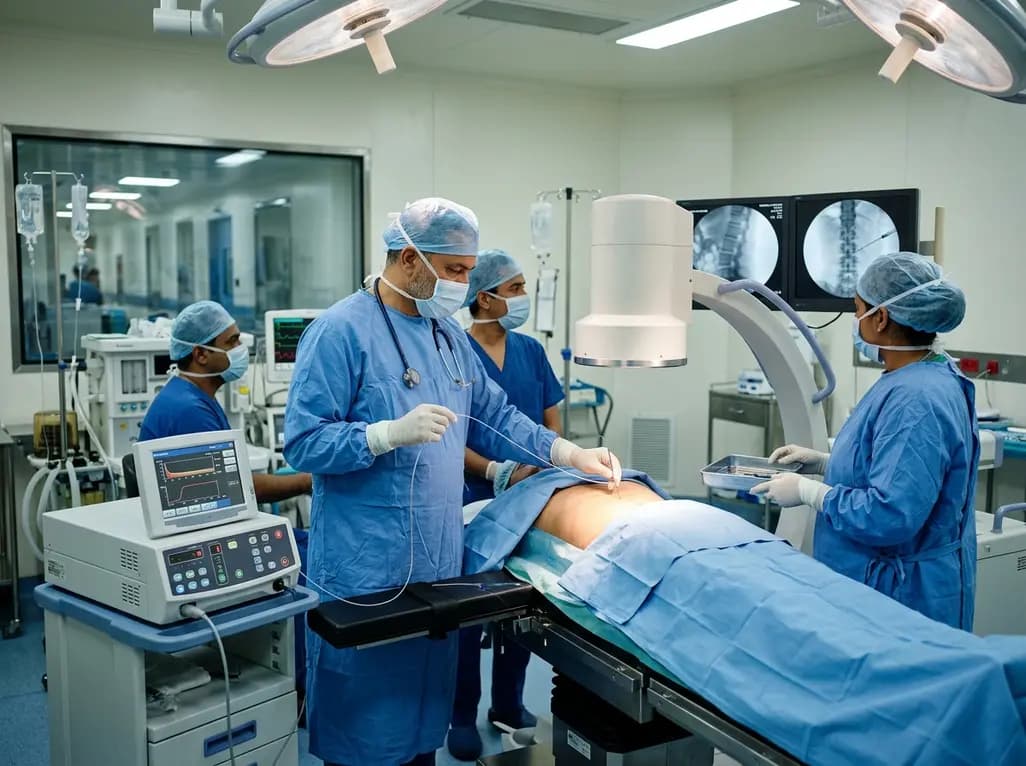
Chordomas are rare, low-to-intermediate grade malignant neoplasms derived from embryonic notochord remnants. Although histologically slow-growing, they display locally aggressive bone invasion and high recurrence rates. Standard frontline therapy demands en bloc resection with wide surgical margins followed by high-dose radiation therapy. However, once local recurrence develops or metastatic lesions emerge along the neuraxis, definitive salvage options become remarkably scarce. Traditional revision surgeries carry severe morbidity, extended hospitalizations, and elevated neurological risks. Consequently, spine oncology specialists are exploring minimally invasive alternatives. Modern advancements now position spinal laser interstitial thermal therapy as a feasible and tissue-sparing modality for challenging spinal chordoma lesions.
Spinal chordomas present formidable anatomical and biological management hurdles. Their proximity to the spinal cord, nerve roots, and major vascular structures frequently precludes repeat radical surgery. Furthermore, prior heavy irradiation often restricts additional conventional radiation due to the limited tolerance of adjacent neural tissues. In this context, spinal laser interstitial thermal therapy provides a targeted thermal cytoreductive option under real-time magnetic resonance guidance. The procedure utilizes stereotactically inserted optical fibers to deliver laser energy directly into the neoplastic tissue. As the tissue absorbs light energy, localized hyperthermia causes coagulative necrosis while real-time MR thermal imaging continuously monitors surrounding vital structures. Therefore, this ablative approach creates a biological separation between the tumor and the spinal cord without requiring extensive open dissection. Consequently, clinicians can achieve cytoreduction and establish safe margins for adjuvant radiosurgery.
A recent institutional study reported the largest clinical experience to date examining spinal laser interstitial thermal therapy for chordoma. The series evaluated four patients who underwent five distinct procedures targeting metastatic and primary lesions across sacral, clival, cervical, and thoracic locations. Specifically, four procedures served as salvage therapies after recurrence, whereas one procedure served as a primary intervention to bypass open surgical morbidity. Patients maintained an excellent baseline functional status, with Karnofsky Performance Scale scores between 90 and 100 before intervention. During the procedures, surgeons utilized a median of four laser fibers and delivered 16 individual ablations per session at power settings between 12 and 15 Watts. The median procedural duration was 352.5 minutes, reflecting the meticulous stereotactic positioning required for precise coverage. Importantly, real-time MR thermometry prevented thermal injury to critical adjacent neural elements throughout every ablation run.
Oncologic assessments demonstrated consistent tumor debulking following the ablation procedures. All patients exhibited measurable volumetric tumor reduction on their earliest postoperative magnetic resonance imaging, which occurred at a median of 4.2 months. Overall, the mean volumetric tumor reduction reached 25.7%, demonstrating effective cytoreduction across diverse spinal segments. Moreover, over a median radiographic follow-up period of 16.8 months, no patient exhibited tumor progression at the ablated sites. Furthermore, none of the treated locations required additional open surgical re-intervention or emergent decompression during follow-up. The median overall survival following the thermal ablation procedure reached 23.0 months. These findings suggest that precise thermal coagulation halts aggressive local growth and provides durable local disease stability in heavily pretreated spine oncology patients.
Minimally invasive spinal ablation demonstrates notable advantages regarding perioperative safety and patient recovery trajectories. In the reported cohort, patients experienced an uncomplicated postoperative course with a median hospital length of stay of only two days. This rapid discharge contrasts sharply with the prolonged recovery and wound complications frequently associated with open spinal revision surgery. Additionally, perioperative neurological morbidity remained remarkably low throughout the series. Only one procedure resulted in a transient radiculopathy, which completely resolved following a short course of oral corticosteroid therapy. No permanent motor deficits, cerebrospinal fluid leaks, wound infections, or thermal injuries to the thecal sac occurred. Therefore, the minimal invasiveness of this approach preserves functional independence and permits swift resumption of normal daily activities.
A comprehensive review of the existing medical literature identified four previous case reports detailing laser ablation for chordoma. Three of those historical reports documented complete thermal ablation accompanied by favorable radiographic responses. In the current series, multidisciplinary teams combined thermal ablation with postoperative stereotactic radiosurgery in four out of five procedures. Because stereotactic radiosurgery followed thermal ablation in most patients, researchers cannot isolate the independent therapeutic contribution of thermal ablation alone. Instead, thermal ablation serves as a biological alternative to mechanical separation surgery by vaporizing epidural tumor burden and creating a thermal safety margin around neural structures. Consequently, radiation oncologists can safely deliver curative or ablative radiation doses without exceeding the spinal cord maximum tolerance limits.
The emerging evidence positions laser ablation as an adaptable tool within modern spine oncology paradigms. Because chordoma represents an intrinsically radioresistant histology, achieving high-dose delivery remains paramount for long-term tumor control. Spinal thermal ablation directly debulks the lesion, reduces intratumoral interstitial pressure, and establishes the required margin away from neural tissue. Furthermore, this technique allows patients to restart adjuvant systemic therapies or radiotherapy within days rather than weeks. Future multicenter registries and prospective clinical trials must evaluate long-term progression-free survival and health-related quality of life. In summary, spinal laser interstitial thermal therapy provides a valuable, tissue-preserving salvage strategy for patients facing complex spinal chordoma recurrences.
Spinal laser interstitial thermal therapy serves primarily as a minimally invasive salvage strategy for recurrent or metastatic chordomas. It creates precise thermal coagulative necrosis within the tumor, debulking epidural disease and establishing a safe distance between the lesion and adjacent neural structures before subsequent stereotactic radiosurgery.
Spinal laser interstitial thermal therapy drastically reduces surgical trauma and recovery duration compared to open revision surgery. Patients experience minimal blood loss and avoid large incisions. Consequently, the median hospital stay is approximately two days, enabling patients to resume systemic oncologic therapy or radiotherapy much faster.
No, laser ablation does not entirely replace stereotactic radiosurgery for chordomas. Instead, clinicians utilize thermal ablation as a cytoreductive and separation tool. The procedure debulks the radioresistant tumor margin away from the spinal cord, thereby enabling radiation oncologists to deliver high-dose radiosurgery safely without exceeding cord tolerances.
Disclaimer: This content is for informational and educational purposes only. It is not intended to provide medical advice, diagnosis, or treatment. Healthcare professionals should exercise independent clinical judgment. Refer to the latest local and national guidelines for clinical practice.
References

Read summarized clinical updates, watch expert medical content, and earn CME certifications right from your smartphone.
Open your smartphone camera to scan and install.





Explore the largest clinical series evaluating spinal laser interstitial thermal therapy (sLITT) for spinal chordoma, highlighting volumetric tumor reduction, procedural safety, and multidisciplinary salvage strategies in complex spine oncology.
4 weeks back
A nationwide English cohort study shows that interstitial lung diseases are no longer rare, with incidence jumping 30% and 200,000 active cases. This analysis highlights clinical implications for diagnosis, multi-disciplinary management, and global health priorities across respiratory and internal medicine.
Today

A nationwide South Korean study shows underreporting of smoking among women dropped from 57.4% to 36.4% between 2008 and 2021. However, over one-third of female smokers still conceal their habit, highlighting the critical role of cotinine verification in clinical risk assessment.
Today

PepsiCo and Monster Beverage have challenged the FSSAI ban on the energy drink label in Indian courts. While companies highlight supply disruptions, regulatory actions spotlight severe cardiovascular and metabolic risks associated with excessive caffeine, sugar, and taurine consumption, especially in adolescents.
Today
A new study evaluates the rheological stability of decellularized peripheral nerve matrix hydrogels under varied storage conditions. Findings show -80°C storage and freeze-drying preserve gelation kinetics and mechanical stiffness, offering key insights for shipping and translational clinical applications.
Today

A qualitative meta-synthesis highlights the complex interplay between gender dysphoria, minority stress, and eating disorders in transgender and gender-diverse individuals. Clinicians must recognize these distinct drivers to offer supportive, gender-affirming, and interdisciplinary eating disorder care.
Today
