.webp&w=384&q=75)

Loading, please wait...
Loading, please wait...
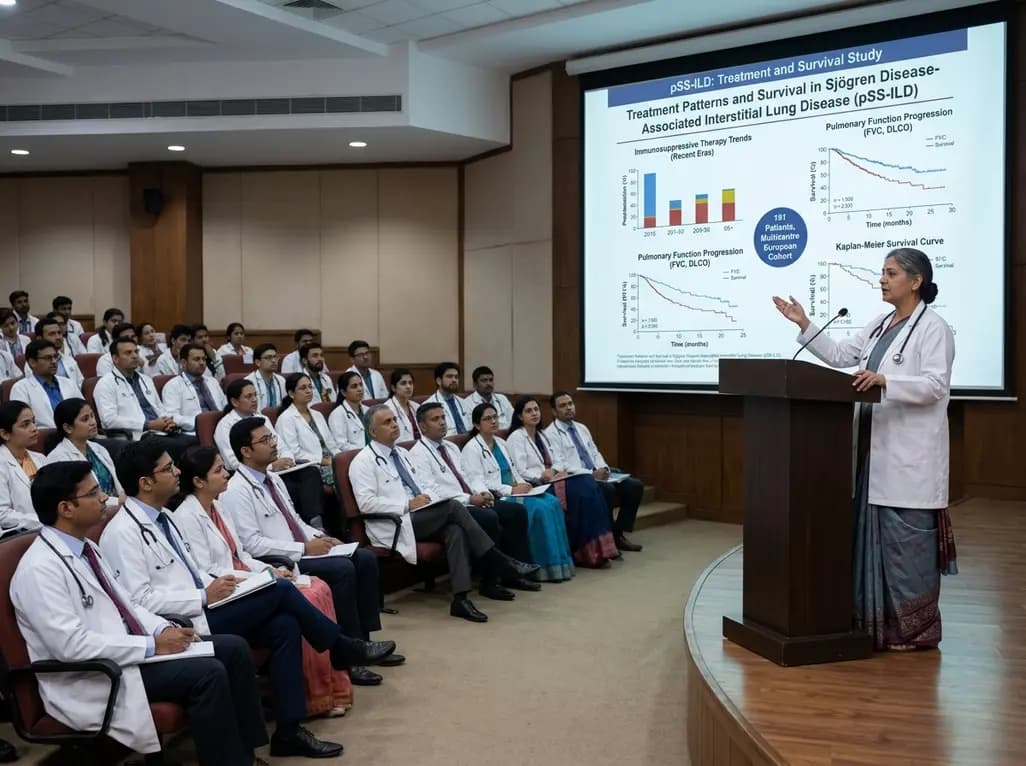
Primary Sjögren disease is a chronic systemic autoimmune disorder that frequently extends beyond exocrine glands. Interstitial lung disease represents one of its most severe systemic manifestations, significantly increasing patient morbidity and mortality. Managing Sjögren disease interstitial lung disease remains clinically challenging because evidence-based guidelines are limited, leaving therapeutic choices largely empirical. To address this knowledge gap, a major multicentre European cohort study evaluated long-term treatment patterns, disease progression, and survival outcomes. Understanding these findings helps clinicians refine treatment strategies and optimize pulmonary monitoring.
Interstitial lung involvement affects a significant proportion of individuals diagnosed with primary Sjögren disease. Pulmonary manifestations vary widely, ranging from asymptomatic radiological abnormalities to rapidly progressive subacute dyspnoea and end-stage fibrotic lung failure. High-resolution computed tomography serves as the primary diagnostic modality to identify specific radiological patterns. The most common patterns include non-specific interstitial pneumonia, usual interstitial pneumonia, and lymphoid interstitial pneumonia. However, distinguishing inflammatory phenotypes from irreversible fibrotic changes remains crucial for therapeutic decision-making. Historically, clinicians managed pulmonary involvement using off-label immunosuppressive agents borrowed from systemic sclerosis or rheumatoid arthritis protocols. Because formal randomized controlled trials are lacking, observational real-world evidence offers indispensable insights into long-term disease trajectories. Furthermore, multidisciplinary collaboration between rheumatologists and pulmonologists is essential to establish early diagnosis. Timely baseline assessment allows physicians to detect subtle pulmonary changes before severe functional impairment occurs. Consequently, understanding clinical phenotypes enables targeted intervention and prevents irreversible parenchymal damage.
This multicentre observational study examined a real-world cohort across three European tertiary referral centres located in Oslo, Zurich, and Vienna. Researchers evaluated patients diagnosed between 1997 and 2025 who fulfilled the official 2016 ACR/EULAR classification criteria for Sjögren disease. Additionally, high-resolution computed tomography confirmed interstitial lung involvement in all included individuals. The investigators analyzed demographic characteristics, pulmonary function parameters, and therapeutic patterns across four distinct calendar periods. Among the 191 included patients, the mean age at diagnosis was 59.9 years, and 81 percent were female. To evaluate secular trends in clinical practice, the authors categorized observations into four temporal eras: before 2006, 2007 to 2011, 2012 to 2016, and 2017 onwards. Longitudinal changes in forced vital capacity and five-year overall survival served as primary clinical endpoints. Moreover, patient research partners with lived experience actively participated in study design and implementation. This collaborative methodology ensured that outcome measures reflected meaningful patient-centered priorities alongside objective physiological data.
Over the multi-decade observation period, therapeutic strategies for Sjögren disease interstitial lung disease shifted substantially toward earlier and more intensive immunosuppression. Overall, 63.9 percent of patients received immunosuppressive therapy during their disease course. Crucially, treatment rates rose significantly from 52.4 percent before 2006 to 71.3 percent after 2017. Glucocorticoids represented the most frequently prescribed systemic agent, administered to 42.4 percent of the total cohort. Meanwhile, targeted biological therapy with rituximab emerged as a prominent intervention, utilized in 25.1 percent of patients. Traditional oral antimetabolites also maintained a major role in disease management. Azathioprine was prescribed in 17.3 percent of cases, whereas mycophenolate mofetil was administered to 16.8 percent of patients. Therefore, clinical practice increasingly shifted from corticosteroid monotherapy toward steroid-sparing combination regimens. Furthermore, logistic regression analysis revealed that severe dyspnoea and reduced baseline forced vital capacity strongly predicted treatment initiation. Clinicians progressively adopted aggressive interventions to stabilize lung function and prevent cumulative pulmonary fibrosis.
Tracking pulmonary function trajectories provides critical objective evidence regarding treatment efficacy and disease behavior. The study monitored longitudinal changes in forced vital capacity over 12 and 24 months. Disease progression was defined as an absolute drop in forced vital capacity of 5 percent or 10 percent from baseline. Conversely, therapeutic response or functional improvement required an equivalent percentage increase over time. Despite immunosuppressive treatment, a substantial subset of patients experienced progressive pulmonary decline. Fibrotic radiologic patterns and baseline low diffusion capacity predicted higher risk of progression. However, patients receiving timely immunosuppressive therapy showed stabilized or improved vital capacity compared to historical controls. Consequently, regular spirometric testing remains indispensable for identifying disease acceleration early. Serial pulmonary function testing every six to twelve months allows clinicians to detect declining functional reserves before severe dyspnoea manifests. Ultimately, monitoring these trajectories enables proactive regimen adjustment rather than reactive salvage therapy.
Identifying clinical predictors of progression and long-term mortality is paramount for risk stratification. The study evaluated five-year all-cause mortality across calendar cohorts and correlated outcomes with clinical variables. Multivariate regression confirmed that severe baseline dyspnoea, reduced forced vital capacity, and extensive radiological involvement significantly increased treatment probability and mortality risk. Patients presenting with dyspnoea had a threefold higher likelihood of receiving intensive immunosuppression. Although overall survival improved in recent calendar eras, interstitial lung disease remains a primary driver of excess mortality in primary Sjögren disease. Therefore, clinicians must maintain high clinical suspicion for pulmonary involvement in every Sjögren patient. Routine screening with high-resolution computed tomography and pulmonary function testing is crucial at initial presentation. Furthermore, incorporating patient-reported outcomes enhances functional monitoring. As therapeutic options expand to include antifibrotic agents, early identification of progressive phenotypes will optimize long-term clinical outcomes.
Interstitial lung disease occurs in approximately 10 to 20 percent of patients diagnosed with primary Sjögren disease. It represents one of the most serious extra-glandular manifestations, substantially increasing morbidity and mortality. Pulmonary involvement can develop early in the disease course or arise years after systemic diagnosis, making routine clinical screening and long-term pulmonary evaluation essential for all affected patients.
Systemic glucocorticoids remain the primary acute intervention for inflammatory pulmonary exacerbations. However, long-term disease management increasingly relies on steroid-sparing immunosuppressive agents to reduce cumulative toxicity. Commonly prescribed medications include mycophenolate mofetil, azathioprine, and the anti-CD20 monoclonal antibody rituximab. Treatment selection depends on disease severity, radiological subtype, rate of functional decline, and comorbid extra-glandular involvement.
Clinicians should monitor patients using serial pulmonary function tests, specifically forced vital capacity and diffusing capacity for carbon monoxide, every six to twelve months. High-resolution computed tomography provides detailed structural information and should be repeated during clinical deterioration. Additionally, evaluating dyspnoea scores and patient-reported outcomes helps clinicians identify functional decline early and adjust immunosuppressive regimens promptly.
Disclaimer: This content is for informational and educational purposes only, and does not constitute medical advice, diagnosis, or treatment. Healthcare professionals should rely on their clinical judgment and refer to the latest local and national guidelines for clinical practice.
References

Read summarized clinical updates, watch expert medical content, and earn CME certifications right from your smartphone.
Open your smartphone camera to scan and install.





A multicentre European cohort study evaluates real-world treatment patterns, pulmonary function progression, and survival outcomes in 191 patients with Sjögren disease-associated interstitial lung disease across four calendar eras, highlighting increased immunosuppressive therapy adoption in recent years.
last month

A pioneering study highlights the first United States experience using the FARAPOINT focal pulsed-field ablation catheter for refractory ventricular tachycardia. The catheter achieved complete acute non-inducibility across tested patients without procedural complications, marking a milestone in ventricular ablation.
Today

A comprehensive meta-analysis of over 278,000 women demonstrates that maternal atopic dermatitis significantly increases risks of premature rupture of membranes and low birth weight. Discover essential clinical insights on disease mechanisms, serial antenatal growth monitoring, and safe therapeutic interventions.
Today

Managing destructive Citrobacter koseri endocarditis with aortocavitary fistula requires meticulous antiplatelet bridging, extensive debridement, and complex redo aortic root and RVOT reconstruction.
Today

A biomechanical study shows that augmenting thin fascia lata grafts with a reinforced polyester patch doubles ultimate tensile strength and stiffness, matching the performance of thick grafts for superior capsule reconstruction while reducing donor-site morbidity.
Today

A cross-sectional study reveals that elevated METS-IR is independently associated with higher myopia odds in adolescents, showing biological synergy with obesity and highlighting the need for metabolic screening in pediatric eye care.
Today
