.webp&w=384&q=75)

Loading, please wait...
Loading, please wait...
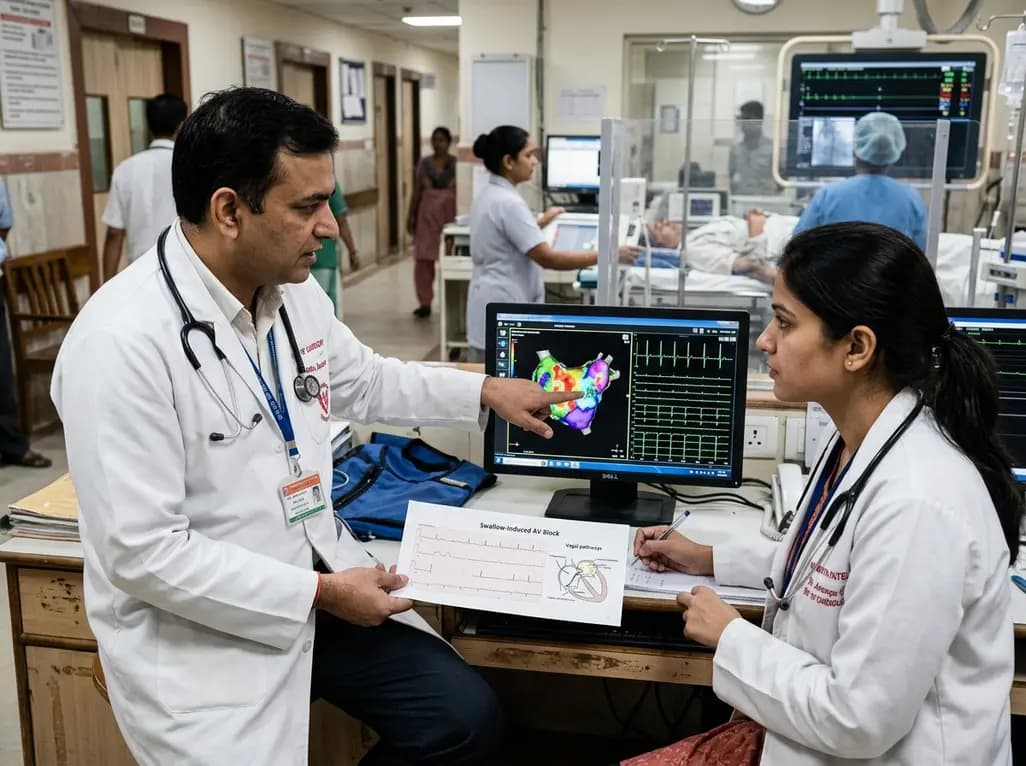
Swallow-induced atrioventricular block represents an uncommon yet debilitating form of functional, vagally mediated reflex bradyarrhythmia. Clinicians historically relied on conservative dietary modifications or permanent pacemaker implantation to manage recurrent syncopal episodes. However, recent electrophysiological advancements highlight selective cardioneuroablation as an effective catheter-based intervention that addresses the underlying neurocardiac reflex pathway.
Deglutition-induced bradyarrhythmia occurs when esophageal sensory receptors trigger an exaggerated vagal reflex arc during food transit. Specifically, mechanical stimulation of the esophagus transmits afferent signals via the vagus nerve to the brainstem. Consequently, efferent parasympathetic impulses travel back to the intrinsic cardiac autonomic nervous system. This surge in acetylcholine release suppresses sinoatrial automaticity and atrioventricular conduction.
In most patients, this neurocardiac disturbance manifests as transient high-grade atrioventricular block or severe sinus pauses during meals. Furthermore, structural heart disease is typically absent in these individuals. Because the conduction tissue remains structurally intact, conventional cardiac pacing may expose patients to long-term lead-related complications. Therefore, targeted autonomic modulation has emerged as an attractive alternative to restore physiological cardiac electrical conduction.
Patients with deglutition syncope frequently present with recurring presyncope, dizziness, or sudden loss of consciousness while eating or drinking. Therefore, establishing a precise diagnosis requires meticulous history taking and directed provocative testing. Electrophysiologists routinely perform swallowing provocation tests under continuous electrogram monitoring to demonstrate reproducible conduction delays.
During electrophysiology studies, swallowing typically induces infra-atrial conduction delay localized specifically at the atrioventricular node. Intravenous atropine administration promptly eliminates this induced block, which confirms a vagally mediated reflex mechanism. Moreover, comprehensive autonomic assessments, including head-up tilt testing, help differentiate deglutition syncope from generalized neurocardiogenic syncope. Thus, documenting atropine responsiveness remains an essential prerequisite before clinicians schedule catheter-based autonomic modification.
Catheter-based neurocardiac denervation targets the major epicardial ganglionated plexi that harbor postganglionic parasympathetic neurons. Electrophysiologists employ a hybrid technique combining anatomical mapping and high-frequency electrical stimulation. First, high-density three-dimensional electroanatomical mapping identifies fractionated atrial potentials across the right and left atria. Next, high-frequency stimulation pinpoints specific neurocardiac sites that evoke marked bradycardia or transient asystole.
Radiofrequency energy is subsequently delivered to these confirmed neurovegetative sites until high-frequency stimulation no longer evokes a cardioinhibitory response. In addition, operators target anatomically predefined regions, including the right anterior and superior ganglionated plexi. By combining physiological endpoints with precise spatial guidance, operators achieve robust autonomic modification while minimizing unnecessary myocardial tissue destruction.
The intrinsic cardiac nervous system consists of interconnected neural networks that independently modulate regional cardiac conduction. Crucially, parasympathetic innervation to the atrioventricular node predominantly traverses the posteromedial left ganglionated plexus and the inferior right atrial ganglionated plexus. Therefore, selective ablation focused around the coronary sinus ostium and the inferior interatrial septum specifically blunts atrioventricular nodal parasympathetic input.
This localized strategy spares the superior ganglionated plexi responsible for sinoatrial node innervation. As a result, patients avoid post-procedural inappropriate sinus tachycardia, which frequently complicates non-selective extensive cardioneuroablation. Furthermore, post-ablation electrophysiological re-evaluation demonstrates shortening of the baseline AH interval and an increase in the Wenckebach cycle length. Consequently, selective cardioneuroablation preserves normal sinus chronotropism while preventing transient high-grade nodal conduction failure.
Permanent pacemaker implantation has traditionally served as the definitive remedy for refractory reflex atrioventricular block. Nevertheless, active patients face substantial lifelong risks from transvenous pacing systems, including lead dislodgement, vascular occlusion, and systemic infections. In contrast, cardioneuroablation eliminates the root neural trigger without leaving permanent intracardiac hardware. Post-procedure surveillance confirms sustained protection against meal-triggered presyncope and syncope.
Additionally, patient-reported quality of life improves markedly once mealtime restrictions are lifted. While long-term parasympathetic reinnervation remains a theoretical concern, clinical registry data indicate excellent medium-to-long-term freedom from recurrent bradyarrhythmia. Thus, in carefully evaluated patients exhibiting robust vagal reactivity, autonomic catheter ablation presents a superior, physiology-preserving therapeutic pathway.
The procedure uses radiofrequency catheter ablation to disrupt hyperactive parasympathetic postganglionic pathways situated within cardiac ganglionated plexi. Consequently, mechanical esophageal swallowing triggers can no longer discharge excessive acetylcholine onto atrioventricular nodal tissue. This denervation abolishes the reflex cardioinhibitory response, thereby preventing symptomatic meal-induced heart block and subsequent fainting.
Electrophysiologists specifically ablate the posteromedial left ganglionated plexus and the inferior right atrial ganglionated plexus near the coronary sinus ostium. These anatomical clusters supply the primary parasympathetic fibers to the atrioventricular node. Targeting these specific zones denervates the conduction node without disrupting sinoatrial chronotropic control.
Physicians should consider catheter ablation in symptomatic patients who lack structural heart disease and demonstrate reproducible, atropine-sensitive vagal heart block. The technique is especially advantageous for active or younger individuals who wish to avoid lifetime risks associated with transvenous pacing leads, generator replacements, and device-related infections.
Disclaimer: This content is for informational and educational purposes only and does not constitute formal medical advice, diagnosis, or treatment recommendations. Refer to the latest local and national guidelines for clinical practice.
References

Read summarized clinical updates, watch expert medical content, and earn CME certifications right from your smartphone.
Open your smartphone camera to scan and install.





Swallow-induced atrioventricular block is a rare, vagally mediated bradyarrhythmia. Selective cardioneuroablation targeting parasympathetic ganglionated plexi offers an effective, pacemaker-sparing intervention for patients refractory to conservative measures.
last month

Chronic eosinophilic pneumonia can present with atypical bronchoalveolar lavage findings and an organizing pneumonia pattern, necessitating surgical lung biopsy.
Today

Discover the crucial distinctions between mesonephric and mesonephric-like proliferations of the female genital tract. Learn the key histomorphologic, immunohistochemical, and molecular differences essential for accurate diagnosis and clinical management.
Today
Kikuchi-Fujimoto disease rarely presents with refractory shock and sinus bradycardia in children. This case report highlights life-threatening hemodynamic instability requiring intensive care, preserved cardiac contractility, and the critical diagnostic role of early excisional lymph node biopsy.
Today

A narrative review investigates whether the articularis genus muscle functions as an independent anatomical entity or blends with the vastus intermedius. We evaluate its morphology, role in retracting the suprapatellar bursa, and direct clinical significance in anterior knee pain and arthroplasty.
Today

A Bayesian multilevel meta-analysis reveals that aerobic training combined with moderate carbohydrate restriction modestly lowers HbA1c in type 2 diabetes. However, sparse data and very low certainty leave incremental benefits over exercise or diet alone unproven, highlighting the need for individualized care.
Today
