.webp&w=384&q=75)

Loading, please wait...
Loading, please wait...

Laparoscopic and open approaches historically anchored hernia repair. However, modern robotic ventral hernia repair provides superior 3D visualization, tremor filtration, and wristed dexterity. While proprietary legacy robots established these advantages, high acquisition costs spurred the development of modular alternatives that expand access globally.
For decades, a single multi-arm system maintained a dominant monopoly in robotic abdominal wall surgery. Although this platform demonstrated clear clinical advantages, high equipment expenses and costly maintenance agreements restricted adoption in smaller community centers. Consequently, medical innovators developed adaptable soft-tissue platforms to address these persistent market barriers. Recent systematic reviews show that systems like Hugo, Versius, and SSI Mantra achieve consistent clinical feasibility. These emerging platforms feature modular arm carts that contrast sharply with bulky monolithic columns. Furthermore, separate bedside units allow surgical teams to customize port placement according to patient habitus and defect location. Surgeons in decentralized healthcare systems find these modular systems particularly valuable because they substantially reduce initial capital investment. In addition, healthy market competition stimulates continuous software refinements, improved console ergonomics, and competitive instrument pricing. As surgical teams gain routine access to versatile robots, advanced abdominal wall reconstruction transitions into a scalable standard of care. Ultimately, institutional adoption expands as clinical teams master these adaptable devices.
Emerging robotic systems emphasize open-console ergonomics and modular bedside flexibility to optimize operating room choreography. Unlike traditional enclosed consoles that isolate operating surgeons, newer platforms employ open 3D displays. Consequently, surgeons maintain clear situational awareness and fluid verbal communication with bedside assistants and scrub nurses. For example, the Hugo platform provides four independent arm carts that position easily around standard surgical tables. Similarly, the Versius system employs compact bedside units that mimic the kinematic freedom of human joints. This articulation simplifies trocar alignment and mesh positioning during deep retromuscular dissections. Furthermore, the SSI Mantra platform features an open stereoscopic console paired with modular instrument arms. This Indian-engineered platform delivers high instrument dexterity alongside practical acquisition costs, which significantly accelerates regional clinical adoption. Each system provides wristed instrumentation with seven degrees of freedom, enabling precise defect closure and tension-free suturing. In addition, digital interfaces track instrument usage and provide actionable intraoperative telemetry. These mechanical innovations minimize physical fatigue and ensure consistent ergonomic comfort during prolonged reconstructive procedures.
Recent systematic evidence demonstrates that alternative robotic platforms achieve dependable clinical safety across various ventral hernia repairs. Investigators evaluated pooled outcomes from 95 patients who underwent abdominal wall procedures using Hugo, Versius, or SSI Mantra platforms. Across all published cohorts, procedural conversion rates remained remarkably low, with only four total conversions documented in the surgical literature. Overall operative times ranged from 39 to 450 minutes, reflecting the broad spectrum of primary defects, complex incisional hernias, and concurrent procedures. Docking durations varied between 10 and 30 minutes, showing rapid decreases as nursing personnel and surgeons refined cart alignment techniques. More importantly, postoperative safety outcomes proved exceptionally reassuring. Clinicians documented isolated minor complications, including benign seromas, small abdominal wall hematomas, temporary urinary retention, and superficial wound infections. No major vascular accidents or bowel perforations occurred in any treated patients. Furthermore, short-term follow-up spanning up to 310 days revealed zero hernia recurrences. These objective metrics indicate that alternative robotic platforms deliver reproducible clinical results that equal traditional laparoscopic and robotic benchmarks.
High capital expenditure and recurring maintenance costs historically restricted advanced robotics to elite metropolitan medical centers. However, modular robotic platforms fundamentally alter healthcare economics by providing scalable procurement models. Because modular arms move independently between operative suites, hospitals can share robotic components across general surgery, urology, and gynecology services. Consequently, healthcare facilities maximize equipment utilization without purchasing redundant capital hardware. In India, indigenous solutions like the SSI Mantra platform significantly diminish procurement expenses and instrument reprocessing fees. This economic advantage directly benefits healthcare providers and patients in settings where out-of-pocket health expenditures remain common. In addition, lower per-procedure costs allow surgeons to deliver advanced retromuscular hernia repairs at transparent, affordable tariffs. Hospital administrators also appreciate shorter postoperative hospital stays and reduced complication rates, which improve surgical bed efficiency. When surgical departments offer minimally invasive abdominal wall reconstructions at sustainable price points, community healthcare outcomes improve dramatically. Therefore, alternative surgical robots bridge the persistent gap between medical innovation and clinical equity.
Adopting a modular robotic platform requires deliberate workflow adjustments and structured team training. While experienced robotic surgeons readily translate basic console skills, bedside scrub nurses must master spatial arm placement to prevent external collisions. Because independent carts require individual docking, surgical teams must follow standardized port positioning protocols. However, operating teams consistently overcome these setup hurdles within five to ten supervised cases. Docking durations reliably drop under fifteen minutes as staff members gain familiarity with cart angles and cable routing. In addition, simulation modules and dry-lab training curricula allow surgical trainees to develop tissue handling proficiency before undertaking live procedures. Video review tools and dual-console systems further streamline proctoring during complex retromuscular dissections and transversus abdominis releases. Moreover, multidisciplinary operating room coordination ensures swift room turnovers and rapid instrument exchanges. Standardized operating protocols will continue to expand as institutional case registries document clinical outcomes across emerging platforms. Consequently, proactive surgical departments can successfully integrate alternative robotic systems into routine practice.
Novel platforms like Hugo, Versius, and SSI Mantra provide comparable 3D visualization, wristed articulation, and suturing precision to established legacy robots. However, they feature modular bedside carts and open-console architecture rather than monolithic structures. Published clinical evidence demonstrates low conversion rates, minimal complications, and zero short-term recurrences across early cohorts. Therefore, these systems deliver equivalent surgical efficacy while providing greater intraoperative flexibility, reduced acquisition costs, and improved team communication.
Because modular platforms utilize separate robotic carts, incorrect spatial positioning can cause external arm collisions during multi-quadrant maneuvers. Therefore, surgical teams must follow standardized port placement grids and cart angle algorithms. As operating room staff gain procedural familiarity, docking times consistently decrease to under fifteen minutes. Proper pre-procedure planning and team communication eliminate mechanical interference, ensuring smooth instrument maneuverability throughout complex abdominal wall reconstructions.
The SSI Mantra system provides an indigenous, cost-effective robotic platform designed to lower capital expenditures and consumable instrument costs significantly. Consequently, Indian hospitals can offer advanced robotic ventral hernia repairs without imposing excessive financial burdens on patients. Furthermore, domestic manufacturing ensures rapid technical support, accessible maintenance services, and robust training programs. This affordability democratizes advanced minimal access surgery across both tertiary teaching hospitals and regional healthcare centers.
Disclaimer: This content is for informational and educational purposes only. It is not intended to substitute for professional medical advice, diagnosis, or treatment. Always seek the advice of a qualified healthcare professional regarding any medical condition or surgical decision. Refer to the latest local and national guidelines for clinical practice.
References

Read summarized clinical updates, watch expert medical content, and earn CME certifications right from your smartphone.
Open your smartphone camera to scan and install.





A systematic review evaluates non-da Vinci robotic platforms—Hugo, Versius, and SSI Mantra—in ventral hernia repair. Across 95 patients, these modular systems demonstrated high feasibility, low conversion rates, and favorable safety, expanding access to cost-effective minimally invasive abdominal wall surgery.
Today
A study reveals that salivary cortisone correlates more strongly with serum cortisol than salivary cortisol during dynamic adrenal testing, while salivary dexamethasone accurately confirms compliance. This provides a non-invasive, precise alternative to venipuncture for diagnosing adrenal disorders.
Today
Prenatal evaluation of fetal growth restriction requires an integrated diagnostic approach. While chromosomal microarray remains fundamental, exome sequencing offers significant diagnostic yield in isolated and syndromic cases, especially when ultrasound shows skeletal anomalies or normal placental function.
Today

Evaluating disagreement among Friedewald, Martin-Hopkins, and Sampson LDL-C equations reveals diagnostic uncertainty at statin cutoffs. An interpretable regime-aware calibration model rescues patient misclassifications without extra testing costs.
Today

A randomized controlled trial compared ultrasound-guided intra-articular injections of PRP, hydrolyzed type I collagen, and hyaluronic acid in knee osteoarthritis. All therapies demonstrated significant improvements in WOMAC and pain scores at six months, supporting hydrolyzed collagen as a viable biological option.
Today
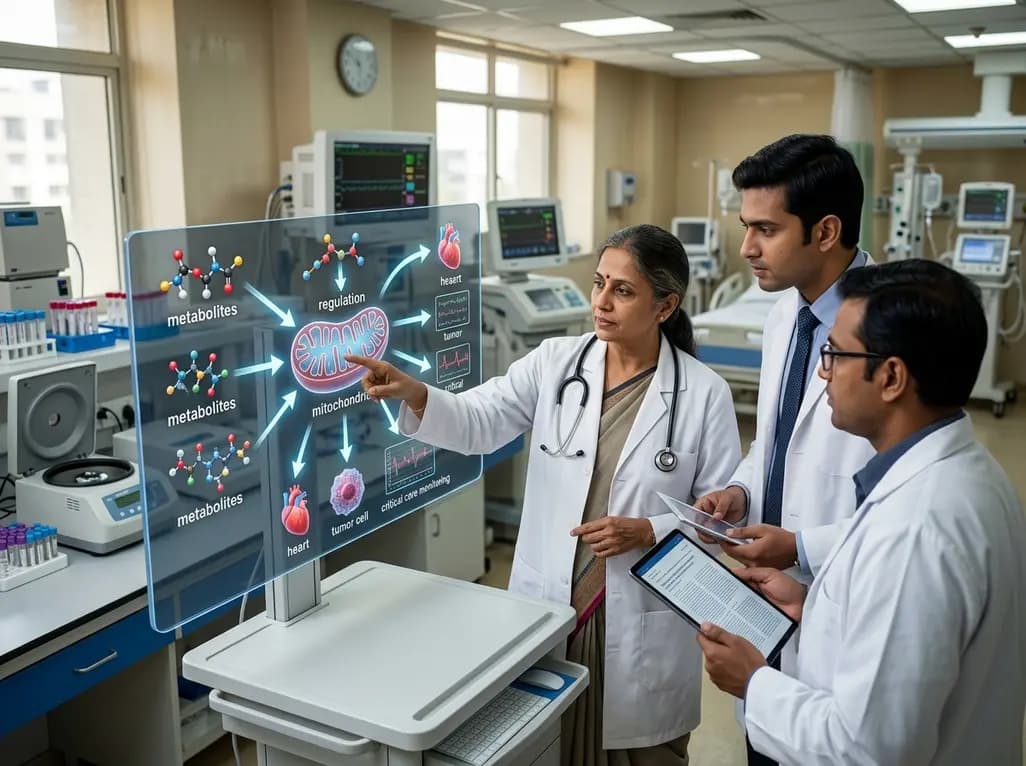
A groundbreaking review highlights mitochondrial quality control as a pivotal gating layer between metabolite signaling and regulated cell death, offering transformative therapeutic avenues across cardiology, oncology, and critical care.
Today
