

Loading, please wait...
Loading, please wait...

Managing cognitive recovery after a sports injury requires balancing brain rest and gradual cognitive reintegration. While physical recovery frequently receives attention on the sidelines, optimizing a return to learn concussion protocol is essential for young athletes whose primary work is education. A systematic review published in the Journal of Neurosurgery: Pediatrics by Bishay and colleagues evaluated 21 primary studies comprising 8,475 athletes aged 5 to 27 years. The researchers examined how return-to-learn protocols are defined, the timeline needed to complete them, and specific clinical factors predicting prolonged academic recovery. Consequently, this evidence delivers crucial practical guidance for pediatricians, sports medicine physicians, and neurologists managing student-athletes.
Historically, research on sport-related concussion centered almost entirely on athletic clearance rather than academic recovery. However, Bishay and co-authors identified that academic return definitions vary significantly across the existing medical literature. Specifically, 81% of reviewed studies provided an explicit academic recovery definition, revealing a critical dichotomy between partial and complete academic reintegration. Therefore, clinicians must distinguish between entering the school building and reaching baseline cognitive independence.
When investigators defined recovery as 'any return to learn', the median timeline across cohorts was just 5 days, spanning from 2.5 to 35.3 days. In contrast, when studies evaluated 'full return to learn without academic accommodations', the median time expanded to 17.5 days, with a wide range between 3 and 49 days. This considerable difference demonstrates that returning to a classroom desk does not equate to full neurocognitive readiness. Early classroom presence often relies heavily on structured environmental adjustments, reduced screen exposure, and deferred examinations. Consequently, establishing standard terminology is crucial for setting expectations among students, parents, and educators during early post-injury consultations.
Identifying which student-athletes are vulnerable to protracted recovery allows clinicians to allocate academic supports proactively. In the systematic review, initial symptom severity emerged as an unequivocal predictor of prolonged recovery, showing a consistent correlation across all studies evaluating this measure. Patients presenting with elevated symptom burdens on acute assessment tools, such as the Post-Concussion Symptom Scale, routinely struggle longer with concentration, visual processing, and classroom fatigue.
Furthermore, female sex was linked to delayed academic recovery in seven of nine studies assessing sex-based differences. Female athletes consistently reported higher post-injury symptom scores, greater functional impairment, and longer durations before achieving unassisted academic participation. Biomechanical differences in neck strength, hormonal influences, and distinct symptom reporting tendencies likely drive these divergent recovery patterns. In addition, single studies identified baseline anxiety, attention-deficit/hyperactivity disorder, and integrated performance management demands as potential contributors to delayed recovery. Conversely, variables such as patient age, concussion history, migraine history, preexisting learning disabilities, school type, and early air travel did not show consistent effects on academic recovery length.
For decades, traditional concussion guidance recommended strict cocoon therapy until all symptoms resolved completely. However, contemporary physiological and neurocognitive evidence overturns this prolonged isolation strategy. Complete sensory and social deprivation often induces secondary anxiety, depressive symptoms, and scholastic alienation, which paradoxically delays clinical resolution. Current international guidelines instead emphasize brief relative rest for 24 to 48 hours immediately following the injury, followed by progressive, symptom-limited cognitive activation.
Students should initiate gentle cognitive tasks at home, such as reading or low-stress desktop assignments, as soon as basic activities do not trigger severe symptom exacerbation. If mild symptoms increase slightly during mental exertion, the student simply steps back temporarily rather than restarting absolute rest. Moreover, clinical recovery accelerates when student-athletes maintain social connections and gentle physical movement, such as light walking, alongside academic progression. Physicians should reassure families that brief, transient symptom spikes do not signify structural brain harm. Instead, these signals indicate that the student has reached their current neurocognitive fatigue threshold.
Structured academic adjustments provide the bridge between initial cognitive rest and unassisted learning. Clinicians must actively prescribe individualized accommodations tailored to each patient's predominant symptom clusters. When students experience photophobia, phonophobia, or persistent headaches, schools can implement environmental modifications. These steps include providing sunglasses, allowing passes to quiet rest areas, and excusing students from noisy cafeterias or assemblies.
Similarly, neurocognitive accommodations help mitigate mental fatigue and impaired processing speed. Helpful measures include providing pre-printed class notes, shortening prolonged homework assignments, and scheduling frequent rest breaks during intensive instruction. Furthermore, testing adjustments are essential because high-stakes examinations create acute cognitive stress that worsens concussive symptoms. Teachers should defer major tests, eliminate multiple tests on a single day, and grant extra time for quizzes until the student demonstrates sustained stamina. As the student demonstrates improved tolerance, educators should systematically remove these supports in a step-by-step fashion until the student functions normally.
A vital tenet reaffirmed by modern sports medicine is that full academic recovery must strictly precede unrestricted athletic participation. Because school represents the primary occupational duty of young individuals, cognitive rehabilitation takes clear priority over competitive play. Physical exertion introduces autonomic and metabolic demands that can derail delicate cerebral healing if introduced prematurely.
Under consensus protocols, an athlete may safely perform light aerobic rehabilitation while working through academic stages, provided this exercise remains sub-symptom threshold and non-contact. However, schools and medical teams must never clear an athlete for contact practice or interscholastic competition while classroom accommodations remain active. If an adolescent still requires extra time for examinations or cannot tolerate a full academic schedule without headaches, their neural networks remain vulnerable. Permitting contact sports in this fragile state dramatically amplifies the risk of repetitive concussive trauma, protracted post-concussion syndrome, and catastrophic second-impact phenomenon.
Successful management of sports concussions hinges upon active, transparent communication between diverse stakeholders. The clinical team, comprising primary care physicians, sports medicine specialists, and neurologists, establishes the diagnosis and outlines clinical thresholds. Meanwhile, the educational team, including school nurses, guidance counselors, athletic trainers, and classroom teachers, executes daily adjustments on the ground.
Physicians can facilitate this partnership by supplying clear, standardized medical recommendation forms rather than ambiguous notes. School nurses often serve as the primary coordinators, monitoring symptom fluctuations across classes and administering rest breaks when needed. When academic difficulties persist past four weeks, the care team should promptly escalate management. Multidisciplinary referral networks involving neuropsychologists, vestibular physical therapists, and adolescent mental health professionals help address lingering deficits. By constructing a coordinated safety net, clinicians ensure students recover safely without compromising their long-term educational trajectory.
The systematic review shows that while students achieve partial academic return within a median of 5 days, achieving full return without accommodations requires a median of 17.5 days. Timelines vary considerably based on individual injury severity, personal health history, and the specific academic demands of the student's curriculum.
Research consistently links female sex to longer academic recovery and higher reported symptom burdens. Contributing factors include biomechanical neck musculature differences, hormonal variations affecting neuroinflammatory responses, and greater diligence in reporting functional impairment. Clinicians should anticipate potential delays and establish supportive accommodations early for female athletes.
Yes, light, symptom-free aerobic activity such as stationary cycling or walking can safely begin within two to ten days post-injury. However, student-athletes must achieve complete, unaccommodated academic recovery before participating in sport-specific drills, high-intensity training, or any contact activities that risk head impact.
Disclaimer: This content is for informational and educational purposes only and should not be considered as formal medical advice or guidance. The views and opinions expressed here represent an evidence-based clinical summary intended for healthcare professionals. Medical knowledge and clinical guidelines are continuously evolving; while every effort is made to present current, scientifically sound information, readers are advised to apply their independent clinical judgment and consult relevant specialty guidelines or official institutional policies before making patient care decisions. In cases of clinical emergencies, immediate referral to appropriate acute medical facilities is strongly urged. Neither the author nor the publisher accepts liability for any injury, loss, or damage resulting from the practical application of this material. Refer to the latest local and national guidelines for clinical practice.
References

Read summarized clinical updates, watch expert medical content, and earn CME certifications right from your smartphone.
Open your smartphone camera to scan and install.





A comprehensive systematic review reveals wide variation in return-to-learn timelines after sport-related concussion. Initial symptom severity and female sex significantly prolong academic recovery, highlighting the need for individualized, structured classroom accommodations before unrestricted physical play.
Today

A landmark study reveals that aeronautical expertise bolsters cognitive reserve, helping pilots preserve visuospatial skills, attention, and executive speed across adulthood while avoiding age-related decline breakpoints observed in non-pilots.
Today

Assam reduced maternal sepsis deaths from 21% to 8% through rigorous infection prevention protocols and digital monitoring. Explore the clinical strategies, sterilization quality checks, early recognition pathways, and antimicrobial stewardship lessons essential for obstetric teams across India.
Today

A new study reveals that total thymectomy during neonatal cardiac surgery impairs 6-month lymphocyte recovery compared to partial resection. While unadjusted analysis showed higher infection rates, multivariable adjustment rendered this non-significant, highlighting the urgent need for thymic preservation strategies.
Today

Adding a 12-week tele-supervised resistance band exercise program to intra-articular hyaluronic acid injections significantly improves physical function, chair stands, and mobility in knee osteoarthritis, despite showing no additive reduction in baseline pain scores.
Today
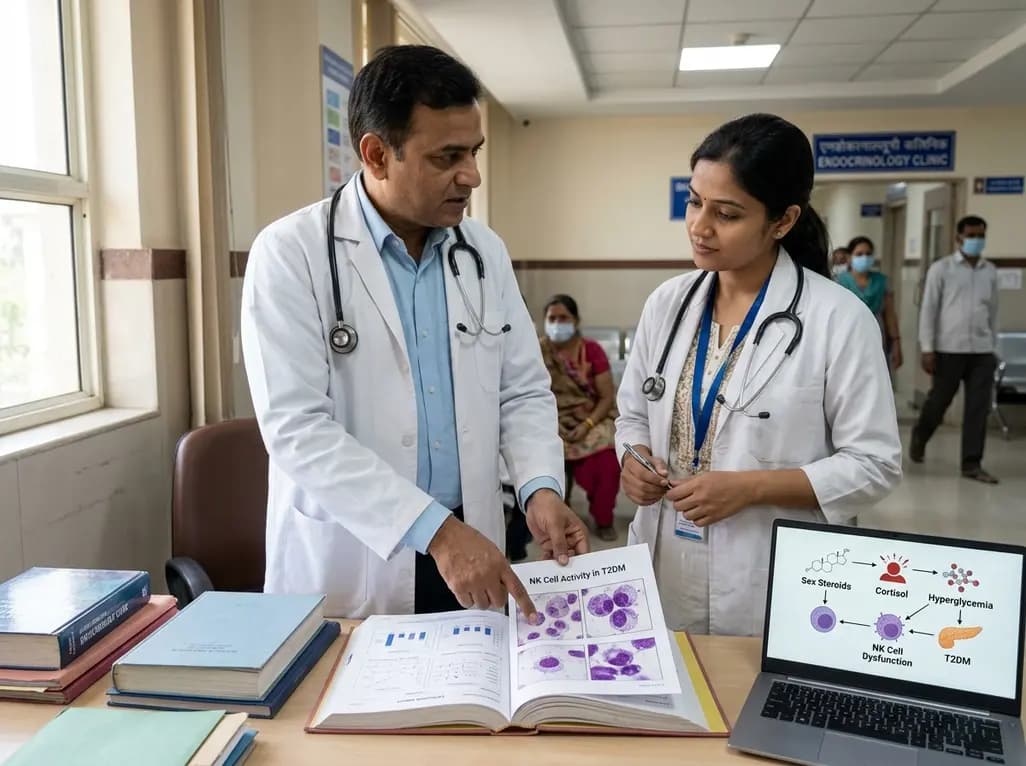
New evidence links altered sex steroids, cortisol elevation, and glycemic stress to natural killer cell dysfunction in type 2 diabetes. Understanding these endocrine-immune pathways provides valuable insights for Indian clinicians managing metabolic inflammation and infection susceptibility in diabetic patients.
Today
