.webp&w=384&q=75)

Loading, please wait...
Loading, please wait...
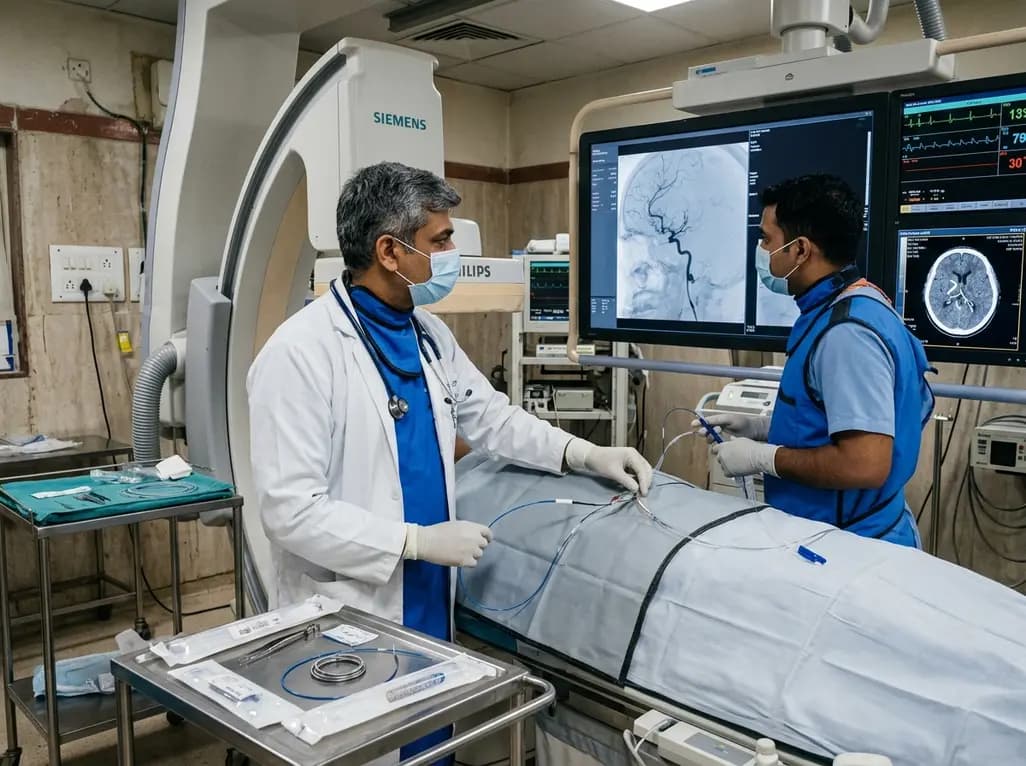
Managing an acute basilar artery occlusion represents one of the most critical challenges in neurovascular emergency medicine. Because posterior circulation ischemia frequently causes devastating neurological deficits and high mortality, interventional teams must achieve rapid and durable revascularization. Mechanical thrombectomy has become the standard of care for these life-threatening presentations. However, standard aspiration and stent-retriever thrombectomy techniques occasionally fail to restore adequate flow. Consequently, neurointerventionalists often consider emergency intracranial rescue stenting. Understanding the safety profile, technical feasibility, and long-term functional impact of permanent stent deployment is essential for refining clinical decision-making during endovascular reperfusion.
Posterior circulation strokes account for a substantial proportion of ischemic cerebrovascular events. In particular, acute basilar artery occlusion carries extreme risks of catastrophic brainstem infarction, coma, and death. While mechanical thrombectomy has transformed modern stroke therapy, refractory occlusions remain an intimidating clinical obstacle. These refractory blockages often arise from severe intracranial atherosclerotic disease or underlying arterial dissection. When standard thrombectomy maneuvers fail to achieve lumen patency, emergency rescue stenting provides an alternative pathway to reconstruct vessel architecture. Therefore, interventional teams deploy permanent stents to scaffold the vessel wall, counteract acute elastic recoil, and prevent immediate reocclusion. Nevertheless, the decision to leave a permanent metallic implant in an acutely thrombosed, inflamed intracranial vessel demands a thorough evaluation of procedural risks versus survival gains.
Recent clinical evidence from a dedicated observational study analyzed 121 consecutive patients presenting with posterior circulation large vessel blockages. The study cohort presented with a mean age of 70 years, and 40% of the individuals were female. Furthermore, patients presented with a median baseline National Institutes of Health Stroke Scale score of 14, highlighting severe neurological impairment upon arrival. Among this cohort, 28 patients required rescue stent placement after initial thrombectomy attempts failed to establish stable reperfusion. Notably, the underlying vascular etiology varied substantially between cohorts. Rescue stenting was deployed primarily in patients with pronounced intracranial atherosclerosis and spontaneous basilar dissection. In contrast, patients who achieved successful revascularization without stenting predominantly presented with cardioembolic occlusions. Thus, underlying vascular substrate represents a major determinant of whether standard clot extraction succeeds or rescue device deployment becomes mandatory.
Achieving successful revascularization remains the primary goal of endovascular therapy. In the study cohort, overall successful recanalization occurred in 91% of patients. Specifically, 94% of patients in the non-stent group achieved successful revascularization compared to 79% in the rescue stent cohort. Multivariable ordinal regression analyses adjusted for age, baseline stroke severity, thrombolysis administration, and time-to-groin puncture revealed that patients requiring stenting had a higher risk of poorer functional outcomes at three months. However, clinical context is paramount when interpreting this finding. Patients requiring rescue stenting represented a highly refractory subgroup with more complex vascular lesions and prolonged procedural times. Crucially, every single patient who failed to achieve vessel recanalization suffered poor functional outcomes or death. Therefore, while rescue stenting correlates with severe disability relative to straightforward clot retrieval, it still offers the only viable salvage strategy when initial extraction fails.
Deploying permanent intracranial stents in acute ischemic stroke carries distinct procedural risks. Interventionalists must balance the mechanical benefit of immediate lumen restoration against the potential for life-threatening complications. In the observational cohort, procedural adverse events occurred more frequently in the stent cohort. Specifically, vessel perforation occurred in 14% of stented patients compared to only 2% in non-stented patients. In addition, acute in-stent thrombosis and distal embolization during stent navigation remain constant procedural threats. The immediate requirement for potent antiplatelet agents to prevent stent thrombosis also complicates post-procedure management, particularly in patients who previously received intravenous tissue plasminogen activator. Consequently, clinicians must maintain meticulous microcatheter control and tailored antiplatelet protocols to mitigate hemorrhagic transformation while preventing acute stent closure.
To optimize patient outcomes, neurovascular teams must establish clear, standardized protocols for refractory posterior circulation occlusions. When underlying intracranial atherosclerotic stenosis or arterial dissection causes persistent re-occlusion, teams must transition rapidly from repetitive thrombectomy attempts to a definitive rescue strategy. Excessive thrombectomy passes directly increase vessel wall endothelial trauma and elevate perforation risks. Therefore, limiting thrombectomy attempts to three passes before considering rescue angioplasty or stenting protects vascular integrity. Additionally, neurointerventionalists should select self-expanding or balloon-expandable stents based on the specific lesion anatomy and vessel diameter. Concurrently, intraprocedural glycoprotein IIb/IIIa inhibitors or intravenous antiplatelet infusions require precise dosing to avoid catastrophic intracranial hemorrhage while ensuring immediate stent patency.
Optimizing rescue stenting outcomes requires advanced imaging and tailored procedural selection. High-resolution vessel wall magnetic resonance imaging and advanced perfusion software will help clinicians identify underlying intracranial atherosclerosis prior to femoral or radial access. Moreover, novel low-profile self-expanding stents and specialized drug-eluting platforms may significantly reduce procedural trauma and decrease restenosis rates. Future prospective randomized trials must focus on comparing specific pharmacological regimens during acute stenting to determine ideal antiplatelet therapy. Ultimately, while rescue stent placement involves technical complexity and distinct procedural risks, it remains an indispensable salvage intervention that prevents fatal outcomes in refractory posterior circulation ischemia.
Rescue stenting refers to the urgent deployment of a permanent intracranial stent when standard mechanical thrombectomy fails to achieve or maintain vessel recanalization. Clinicians use this technique primarily to overcome underlying atherosclerotic stenosis or arterial dissection, ensuring sustained blood flow through previously refractory large vessel occlusions.
Patients who require rescue stenting generally present with more complex, refractory vascular pathologies, such as severe underlying atherosclerosis. Additionally, these patients often endure longer procedure times and multiple thrombectomy attempts before stent deployment. This extended ischemic period and complex baseline disease naturally correlate with worse functional outcomes.
Clinicians must balance the prevention of acute stent thrombosis against the hazard of intracranial hemorrhage. Teams commonly administer intravenous glycoprotein IIb/IIIa inhibitors or short-acting antiplatelet agents during the procedure, followed by carefully monitored oral dual antiplatelet therapy, especially if the patient previously received intravenous thrombolysis.
Disclaimer: This content is for informational and educational purposes only and does not constitute medical advice, diagnosis, or treatment. Healthcare professionals should exercise their independent clinical judgment. Refer to the latest local and national guidelines for clinical practice.
References

Read summarized clinical updates, watch expert medical content, and earn CME certifications right from your smartphone.
Open your smartphone camera to scan and install.





A retrospective cohort study evaluates the clinical efficacy, safety profile, and functional outcomes of rescue intracranial stent placement during endovascular thrombectomy for acute basilar artery occlusion.
last month

Explore advances in precision toxicity control for immune checkpoint immunotherapy. Discover how mechanistic cytokine blockade, cellular targets, and emerging biomarkers mitigate adverse events without compromising antitumor efficacy.
Today
Integrating adult genetic services into reproductive and pregnancy care substantially alters clinical management. A study reveals that diagnostic genetic evaluations directly inform maternal, fetal, and neonatal care in nearly 57% of tested patients, highlighting the value of preconception and antenatal genomics.
Today
A cross-sectional study in Nepal evaluates cardiovascular risk factors among adults working above 4,000 meters. The findings reveal unexpected rates of diabetes, hypertension, and mountain sickness, underscoring the urgent need for targeted cardiometabolic screening in high-altitude occupational cohorts.
Today
An economic evaluation shows that combining physiotherapist-delivered stress inoculation training with exercise is cost-effective compared with exercise alone for acute whiplash injury, improving functional recovery and lowering downstream healthcare expenditure.
Today
Preclinical findings demonstrate that dietary flavonoid hyperoside ameliorates high-fat diet-induced type 2 diabetes by stimulating brown adipose tissue thermogenesis, promoting white fat browning, dampening adipose macrophage inflammation, and restoring gut microbiota homeostasis.
Today
