

Loading, please wait...
Loading, please wait...

Pediatric head trauma represents one of the most frequent clinical presentations in emergency departments and outpatient clinics worldwide. While clinicians generally consider single concussive events benign, recurrent concussions present complex neurological challenges. Emerging epidemiological research now demonstrates that repeated head impacts multiply long-term adverse events, specifically post-traumatic seizure risk. Consequently, clinicians require precise predictive tools to distinguish benign recoveries from impending post-traumatic epilepsy. A recent multicenter investigation evaluated over 156,000 pediatric patients to address this clinical dilemma. By applying machine learning approaches, the authors quantified how cumulative injuries, acute loss of consciousness, and neuroimaging findings affect late epileptogenesis.
Historically, medical providers struggled to quantify the cumulative biological impact of sequential concussions in pediatric patients. In this nationwide study of 156,118 children, researchers identified a distinct dose-response relationship between recurrent head trauma and subsequent epilepsy. Specifically, children experiencing mild head injury without loss of consciousness showed an adjusted hazard ratio of 1.196 for subsequent seizures. Furthermore, when children experienced repeat injuries accompanied by loss of consciousness, their hazard ratio surged to 2.025. Therefore, each successive mechanical impact damages the developing cerebral cortex in an additive manner. This compounding injury profile lowers the threshold for unprovoked cortical discharges over time. Clinicians must recognize that even injuries labeled as mild can disrupt delicate neural connectivity. Consequently, discharge protocols should treat repeated minor trauma as an escalating neurological risk factor rather than isolated episodes.
The temporal onset of post-traumatic epilepsy varies dramatically depending on early injury characteristics. Across the entire cohort, the median interval between the concussive trauma and subsequent seizure onset was 306 days. However, high-risk features dramatically accelerated this timeline. For instance, children presenting with acute neuroimaging abnormalities developed seizures at a median of 112.5 days. Similarly, children presenting with isolated loss of consciousness had a median latency of 80 days. Most strikingly, children with both neuroimaging findings and loss of consciousness developed seizures within a median of 22 days. These striking differences highlight that parenchymal injury combined with immediate network disruption drastically accelerates epileptogenesis. Therefore, acute clinical manifestations dictate the urgency and duration of outpatient surveillance. Clinicians must educate families that delayed convulsions can emerge months after apparent clinical recovery from the inciting event.
Predicting which pediatric patient will develop epilepsy after head trauma requires evaluating complex, multidimensional clinical variables. In this study, investigators evaluated three supervised computational architectures, identifying the random survival forest approach as the most accurate predictor. The survival forest model achieved fixed-time areas under the receiver operating characteristic curve of 0.780 at 30 days and 0.777 at 90 days. Most importantly, children stratified into the high-risk tier experienced a 46.7% incidence of early seizures within the initial month. In contrast, low-risk and medium-risk cohorts experienced early seizure rates of only 17.7% and 19.9%, respectively. Furthermore, investigators demonstrated that a simplified model utilizing only the top 12 clinical variables retained 95% of full model performance. Consequently, this computational efficiency enables practical integration into electronic medical records for bedside triage.
Integrating machine learning algorithms into routine clinical workflows can improve pediatric neurotrauma management. In primary care and emergency departments, clinicians frequently face difficult management dilemmas regarding follow-up intensity and activity clearance. A validated risk engine can provide real-time objective scoring immediately after each injury episode. Consequently, medical teams can promptly identify high-risk candidates who warrant electroencephalography or specialized neurosurgical referral. Moreover, objective risk stratification empowers pediatricians to counsel parents with clear numerical prognoses rather than ambiguous reassurances. This data-driven approach also aids return-to-play decisions in sports medicine clinics. By distinguishing children with elevated latent vulnerability, physicians can prevent premature athletic participation and subsequent repeated concussive impacts. Ultimately, individualized algorithmic stratification transforms reactive trauma management into proactive neurological care.
Identifying an elevated post-traumatic seizure risk early allows clinicians to deploy targeted clinical interventions. While prophylactic antiepileptic therapy remains debated for mild injuries, high-risk patients warrant heightened clinical vigilance and structured safety counseling. Clinicians must teach parents, educators, and athletic coaches how to identify early seizure semiology, including subtle focal episodes. Furthermore, establishing clear safety guidelines regarding swimming, high-altitude sports, and sleep hygiene mitigates secondary trauma risks. Clinicians should also consider obtaining baseline electroencephalographic monitoring in patients categorized within the highest predictive tiers. As digital health tools expand, embedding predictive algorithms directly into hospital triage platforms will enhance timely specialist referrals. Consequently, early risk identification bridges the critical gap between emergency discharge and long-term neurodevelopmental protection.
What defines repetitive mild traumatic brain injury in children?
Repetitive mild traumatic brain injury refers to multiple separate concussive impacts to the head occurring over time. These injuries typically present with Glasgow Coma Scale scores between 13 and 15, transient neurological symptoms, and absence of penetrating trauma, but cumulative cellular disruptions can permanently lower cortical seizure thresholds.
How quickly do seizures typically occur after repetitive concussions?
While the overall median time to seizure onset is approximately 306 days, acute clinical indicators significantly accelerate onset. Children with loss of consciousness develop seizures around 80 days post-injury, whereas children exhibiting both loss of consciousness and positive neuroimaging findings develop seizures within a median of 22 days.
Should children with mild head trauma routinely receive anticonvulsant prophylaxis?
Routine antiepileptic prophylaxis is generally not recommended for uncomplicated mild head injuries. However, when machine learning prognostics or clinical findings identify patients at high risk for rapid epileptogenesis, pediatricians and neurologists can consider tailored clinical monitoring, targeted neuroimaging, and individualized therapeutic surveillance strategies.
Disclaimer: This content is for informational and educational purposes only and should not be considered as medical advice. Healthcare professionals should exercise their independent clinical judgment. Refer to the latest local and national guidelines for clinical practice.
References
Jin MC et al. Prediction of seizure risk after repetitive mild traumatic brain injury in childhood. J Neurosurg Pediatr. 2025 Jul 01. doi: 10.3171/2025.1.PEDS2436. PMID: 40279715.
Lumba-Brown A, Yeates KO, Sarmiento K, et al. Centers for Disease Control and Prevention Guideline on the Diagnosis and Management of Mild Traumatic Brain Injury Among Children. JAMA Pediatr. 2018;172(11):e182853.
Kochanek PM, Tasker RC, Carney N, et al. Guidelines for the Management of Pediatric Severe Traumatic Brain Injury, Third Edition: Update of the Brain Trauma Foundation Guidelines. Pediatr Crit Care Med. 2019;20(3S Suppl 1):S1-S82.

Read summarized clinical updates, watch expert medical content, and earn CME certifications right from your smartphone.
Open your smartphone camera to scan and install.





A study of over 156,000 children reveals that repetitive mild traumatic brain injuries significantly elevate long-term post-traumatic seizure risk. Using machine learning, researchers developed a prognostic model demonstrating that loss of consciousness and imaging findings drastically accelerate seizure onset.
Today

The Food Safety and Standards Authority of India has issued an urgent advisory against food business operators violating mandatory labelling standards for nutraceuticals and botanicals. Regulators prohibited therapeutic claims while mandating clear advisory warnings to prevent patient toxicity and medical misuse.
Today

Biotechnology researchers in India are developing an automated liquid biopsy platform to detect cervical malignancy from blood samples. Supported by the MAHA MedTech Mission, this initiative applies nanopore sequencing and piRNA biomarker detection to eliminate invasive speculum exams and expand rural screening.
Today
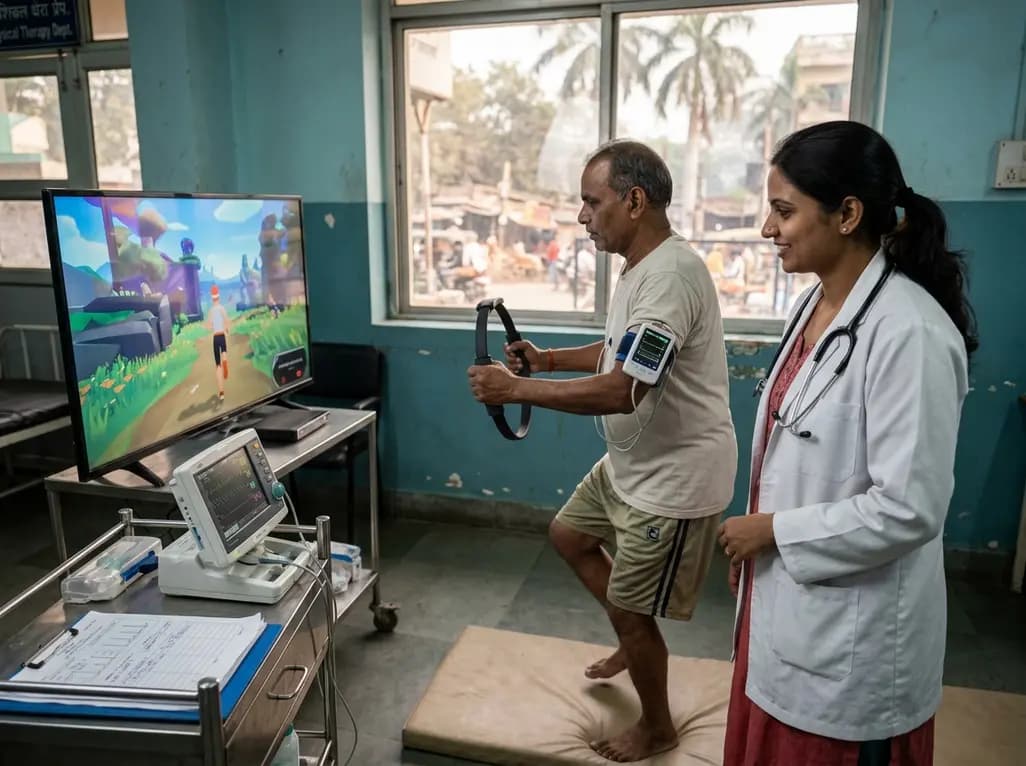
A clinical study evaluated Ring Fit Adventure in adults with chronic conditions, revealing that exergaming achieves moderate-to-vigorous exercise intensity while maintaining hemodynamic stability, high enjoyment, and zero adverse events.
Today

A retrospective cohort study reveals that selecting the touched vertebra as the lowest instrumented vertebra in thoracic adolescent idiopathic scoliosis yields a 20.8% distal add-on rate, driven by remnant motion segments and axial rotational discrepancies.
Today

A study evaluates a cardiometabolic HFpEF model combining metabolic stress with chronic mineralocorticoid excess. The findings reveal profound diastolic stiffness, endothelial dysfunction, and pulmonary hypertension, illuminating key pathophysiological mechanisms for targeted cardiopulmonary therapies.
Today
