

Loading, please wait...
Loading, please wait...

Over the past decade, healthcare systems worldwide have observed an alarming escalation in youth mental health distress. Consequently, clinicians now experience an unprecedented surge in demand for pediatric psychiatric services. A landmark nine-year study from Nanjing Brain Hospital evaluated 594,510 clinical encounters between July 2015 and June 2024. This rigorous analysis mapped changing presentation patterns among individuals aged 18 years and younger. Furthermore, the findings deliver critical insights for Indian physicians who navigate severe service constraints while managing escalating adolescent psychiatric morbidities.
The Nanjing Brain Hospital study systematically reviewed electronic records across outpatient and inpatient departments over nine years. Overall, patient volumes demonstrated a relentless expansion throughout the entire evaluation period. This steep rise highlights growing mental health distress alongside heightened parental and educational awareness. However, this growth has severely strained tertiary psychiatric centers. Specialized outpatient clinics experienced massive patient influxes, and inpatient bed occupancy frequently exceeded operational limits. In addition, this surge confirmed that childhood emotional suffering represents an urgent public health crisis. Similar trends emerge across metropolitan hubs in India, where tertiary centers face relentless pediatric queues. Therefore, clinicians must understand the underlying epidemiological drivers that propel this high institutional demand. The investigators utilized Error, Trend, Seasonal time series models to evaluate service capacity. Unfortunately, the empirical forecasts confirmed a widening mismatch between population need and clinical supply. Thus, hospital systems must transition from reactive treatment to structured, community-based developmental screening. Early distress identification helps healthcare systems alleviate severe tertiary bottlenecks.
Diagnostic stratification revealed that mood disorders formed the primary driving force behind escalating caseloads. Specifically, clinical visits for major depressive disorder and bipolar conditions exhibited the fastest annual growth among all diagnoses. Neurodevelopmental conditions remained common in younger children. However, affective disorders rapidly surpassed other categories during pubertal transitions. Adolescents presented with profound despair, severe anhedonia, incapacitating fatigue, and escalating self-harm behaviors. Furthermore, scholastic stress, intense examination anxiety, and family relational conflict magnified these emergencies. Digital environments also played an exacerbating role. Excessive screen time, online cyberbullying, and unrealistic peer comparisons severely undermined emotional equilibrium. Consequently, these compounding stressors triggered acute affective crises requiring urgent clinical care. In India, pediatricians observe remarkably parallel trajectories among secondary school students. Academic expectations frequently provoke crippling depressive episodes and suicidal crises. Therefore, clinical teams must adopt validated assessment tools during routine consultations. Early recognition empowers physicians to implement timely psychoeducation and psychological support before chronic impairment occurs.
One of the most consequential findings of the Nanjing study centers on striking gender divergence. The longitudinal growth rate of psychiatric visits among boys was significantly slower than that among girls. Specifically, boys exhibited slower visit growth in outpatient clinics, with an odds ratio of 0.93. An even more pronounced reduction appeared in inpatient admissions, where boys demonstrated an odds ratio of 0.88. Consequently, adolescent girls constituted a rapidly expanding majority of both outpatient and acute inpatient encounters. Biopsychosocial vulnerabilities explain much of this divergence. Pubertal neuroendocrine fluctuations markedly heighten susceptibility to depressive episodes and anxiety disorders in young females. Additionally, adolescent girls experience unique psychosocial pressures, including body image dissatisfaction and internalized distress. In contrast, boys tend to express distress through externalizing behaviors like hyperactivity or conduct difficulties. Because internalizing disorders frequently escalate into severe self-harm, young women disproportionately require tertiary inpatient stabilization. Healthcare providers in India must recognize this pronounced vulnerability. Clinicians should maintain high diagnostic suspicion for occult depression during consultations with adolescent girls.
To evaluate resource sustainability, the researchers implemented Error, Trend, Seasonal time series forecasting models. The mathematical models projected future clinical volume based on historical outpatient and inpatient utilization patterns. Crucially, the predictive trajectory demonstrated that demand will continue outstripping available clinical beds and consultation hours. Tertiary hospitals cannot simply expand beds indefinitely to accommodate this exponential expansion. Furthermore, physical ward expansion without expanding skilled personnel severely compromises clinical quality. Inpatient child psychiatry units require dedicated multidisciplinary teams, including psychiatric nurses, child psychologists, and social workers. When patient volume exceeds staffing capacity, clinicians face severe burnout and compromised safety. In low- and middle-income nations like India, this capacity mismatch creates an immense public health challenge. Additionally, India currently faces a profound shortage of certified child psychiatrists. Most districts lack dedicated pediatric psychiatric beds entirely. Therefore, reliance solely on tertiary facilities cannot resolve this growing crisis. Healthcare planners must decentralize psychiatric resources and reinforce district-level care facilities. Implementing tiered stepped-care systems preserves tertiary inpatient capacity for life-threatening psychiatric emergencies.
The epidemiological shifts observed in Nanjing provide compelling parallels for Indian clinical practice. According to data from the National Mental Health Survey of India, nearly ten percent of adolescents experience psychiatric morbidities. Nevertheless, widespread social stigma, poor mental health literacy, and geographic disparities prevent most youth from seeking assistance. Families frequently delay medical consultation until behavioral crises or suicide attempts occur. Consequently, tertiary psychiatric hospitals in Indian cities experience overwhelming caseloads resembling those described in Nanjing. General pediatricians, family physicians, and primary doctors serve as the vital frontline defense. Because parents frequently consult pediatricians for somatic complaints, clinicians possess an ideal opportunity to detect psychological distress. Unexplained chronic headaches, abdominal pain, sudden academic decline, or persistent fatigue frequently mask underlying mood disorders. Additionally, primary practitioners can provide crucial psychoeducation to combat parental denial. By demystifying psychiatric illness, primary doctors foster treatment adherence and reduce societal stigma. Collaborative care models connecting primary physicians with visiting specialists can bridge critical diagnostic gaps across Indian communities.
Addressing this escalating burden requires immediate and systemic clinical interventions. First, primary care practitioners should integrate standardized mental health screening tools into routine annual adolescent check-ups. Instruments such as the Patient Health Questionnaire-9 Modified for Adolescents take only minutes to complete. Furthermore, these objective tools allow clinicians to identify depressive symptoms before acute crises develop. Second, hospitals must implement structured collaborative care frameworks. In these models, general practitioners partner with child psychologists and psychiatrists to deliver stepped-care management. Mild to moderate cases can successfully receive cognitive behavioral therapy and family counseling in community clinics. Consequently, specialized tertiary beds remain reserved for refractory, highly complex, or actively suicidal patients. Third, health systems must prioritize comprehensive school-based mental health initiatives. Training educators to recognize early signs of affective disturbance enables prompt referrals. Moreover, educating adolescents on emotional regulation, sleep hygiene, and digital moderation bolsters psychological resilience. Ultimately, proactive community-level screening and cross-disciplinary collaboration will preserve hospital resources. These targeted measures ensure timely, life-saving mental healthcare for vulnerable youth.
Female adolescents experience significant biological, endocrine, and psychosocial shifts during puberty that heighten vulnerability to internalizing disorders. Hormonal fluctuations interact with environmental stressors, such as academic competition and social media pressures. Consequently, adolescent girls present more frequently with major depressive disorder, severe anxiety, and self-harm, driving up specialized healthcare utilization.
Clinicians can incorporate brief, validated screening tools into routine health consultations. The Patient Health Questionnaire-9 modified for adolescents and the Generalized Anxiety Disorder-7 scale effectively assess mood disturbances. Additionally, physicians should evaluate recurrent somatic complaints without organic pathology, sudden academic deterioration, altered sleep patterns, and social withdrawal as potential indicators of distress.
Stepped-care models optimize healthcare delivery by matching clinical intervention intensity to patient illness severity. Community clinicians and primary care physicians manage mild to moderate emotional conditions using psychoeducation and structured psychotherapy. Consequently, tertiary hospitals reserve resource-intensive inpatient beds and specialized child psychiatrists for complex, treatment-refractory, or life-threatening psychiatric emergencies, preventing health system overload.
Disclaimer: This content is for informational and educational purposes only... Refer to the latest local and national guidelines for clinical practice.
References

Read summarized clinical updates, watch expert medical content, and earn CME certifications right from your smartphone.
Open your smartphone camera to scan and install.





A nine-year study of 594,510 psychiatric visits reveals surging pediatric demand, driven by adolescent mood disorders with female predominance. Learn how stepped-care models and routine screening address these critical psychiatric capacity constraints.
Today

A landmark study reveals that aeronautical expertise bolsters cognitive reserve, helping pilots preserve visuospatial skills, attention, and executive speed across adulthood while avoiding age-related decline breakpoints observed in non-pilots.
Today

Assam reduced maternal sepsis deaths from 21% to 8% through rigorous infection prevention protocols and digital monitoring. Explore the clinical strategies, sterilization quality checks, early recognition pathways, and antimicrobial stewardship lessons essential for obstetric teams across India.
Today

A new study reveals that total thymectomy during neonatal cardiac surgery impairs 6-month lymphocyte recovery compared to partial resection. While unadjusted analysis showed higher infection rates, multivariable adjustment rendered this non-significant, highlighting the urgent need for thymic preservation strategies.
Today

Adding a 12-week tele-supervised resistance band exercise program to intra-articular hyaluronic acid injections significantly improves physical function, chair stands, and mobility in knee osteoarthritis, despite showing no additive reduction in baseline pain scores.
Today
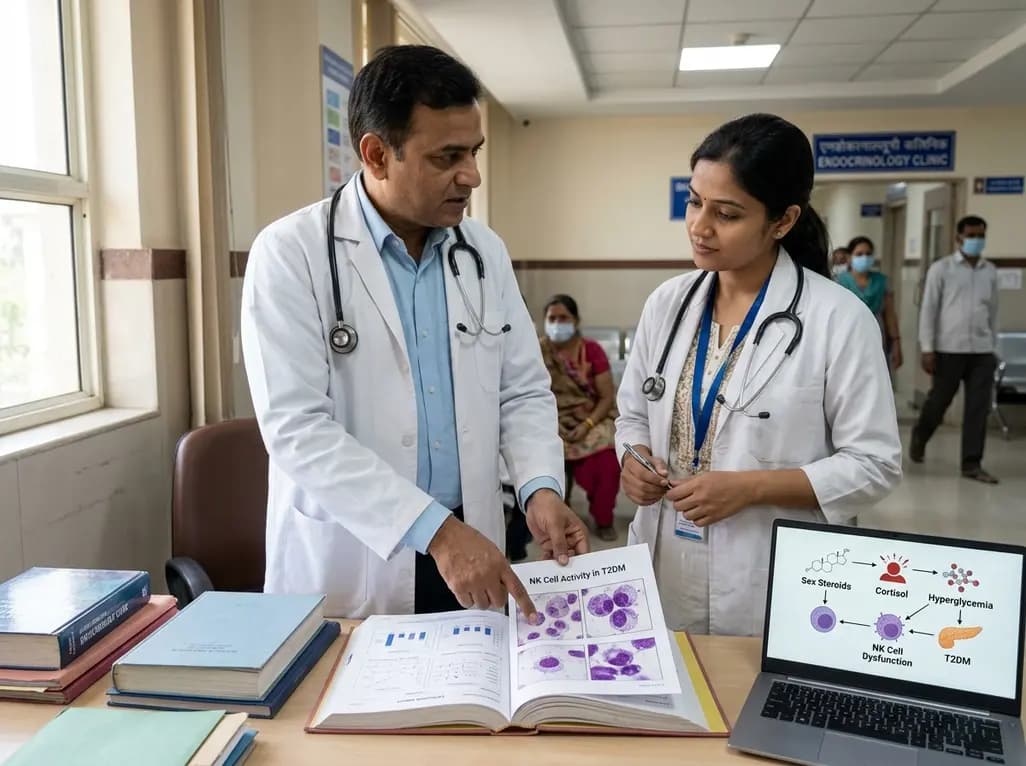
New evidence links altered sex steroids, cortisol elevation, and glycemic stress to natural killer cell dysfunction in type 2 diabetes. Understanding these endocrine-immune pathways provides valuable insights for Indian clinicians managing metabolic inflammation and infection susceptibility in diabetic patients.
Today
