.webp&w=384&q=75)

Loading, please wait...
Loading, please wait...
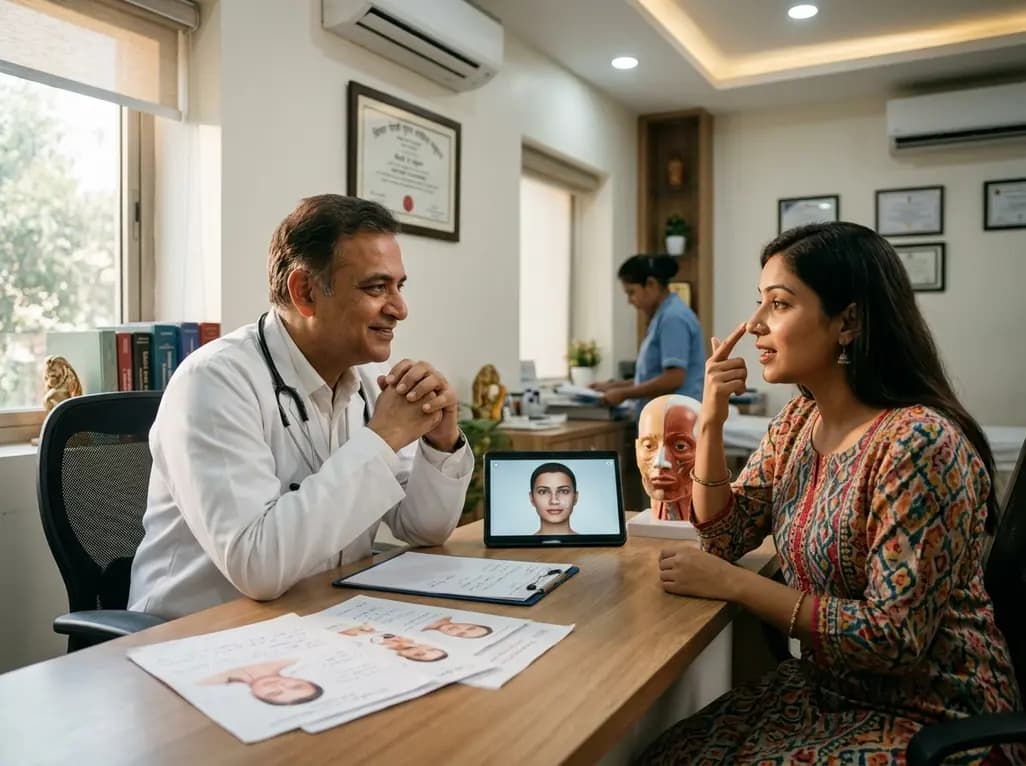
Patient-centered communication serves as the cornerstone of modern medical ethics, particularly in elective procedures like cosmetic eyelid surgery. In these preference-sensitive encounters, clinical success depends heavily on aligning surgical possibilities with the patient’s aesthetic aspirations. A recent observational study conducted at a tertiary oculoplastics center in Shanghai utilized the E5 framework to evaluate the quality of these interactions. This framework—comprising Engage, Educate, Empathize, Enable, and Enlist—provides a structured approach to clinical dialogue. Researchers analyzed 50 audio-recorded consultations for procedures such as double-eyelid blepharoplasty. They discovered that while consultations lasted an average of 10.8 minutes, the distribution of communication functions was heavily skewed. Doctors typically dominated 85% of the speaking time, leaving minimal room for patient input. Consequently, the interaction often became a unidirectional flow of information rather than a collaborative discussion. For practitioners in India, where patient volumes are similarly high, these findings offer a critical opportunity for reflection. Improving communication requires moving beyond mere data delivery toward a more holistic engagement with the patient's individual needs and psychosocial motivations.
High-throughput outpatient services often prioritize efficiency, which can lead to a communication style dominated by medical facts. The Shanghai study revealed that educational talk accounted for over 66% of the clinician’s coded time. This time was primarily spent on step-by-step procedural explanations and visual demonstrations of the surgery itself. While educating the patient is vital for informed consent, an over-reliance on information delivery can crowd out other essential components of a consultation. When clinicians spend the majority of the visit talking, they inadvertently restrict the interactional space available for the patient. Patients may feel hesitant to articulate their deeper anxieties or social motivations for seeking surgery. Furthermore, this dominance can lead to a mismatch between the surgeon’s technical goals and the patient’s subjective aesthetic preferences. To mitigate this, clinicians must recognize that effective education is not just about the volume of information provided. Instead, it is about ensuring the patient understands the implications of the procedure relative to their own values. Balancing education with active listening is essential for fostering a truly therapeutic relationship.
Patient-centered communication is not merely a soft skill; it is a clinical tool that directly influences surgical satisfaction and patient safety. When surgeons utilize the 'Empathize' and 'Enlist' components of the E5 framework, they create a stronger bond of trust. In the Shanghai study, however, these relational strategies were strikingly rare, representing less than 4% of the total communication time. This absence suggests that clinicians may be missing critical opportunities to address patient concerns before they become post-operative complaints. In the context of cosmetic surgery, where the "success" of the operation is defined by the patient's perception, failing to elicit patient values can be detrimental. Moreover, shared decision-making ensures that the patient is fully committed to the chosen surgical path. By protecting moments for elicitation, surgeons can better manage expectations and reduce the likelihood of dissatisfaction. Studies globally have shown that patients who feel heard are more likely to follow post-operative instructions and report higher quality-of-life improvements. Therefore, integrating these strategies into routine practice is a prudent clinical strategy for any surgeon.
To move away from a clinician-led agenda, surgeons can adopt specific interactional techniques that encourage patient participation. The research indicated that preference negotiation and expectation setting were consistently shorter than procedural explanations. To reverse this trend, clinicians should consciously implement open-ended questions early in the visit. Asking "What are you hoping to achieve with this surgery?" or "What concerns you most about the recovery?" can reveal vital information that a procedural lecture might miss. Additionally, the 'Enable' and 'Enlist' stages of the E5 framework involve inviting the patient to participate in the planning process. This might include asking for the patient’s feedback on visual simulations or discussing the trade-offs between different surgical techniques. Notably, these moments do not necessarily require significant extra time; they simply require a shift in focus. By prioritizing the patient’s voice, the surgeon transforms the consultation into a collaborative partnership. This approach not only improves the patient's experience but also clarifies the surgical goals, leading to more predictable and satisfying outcomes for both parties.
One of the primary barriers to patient-centered communication in busy clinics is the perceived lack of time. Clinicians often feel they must spend every available minute explaining the technical aspects of surgery. However, the study suggests that services should streamline repetitive explanations by using reusable visual and digital materials. For example, providing patients with pre-recorded videos or interactive digital brochures before the consultation can cover the basic procedural facts. This strategy offloads the 'Educate' portion of the visit, freeing up valuable minutes for the clinician to focus on 'Engage,' 'Empathize,' and 'Enlist.' When the patient arrives already informed about the surgical steps, the face-to-face time can be spent on high-level decision-making and addressing specific personal concerns. Furthermore, digital tools can standardize the quality of information provided, ensuring that all patients receive a consistent baseline of knowledge. In an Indian context, where language and literacy levels vary, visual aids can be particularly effective in bridging communication gaps and enhancing overall health literacy.
The transition toward more participatory consultations requires a shift in both clinical training and service delivery models. The findings from the Shanghai study serve as a call to action for tertiary centers to protect brief, observable moments for patient values to emerge. In the future, medical education should place a greater emphasis on structured communication frameworks like E5. Training surgeons to recognize and enact 'enlistment moments' can significantly improve the alignment of surgical plans with patient desires. Additionally, health systems must value communication as a core clinical competency rather than an optional extra. Future research should explore how these communication patterns vary across different cultures and surgical specialties. By continuing to observe and transcribe real-world interactions, the medical community can identify the most effective ways to balance volume with care quality. Ultimately, the goal is to ensure that every patient feels like a partner in their own care. Implementing these changes will lead to a more resilient healthcare system that prioritizes human connection alongside technical excellence.
The E5 framework actually helps save time by structuring the consultation more efficiently. By using digital tools for the 'Educate' phase, you can offload repetitive procedural explanations. This allows you to focus your limited face-to-face time on the 'Engage' and 'Enlist' phases, which are critical for setting realistic expectations and preventing time-consuming post-operative misunderstandings or complaints from dissatisfied patients.
Enlisting the patient means involving them actively in the final decision-making process. In cosmetic surgery, outcomes are often subjective. If a patient does not feel they were part of the planning process, they may feel the results do not match their personal vision, even if the surgery is technically perfect. Enlistment ensures that the patient takes ownership of the chosen plan, which significantly boosts post-operative satisfaction.
Not necessarily. The Shanghai study showed that clinicians accounted for 85% of speaking time, yet this often resulted in a unidirectional information dump. Excessive clinician talk can overwhelm patients, leading to poor retention of key information. Effective communication involves a dialogue where the patient has the interactional space to ask questions, voice concerns, and confirm their understanding, ensuring the education is truly effective and patient-centered.
Disclaimer: This content is for informational and educational purposes only and does not constitute medical advice or a professional relationship. The information provided is based on recent research and general clinical frameworks. Surgeons should adapt these strategies to their specific clinical context and patient population. Refer to the latest local and national guidelines for clinical practice.
References
Wang F et al. Patient-centered communication in cosmetic eyelid surgery consultations in China: an observational transcript-based E5 study. BMC Health Serv Res. 2026 Jul 13. doi: 10.1186/s12913-026-15106-9. PMID: 42443892.
Levinson W, Lesser CS, Epstein RM. Developing physician communication skills for patient-centered care. Health Aff (Millwood). 2010;29(7):1310-1318.
Ha JF, Longnecker N. Doctor-patient communication: a review. Ochsner J. 2010;10(1):38-43.

Read summarized clinical updates, watch expert medical content, and earn CME certifications right from your smartphone.
Open your smartphone camera to scan and install.





A recent study in China highlights that most cosmetic surgery consultations are information-heavy but lack patient participation. Using the E5 framework—Engage, Educate, Empathize, Enable, Enlist—surgeons can better align clinical options with patient goals to improve satisfaction in high-volume settings.
3 months ago

Explore why official drug package inserts fail to reflect modern evidence for clozapine prescribing. Learn how legal standards of care, case law, slow titration, and vital adverse event monitoring empower clinicians to prioritize evidence-based medical practice over outdated manufacturer labeling.
Today

Occult maternal malignancy accounts for 3.82% of persistent unreportable NIPT results with genomic noise. Multiple chromosomal aberrations, notably on chromosome 18, warrant thorough oncological evaluation and whole-body MRI to ensure timely maternal diagnosis while preserving fetal care.
Today

This article reviews the forensic and clinical complexities of acute myocarditis arising on left ventricular hypertrophy in children, highlighting early diagnostic red flags and multidisciplinary postmortem autopsy protocols.
Today
A randomized controlled trial demonstrates that an eight-week dual-task training intervention significantly improves static and dynamic postural control over standard balance exercises in individuals with chronic ankle instability, addressing critical neurocognitive deficits during athletic and daily activities.
Today

A retrospective cohort study of 7,716 ICU patients from the MIMIC-IV database demonstrates that Gradient Boosting Decision Trees significantly outperform traditional SOFA scores in predicting in-hospital mortality among patients with sepsis and diabetes, with SHAP analysis providing clinical interpretability.
Today
