.webp&w=384&q=75)

Loading, please wait...
Loading, please wait...
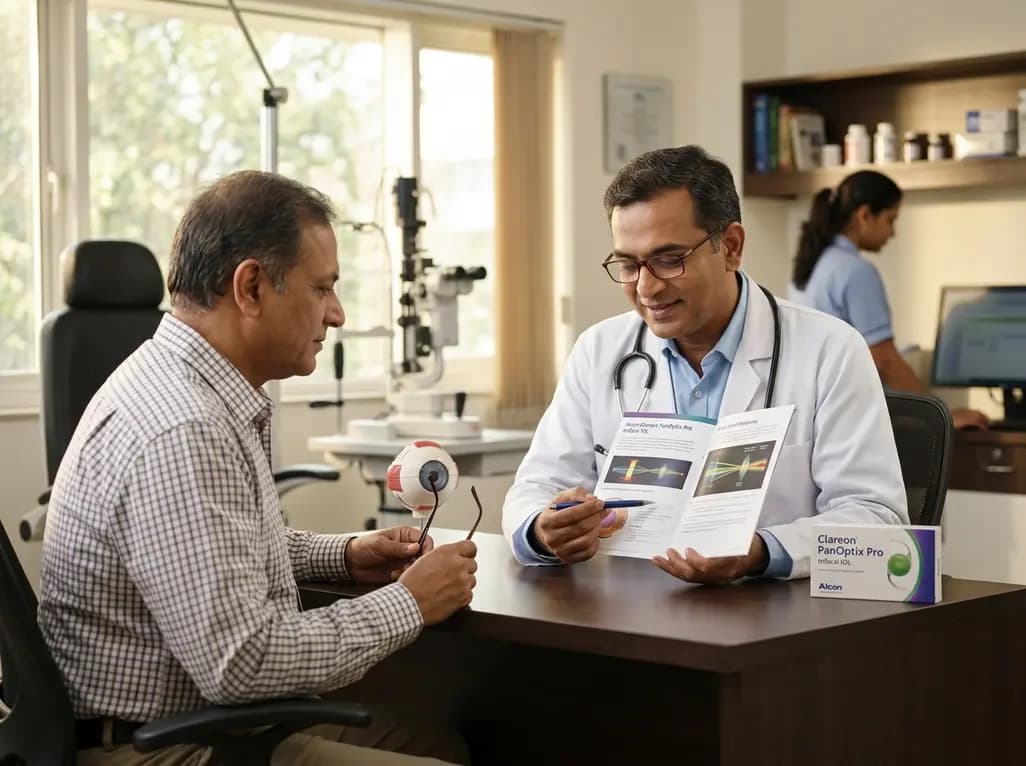
Modern cataract surgery has evolved into a sophisticated refractive procedure that prioritizes complete spectacle independence. Consequently, ophthalmic surgeons continuously seek intraocular lenses that provide superior visual acuity at all functional working distances. In this context, the recent introduction of the PanOptix Pro intraocular lens in India marks a notable technical advancement for cataract patient care. Developed on the hydrophobic Clareon material, this novel trifocal optic addresses longstanding limitations associated with diffractive light loss and visual disturbances. As a result, eye care specialists across the country now have access to an expanded surgical armamentarium.
The fundamental design of this next-generation implant centers on Alcon's proprietary ENLIGHTEN NXT optical technology. Historically, multifocal and trifocal optics required compromises in light transmission because diffractive steps disperse photons away from retinal focus. In contrast, ENLIGHTEN NXT reorganizes the diffractive rings to minimize stray scatter and reclaim valuable optical energy. Furthermore, engineers manufactured this optic using the Clareon hydrophobic acrylic biomaterial, known for outstanding clarity and glistening resistance. This biomaterial features high optical purity, which ensures durable vision over many decades. Additionally, the manufacturer paired the lens with advanced automated delivery platforms to optimize surgical control during capsular bag insertion. Therefore, surgeons experience smooth, reproducible implantation through small micro-incisions without risking mechanical damage to the optic. Moreover, the redesigned ring profile provides an uninterrupted light distribution curve from infinity down to reading distance. Consequently, patients experience fewer sudden drop-offs in clarity when transitioning their gaze between various working tasks. These physical characteristics address both surgical handling needs and optical precision demands. Overall, the engineering demonstrates a focused effort to eliminate energy wastage while maintaining proven biomaterial stability. Thus, the structural architecture provides a strong foundation for long-term optical fidelity.
Optical throughput remains the defining benchmark for assessing presbyopia-correcting intraocular lenses. Notably, the PanOptix Pro delivers ninety-four percent total light utilization to the retina. In comparison, diffractive optics exhibit a theoretical maximum light utilization ceiling of ninety-six percent. Thus, the new lens leaves merely six percent of light lost to scatter, representing a fifty percent scatter reduction over older platforms. Because light scatter decreases so markedly, patients experience significantly better image contrast across various lighting environments. Furthermore, bench simulations show a sixteen percent increase in image contrast within the intermediate range. Consequently, the optic minimizes troublesome photic phenomena, such as debilitating nighttime glare and concentric halos around headlights. Traditional diffractive models frequently divided light unevenly, which diminished night vision clarity. However, this updated optical platform distributes usable photons efficiently to maintain consistent visual quality. Moreover, intermediate contrast gains help individuals perform detailed tasks without straining under dim indoor lighting. As a result, the optical efficiency translates directly into heightened patient comfort during everyday visual routines. In summary, these measurable performance gains elevate the standard of visual recovery following cataract extraction. Clinicians therefore obtain higher predictability in low-contrast conditions.
Achieving optimal refractive outcomes requires precise surgical planning and versatile lens power availability. Specifically, the PanOptix Pro portfolio offers base spherical powers from plus six to plus thirty diopters in half-diopter steps. In addition, the manufacturer supplies extended powers from plus thirty-one to plus thirty-four diopters in one-diopter increments. This broad range allows clinicians to treat patients with extreme axial lengths, including high hyperopes and axial myopes. Furthermore, the optic incorporates a fixed intermediate add power of plus two point seventeen diopters. This specific add provides comfortable vision at approximately sixty centimeters, which aligns perfectly with modern desktop monitor usage. Meanwhile, a plus three point twenty-five diopter near add establishes crisp reading clarity at roughly forty centimeters. Therefore, surgeons do not have to compromise intermediate working distances to secure functional near sight. Accurate pre-operative biometry remains vital for calculating appropriate lens power. Consequently, practitioners should utilize swept-source optical coherence tomography biometers to measure axial length and corneal keratometry accurately. Moreover, surgeons must evaluate corneal astigmatism meticulously before selecting spherical models. Through rigorous preoperative assessment, ophthalmic teams ensure each patient achieves the full benefit of this trifocal optic. Accordingly, meticulous biometry calculations safeguard against undesirable post-surgical refractive surprises.
Modern cataract patients consistently express a strong desire for complete freedom from corrective eyewear. Fortunately, the continuous focal distribution of this lens satisfies those visual expectations across multiple daily scenarios. For example, patients can effortlessly transition between reading smartphone messages, working on laptop screens, and driving vehicles at dusk. In addition, the substantial reduction in light scatter fosters improved contrast sensitivity in low-contrast environments. Thus, individuals experience fewer visual disruptions when eating in dimly lit dining rooms or navigating dark hallways. Nevertheless, clinicians must maintain thorough patient selection standards during surgical consultations. Individuals with active ocular surface disease, advanced glaucoma, or macular degeneration represent unsuitable candidates for diffractive optics. Instead, surgeons should target motivated individuals with healthy ocular structures who prioritize spectacle independence. Furthermore, extensive counseling helps align personal visual habits with expected outcomes. When surgeons select appropriate candidates, patient satisfaction rates regularly exceed ninety-five percent in clinical practice. Indeed, successful neural adaptation occurs rapidly because the optic delivers consistent light across all three focal planes. Consequently, patients adapt quickly to their new visual reality without lingering complaints. Hence, targeted clinical communication plays an indispensable role in securing happy surgical recipients.
India performs over seven million cataract surgeries annually, representing one of the largest surgical volumes globally. Concurrently, demographic shifts and increased digital screen adoption have substantially transformed patient visual requirements across urban and semi-urban centers. Today, active Indian seniors manage professional careers, use mobile smartphones continuously, and participate in evening driving. Consequently, the clinical demand for premium presbyopia-correcting intraocular implants continues to accelerate rapidly. The commercial launch of PanOptix Pro directly addresses these changing lifestyle demands. Moreover, Indian eye surgeons possess deep expertise in advanced micro-incision cataract surgery and femtosecond laser-assisted techniques. Therefore, our surgical centers can seamlessly adopt this refined diffractive platform into existing clinical pathways. However, refractive clinics must ensure equitable access and transparent financial counseling for prospective patients. In addition, surgeons must emphasize tear film stability before surgery, as untreated dry eye compromises multifocal visual outcomes. As adoption widens across major medical institutions, clinical registries will provide valuable real-world efficacy data. Ultimately, introducing this advanced optical technology raises the benchmark of visual rehabilitation across the Indian subcontinent. Surgeons can now confidently deliver functional, full-range visual acuity to discerning cataract patients. Thus, ophthalmic practices will likely see increased enthusiasm for modern refractive cataract procedures.
Q1: What optical technology distinguishes the PanOptix Pro from previous trifocal intraocular lenses?
The PanOptix Pro incorporates proprietary ENLIGHTEN NXT optical technology, which significantly refines diffractive ring architecture. Consequently, this design captures ninety-four percent of total transmitted light energy while cutting light scatter in half compared to predecessor platforms. Furthermore, the enhanced optics direct more useful light onto the retina, providing sharper contrast sensitivity, uninterrupted continuous vision across all working distances, and noticeably fewer nighttime photic disturbances like halos and glare.
Q2: What dioptric powers and add powers does the PanOptix Pro offer for cataract patients?
The lens platform provides a versatile range of base spherical powers from plus six to plus thirty diopters in half-diopter steps. Additionally, surgeons can access extended powers ranging from plus thirty-one to plus thirty-four diopters in one-diopter increments. The optical design integrates a plus two point seventeen diopter intermediate add for comfortable computer viewing at sixty centimeters, alongside a plus three point twenty-five diopter near add for clear reading at forty centimeters.
Q3: Which clinical patient populations benefit most from selecting this trifocal intraocular lens?
Active cataract patients who desire complete spectacle independence across distance, computer, and reading zones represent ideal candidates for this optic. Furthermore, motivated individuals with healthy corneas, stable tear films, and normal maculae achieve the highest post-operative visual satisfaction. Conversely, patients with severe ocular pathology, irregular corneal astigmatism, or unrealistic visual expectations should avoid diffractive multifocal optics. Therefore, detailed pre-operative clinical counseling and precise corneal topography remain critical for identifying suitable surgical candidates.
Disclaimer: This content is for informational and educational purposes only. It does not constitute medical advice or replace professional judgment. Refer to the latest local and national guidelines for clinical practice.
References

Read summarized clinical updates, watch expert medical content, and earn CME certifications right from your smartphone.
Open your smartphone camera to scan and install.





Alcon introduced the Clareon PanOptix Pro trifocal IOL in India. Using ENLIGHTEN NXT optics, the lens provides 94% light utilization and reduces optical scatter. This technology optimizes visual performance across near, intermediate, and distance ranges for cataract surgical candidates.
Today

Groundbreaking clinical research demonstrates that early-onset Alzheimer's disease is not merely an accelerated version of late-onset dementia. Patients exhibit distinct multisystem prodromal conditions, including otolaryngologic and neuropsychiatric disturbances, years before memory failure emerges.
Today

An all-printed immunosensing microchip detects urinary sFlt-1 in just 10 minutes with 3.61 pg/mL sensitivity. By leveraging photonic bandgap engineering, this low-cost, cleanroom-free platform provides non-invasive preeclampsia screening, offering substantial benefits for point-of-care obstetric triage.
Today

Wearable ultrasound patches are transforming healthcare by shifting medicine from episodic evaluations to continuous monitoring. Discover how flexible acoustic transducers advance cardiovascular tracking, musculoskeletal imaging, neuromodulation, and on-demand closed-loop theranostics.
Today

A landmark biomechanical study demonstrates that sports bra support and running shoe cushioning interact significantly to influence tibial acceleration, breast motion, and comfort in female runners, providing crucial insights for clinical counseling in sports medicine and women's health.
Today

A landmark Monte Carlo simulation study reveals widespread perchlorate and chlorate exposure through vegetables and drinking water, presenting significant thyroid disruption risks in young children. Learn the physiological mechanisms, dietary drivers, and preventive strategies for clinical practice.
Today
