.webp&w=384&q=75)

Loading, please wait...
Loading, please wait...
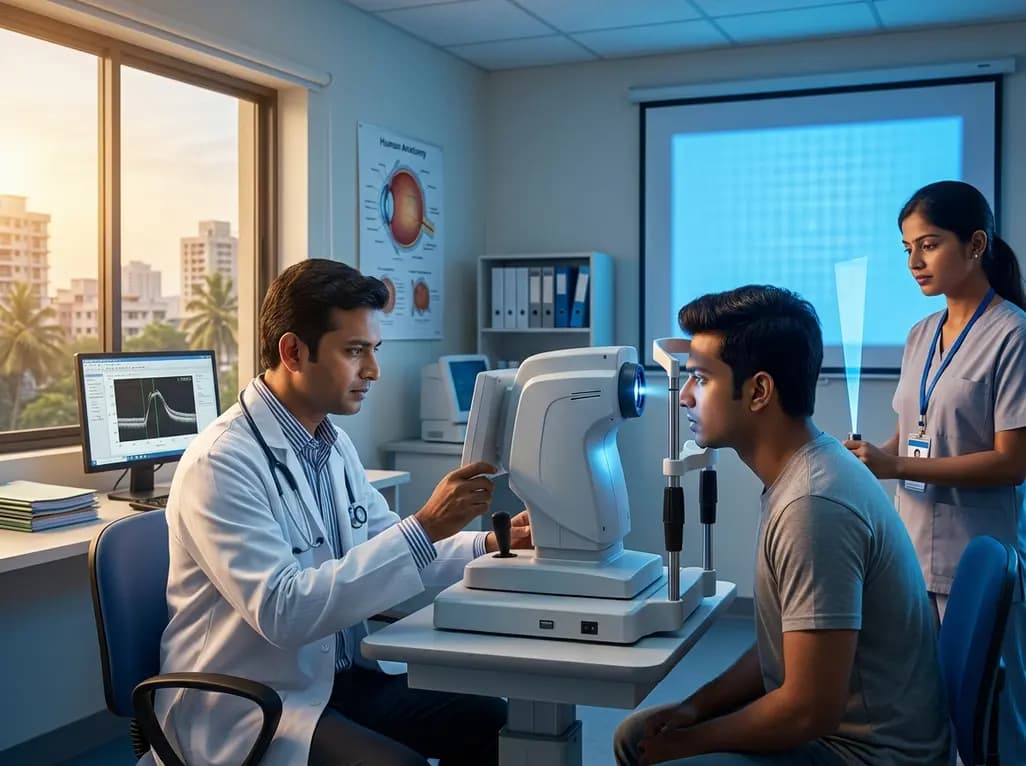
Recent clinical research highlights the significant impact of short-wavelength light on human ocular biometry and refractive development. Specifically, exposure to narrowband blue light influences short-term axial length changes in distinct ways depending on the time of day. Understanding these biomechanical responses provides valuable insights into visual physiology, circadian rhythms, and future myopia control strategies for eye care practitioners.
Light wavelength plays a fundamental role in regulating eye growth and ocular biometry. Earlier animal and human studies demonstrated that short-wavelength light can suppress axial elongation effectively. However, human eyes display natural diurnal variations in axial length, typically swelling or shrinking slightly across a twenty-four-hour period. Consequently, exposure timing plays a pivotal role in how ocular tissues respond to external visual stimuli.
Researchers recently sought to evaluate how exposure timing alters short-term ocular responses in human eyes. Additionally, they examined whether combining monochromatic light with optical defocus alters axial length changes. Myopic defocus created by positive lenses typically slows axial elongation by shifting the focal plane in front of the retina. Therefore, combining chromatic light with optical defocus might offer an additive therapeutic benefit for myopia control.
Understanding these biological interactions is vital for developing effective non-invasive myopia interventions. Moreover, clarifying circadian variations helps clinicians determine optimal intervention windows for phototherapy protocols. Consequently, evaluating chromatic light during specific times of the day provides critical data for translational optometry and preventive eye care.
To investigate these physiological interactions, investigators conducted a detailed two-part clinical study involving healthy young adult participants. In the first objective, eighteen individuals underwent sixty minutes of narrowband blue light exposure at four hundred sixty nanometers. They completed these sessions during morning hours between nine and eleven AM and evening hours between five and seven PM on the same day. Researchers normalized axial length values to the baseline average to account for normal diurnal variations. Furthermore, participants experienced broadband white light exposure under identical timing conditions to serve as a control group.
In the second objective, twenty-seven young adults participated in a distinct experimental protocol to test optical interactions. Participants wore a plus three diopter spectacle lens over their right eye to induce myopic defocus. Subsequently, they received sixty minutes of light exposure under both narrowband blue light and broadband white light conditions.
Investigators measured axial length using the Lenstar LS900 non-contact optical biometer before and immediately after each exposure session. Consequently, this high-precision biometer accurately captured subtle micron-level shifts in axial length across all experimental conditions.
The experimental results revealed significant differences in axial length responses depending on exposure timing. Specifically, exposure to morning blue light caused a significant reduction in axial length compared to evening exposure. Morning exposure reduced axial length by ten microns, whereas evening exposure yielded a minimal decrease of less than one micron. In contrast, broadband white light showed no significant difference between morning and evening exposures.
Furthermore, light spectral composition significantly influenced natural diurnal axial length variations. Under broadband white light, the eyes maintained their expected circadian rhythm, displaying a positive shift in the morning and a negative shift in the evening. However, narrowband blue light exposure diminished this natural diurnal pattern significantly.
Consequently, these findings demonstrate that morning light exposure generates a much stronger transient axial shortening response. Moreover, the timing of short-wavelength light exposure directly modulates the natural diurnal rhythm of human ocular biometry. These insights suggest that morning hours represent the most sensitive physiological window for short-wavelength light interventions.
In the second objective, researchers evaluated whether myopic defocus provides additive axial shortening when combined with chromatic light. Surprisingly, lens-induced myopic defocus did not produce additional short-term modulation of axial length. Axial length responses remained similar under both narrowband blue light and broadband white light conditions regardless of optical defocus.
These observations suggest that short-term chromatic light pathways may operate independently of short-term optical defocus pathways. Alternatively, a sixty-minute exposure duration might be insufficient to demonstrate synergistic effects between optical defocus and chromatic stimulation. Consequently, visual pathways processing spectral signals may follow distinct temporal mechanisms compared to optical defocus pathways.
Furthermore, individual sensitivity to optical defocus varies across different light environments and refractive states. Therefore, short-term exposure to plus three diopter lenses does not amplify blue light-induced axial shortening in young adults. Additional longitudinal studies are necessary to clarify long-term interactions between spectral filters and defocus optics in clinical populations.
These findings carry important clinical implications for future myopia control therapies and emerging phototherapy protocols. Myopia progression relies heavily on progressive axial elongation of the eyeball. Therefore, interventions that induce axial shortening or suppress elongation represent highly valuable clinical tools for eye care practitioners.
The discovery that morning short-wavelength light significantly reduces axial length suggests that phototherapy timing is crucial. Clinicians designing light-based myopia control protocols should consider prescribing short-wavelength light interventions specifically during morning hours. Conversely, evening exposure may yield minimal biometric benefit and could potentially disrupt natural circadian rhythms and sleep patterns.
Additionally, the lack of immediate synergistic effect with myopic defocus highlights the complexity of ocular growth pathways. Practitioners should not assume that combining optical defocus with monochromatic light automatically enhances short-term clinical efficacy. Instead, future clinical guidelines must rely on rigorous clinical evidence regarding exposure duration, timing, and wavelength selection.
Overall, this research advances our understanding of human ocular biometry and circadian dynamics. Consequently, optimizing phototherapy timing offers a promising avenue for refining non-pharmacological myopia management strategies.
Yes, research shows that sixty minutes of narrowband blue light exposure in the morning leads to a statistically significant reduction in axial length compared to evening exposure. In clinical experiments, morning blue light exposure resulted in an average axial length reduction of ten microns. Consequently, timing plays a pivotal role when utilizing short-wavelength light to influence human ocular biometry and transient axial shortening.
Natural ocular biometry follows a diurnal rhythm where axial length fluctuates predictably throughout the day. While broadband white light preserves this normal circadian pattern, narrowband blue light exposure significantly diminishes it. Blue light alters the normal difference between morning and evening axial length values, demonstrating that short-wavelength light directly interacts with biological mechanisms governing circadian variations in human eyes.
Short-term clinical findings indicate that combining lens-induced myopic defocus with narrowband blue light does not provide additional axial shortening. In experimental studies, wearing a plus three diopter lens during sixty minutes of blue light exposure did not produce greater axial length reduction than blue light alone. Consequently, chromatic light and optical defocus may operate through distinct physiological pathways over short exposure durations.
Disclaimer: This content is for informational and educational purposes only and does not constitute professional medical advice, diagnosis, or treatment. Always seek the advice of a qualified healthcare provider with any questions regarding a medical condition. Refer to the latest local and national guidelines for clinical practice.
References
1. Thakur S et al. Effects of Morning and Evening Narrowband Blue Light and Myopic Defocus on Axial Length in Humans. Curr Eye Res. 2026 Aug 10. doi: 10.1080/02713683.2026.2709886. PMID: 42572912.
2. Thakur S, Dhakal R, Verkicharla PK. Short-Term Exposure to Blue Light Shows an Inhibitory Effect on Axial Elongation in Human Eyes Independent of Defocus. Invest Ophthalmol Vis Sci. 2021;62(15):22.

Read summarized clinical updates, watch expert medical content, and earn CME certifications right from your smartphone.
Open your smartphone camera to scan and install.





A clinical study evaluated how morning and evening narrowband blue light exposure and myopic defocus affect human axial length, finding significant morning axial reduction.
last month

Evaluating the Endothelial Activation and Stress Index (EASIX) provides critical prognostic insight into in-hospital mortality for patients with NSTEMI. Combining routine admission biomarkers like LDH, creatinine, and platelets enables rapid, cost-effective risk stratification in emergency and intensive cardiac care.
Today

The ClinGen Prenatal Gene Curation Expert Panel evaluated 63 disease relationships across 61 genes, establishing clinical validity for severe fetal phenotypes like hydrops and stillbirth to enhance prenatal genomic interpretation and clinical care.
Yesterday

A cohort study demonstrates that the weight-adjusted waist index predicts all-cause and cardiovascular mortality more accurately than BMI and conventional adiposity metrics, offering clinicians a practical anthropometric tool for superior cardiometabolic risk stratification.
Today

New research reveals that HOXD13 regulates primary cilia signalling and genomic stability in distal synovial fibroblasts, uncovering why conditions like rheumatoid arthritis target specific joints.
Today

A real-world observational study evaluates pediatric isolated growth hormone deficiency patients transitioning to once-weekly somatrogon, showing sustained height velocity, early IGF-1 shifts, and stabilized BMI.
Today
