.webp&w=384&q=75)

Loading, please wait...
Loading, please wait...
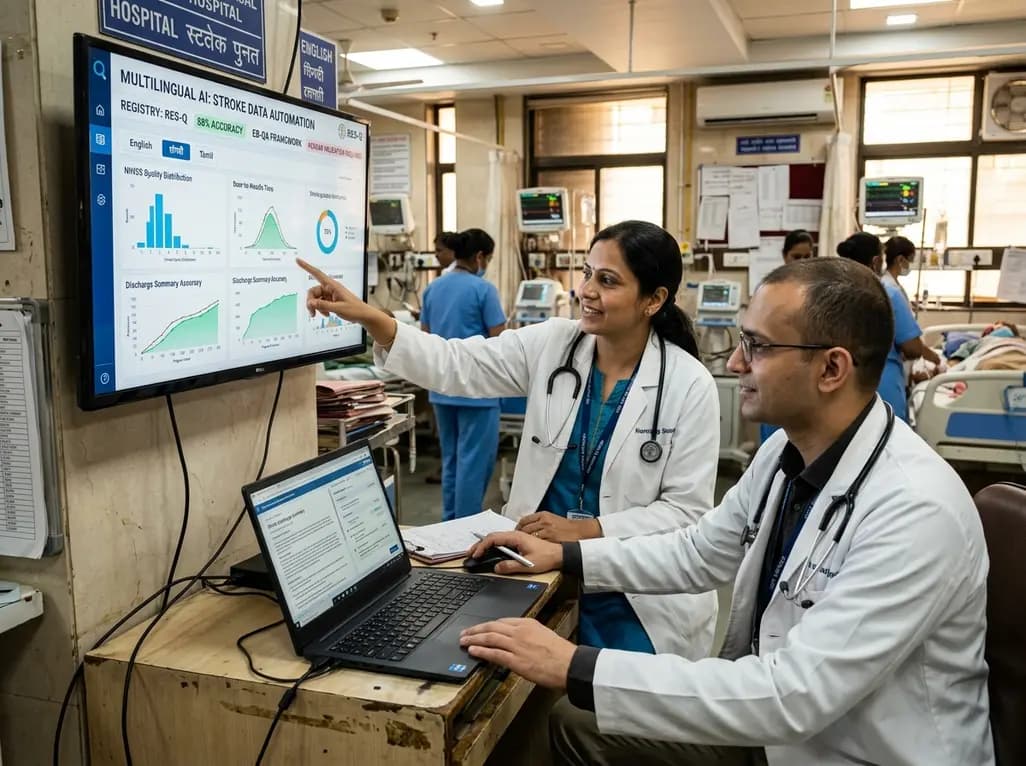
Accurate clinical documentation remains the cornerstone of modern stroke audit and quality improvement programs worldwide. Clinicians routinely examine stroke discharge summaries to extract vital quality-of-care indicators for international registries, including the Registry of Stroke Care Quality (RES-Q). However, manual chart abstraction demands excessive time and causes substantial cognitive burden for healthcare professionals. To address this challenge, researchers developed an advanced multilingual Evidence-Based Question-Answering (EBQA) system. This innovative artificial intelligence framework automatically identifies supporting text spans within clinical narratives and suggests standardized form answers. Consequently, it drastically reduces documentation burden while preserving indispensable human oversight.
International quality registries require extensive data entry for every hospitalized stroke patient. Clinical teams document diverse metrics, including exact symptom onset times, acute vascular imaging findings, thrombolysis administration, and discharge secondary prevention regimens. Consequently, abstracting these variables from semistructured documents demands hours of meticulous manual labor. The newly developed EBQA framework streamlines this labor-intensive process effectively. By analyzing stroke discharge summaries across hospital networks, the system highlights relevant source sentences and suggests corresponding structured registry fields. Therefore, healthcare providers spend less time navigating administrative interfaces and more time delivering direct bedside patient care. Moreover, maintaining full human oversight ensures complete clinical safety and regulatory accountability. Clinicians simply verify highlighted source fragments before confirming suggested entries. This collaborative human-in-the-loop design minimizes transcription errors and significantly accelerates registry participation. Furthermore, stroke centers can monitor real-time adherence to established clinical guidelines, ultimately elevating healthcare standards across hospital departments.
The EBQA framework employs an efficient two-stage architecture to interpret complex clinical narratives. First, encoder-based language models scan the document to locate and extract relevant evidence spans. These extracted text fragments serve as verifiable evidence for the subsequent processing step. Second, generative language models process the isolated evidence to predict normalized, standardized answers for registry forms. Researchers trained and evaluated this framework using more than 1500 pseudonymized stroke reports across five languages. Additionally, the investigators systematically compared monolingual training, joint cross-lingual training, and cross-lingual data augmentation approaches. Interestingly, this two-step architecture offers substantial advantages over single-step end-to-end generative models. By explicitly separating evidence extraction from final answer prediction, the system provides transparent rationale for every proposed answer. Clinicians can immediately review the underlying source sentences in the original record. Thus, this structural transparency fosters professional trust and facilitates seamless clinical adoption into electronic health record workflows.
Empirical evaluation revealed distinct performance characteristics between the two pipeline stages. Overall, the complete Evidence-Based Question-Answering system achieved an impressive 88% end-to-end accuracy across five diverse languages. Answer prediction demonstrated remarkable stability and precision, achieving a 95% accuracy rate when provided with appropriate evidence spans. In contrast, evidence extraction represented the primary technical bottleneck, reaching 85% F1-score and 79% exact match accuracy. Performance also varied considerably based on question complexity; patient-specific variables reached 77% accuracy, whereas default or unverifiable items reached 95% accuracy. Consequently, locating precise text spans within diverse clinical narratives remains substantially more challenging than categorizing structured responses. Variations in sentence structure, shorthand phrasing, and clinical terminology directly impact extraction fidelity. Nevertheless, when the model successfully isolates source evidence, generative components consistently produce correct registry entries. Therefore, future algorithmic refinements should focus primarily on enhancing the sensitivity of initial evidence retrieval models.
Clinical documentation practices vary markedly across different healthcare institutions, geographical regions, and native languages. Surprisingly, the researchers observed that local reporting conventions and dataset characteristics influenced model performance far more than language grammar itself. Joint cross-lingual training slightly degraded evidence extraction performance across languages, while exerting minimal influence on answer prediction accuracy. Consequently, institutional narrative structures, specialized medical abbreviations, and section layouts govern how effectively models identify relevant clinical facts. Direct cross-lingual model transfer without local fine-tuning remains insufficient for nuanced evidence extraction tasks. Therefore, healthcare organizations seeking to implement automated registry solutions must incorporate representative target-language training data. Furthermore, hospital administrators should promote standardized documentation templates among clinicians. Standardized reporting formats reduce syntactic ambiguity, improve natural language processing performance, and ensure consistent data quality across multi-center international registries.
Automated quality monitoring provides transformative benefits for stroke centers and health networks. In high-volume hospitals, manual registry reporting frequently suffers from administrative backlogs and incomplete submissions. Implementing evidence-based question answering converts retrospective data entry into an agile, near-real-time quality improvement mechanism. Because the system presents explicit source text alongside answer recommendations, clinical auditors verify data rapidly without reading lengthy summaries multiple times. Furthermore, this modular framework operates efficiently with moderate computational infrastructure, making local hospital deployment feasible and cost-effective. Consistent registry data collection generates actionable insights into door-to-needle times, endovascular thrombectomy rates, and guideline-directed pharmacotherapy. Ultimately, reducing clinician administrative burden preserves critical cognitive bandwidth for patient care, thereby driving continuous quality improvements and enhancing long-term functional recovery for stroke survivors.
The AI framework uses a sequential two-stage pipeline to extract data. First, encoder language models identify and extract supporting text spans directly from stroke discharge summaries. Generative language models then analyze these extracted text fragments to produce normalized, structured answers for registry forms. Finally, clinicians review the extracted evidence and confirm the suggested answers, maintaining full oversight and verification.
Evidence extraction requires navigating unstructured, lengthy, and variable clinical text to locate specific sentences amidst complex medical terminology and diverse formatting styles. In contrast, answer prediction evaluates pre-selected, concise text spans to map information into standardized form values. Generative models easily classify focused evidence, making initial span discovery the primary operational challenge in automated form filling.
Multilingual models allow healthcare networks across multiple countries to automate data extraction without building separate software tools from scratch. Although local language data remains necessary to optimize evidence extraction, standardized question-answering frameworks expand participation in global quality initiatives like RES-Q. Consequently, hospitals can benchmark stroke performance metrics, identify clinical gaps, and enhance international stroke care standards.
Disclaimer: This content is for informational and educational purposes only and is not intended to substitute for professional medical advice, diagnosis, or treatment. Always seek the advice of your physician or other qualified health provider with any questions you may have regarding a medical condition or clinical management. Never disregard professional medical advice or delay in seeking it because of something you have read here. The views expressed are based on recent scientific research and may evolve as new clinical data emerges. Refer to the latest local and national guidelines for clinical practice.
References

Read summarized clinical updates, watch expert medical content, and earn CME certifications right from your smartphone.
Open your smartphone camera to scan and install.





A multilingual Evidence-Based Question-Answering framework automates data extraction from stroke discharge summaries for quality registries like RES-Q, achieving 88% accuracy with full human-in-the-loop validation.
last month
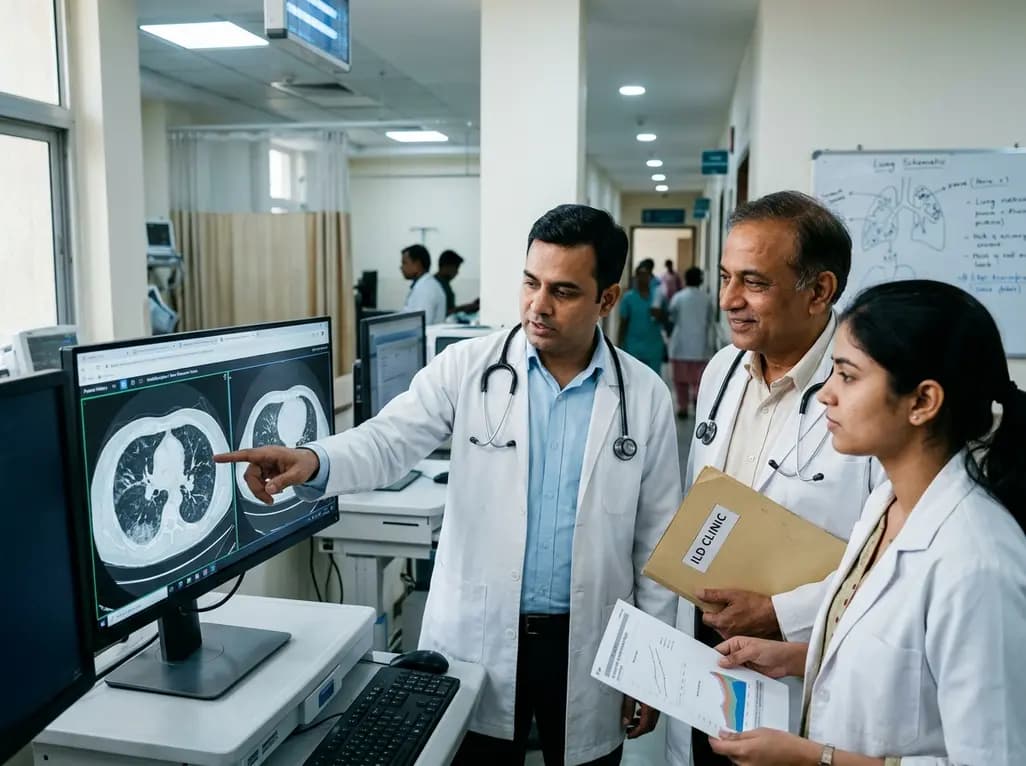
A nationwide English cohort study shows that interstitial lung diseases are no longer rare, with incidence jumping 30% and 200,000 active cases. This analysis highlights clinical implications for diagnosis, multi-disciplinary management, and global health priorities across respiratory and internal medicine.
Today

A nationwide South Korean study shows underreporting of smoking among women dropped from 57.4% to 36.4% between 2008 and 2021. However, over one-third of female smokers still conceal their habit, highlighting the critical role of cotinine verification in clinical risk assessment.
Today

PepsiCo and Monster Beverage have challenged the FSSAI ban on the energy drink label in Indian courts. While companies highlight supply disruptions, regulatory actions spotlight severe cardiovascular and metabolic risks associated with excessive caffeine, sugar, and taurine consumption, especially in adolescents.
Today

A new study evaluates the rheological stability of decellularized peripheral nerve matrix hydrogels under varied storage conditions. Findings show -80°C storage and freeze-drying preserve gelation kinetics and mechanical stiffness, offering key insights for shipping and translational clinical applications.
Today

A Bayesian multilevel meta-analysis reveals that aerobic training combined with moderate carbohydrate restriction modestly lowers HbA1c in type 2 diabetes. However, sparse data and very low certainty leave incremental benefits over exercise or diet alone unproven, highlighting the need for individualized care.
Yesterday
