.webp&w=384&q=75)

Loading, please wait...
Loading, please wait...
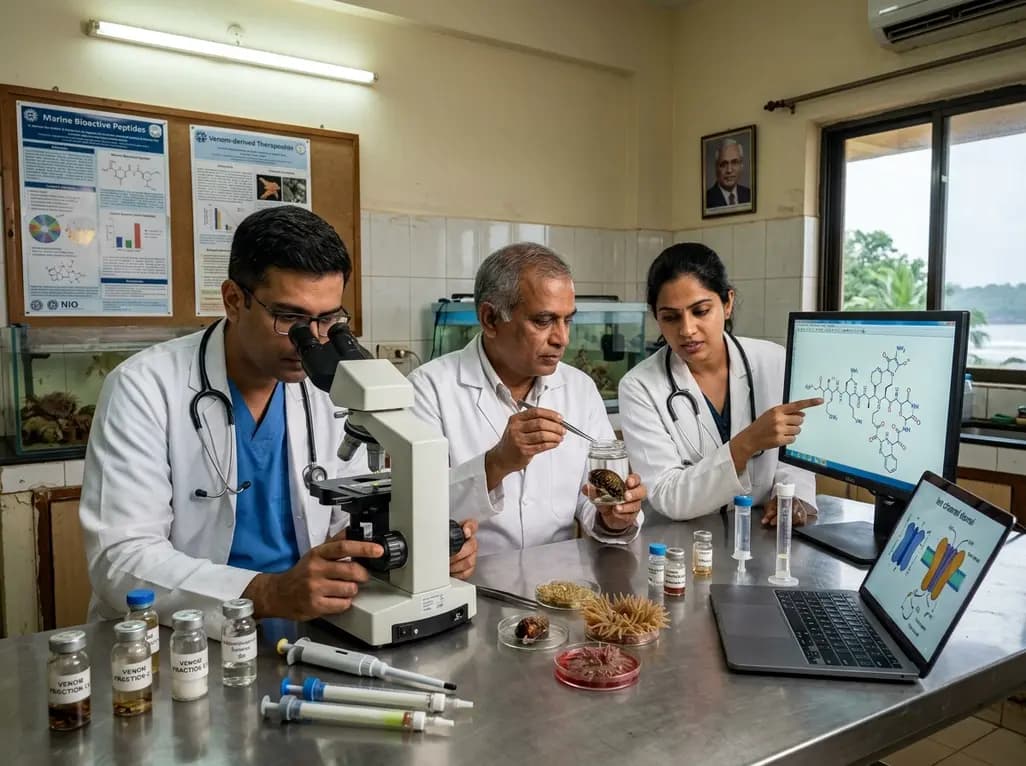
Marine ecosystems represent an extraordinary reservoir of biochemical diversity with profound therapeutic potential. Scientists at the CSIR-National Institute of Oceanography in Goa are actively exploring marine organisms to identify novel pharmaceutical compounds. Consequently, marine venom drug discovery has gained substantial momentum as researchers investigate coastal species to treat intractable medical conditions. By isolating complex peptides from marine fauna, investigators aim to design effective solutions for severe pain, antibiotic-resistant infections, and progressive neurodegenerative disorders.
The Council of Scientific and Industrial Research initially launched this bioprospecting initiative along the Goa coastline in 2024. Because preliminary explorations yielded remarkable findings, researchers have now extended their surveys across diverse intertidal rocky shores. Specifically, the project encompasses strategic coastal locations including Veraval, Mumbai, Kunkeshwar, and Kumta. These geographical zones provide rich habitats for predatory and defensive sea creatures that produce intricate venom cocktails.
Field scientists systematically document and harvest specimens such as cone snails, jellyfish, sea anemones, zoanthids, and sea urchins. Over millions of years, these organisms evolved specialized toxins to immobilize prey and deter predators rapidly. Consequently, their venom components exhibit extraordinary target specificity and potency in biological systems. Tapping into this biochemical repository allows Indian researchers to uncover entirely novel chemical scaffolds. Therefore, these ongoing surveys establish a vital foundation for modern pharmacotherapy and commercial drug pipeline development.
Marine venoms contain hundreds of biologically active peptides that precisely modulate physiological pathways. For instance, predatory cone snails synthesize conotoxins that selectively block voltage-gated calcium channels, sodium channels, and nicotinic acetylcholine receptors. This precise receptor selectivity enables profound therapeutic actions while minimizing off-target adverse effects. A notable example is ziconotide, a synthetic peptide derived from cone snail venom that successfully treats severe chronic refractory pain.
Furthermore, toxins isolated from sea anemones and jellyfish demonstrate exceptional affinity for voltage-gated potassium channels. These specific ion channels play crucial roles in regulating T-cell activation and autoimmune responses. Thus, modifying these peptides provides promising leads for managing chronic inflammatory disorders and multiple sclerosis. Similarly, bioactive metabolites from zoanthids and sea urchins disrupt abnormal cellular proliferation. Consequently, oncologists and pharmacologists view these marine natural products as valuable templates for next-generation antineoplastic and cytotoxic therapies.
Accurate taxonomic identification and chemical characterization remain critical challenges in marine bioprospecting. To overcome these hurdles, the research team integrates advanced molecular tools with high-resolution analytical platforms. Specifically, scientists employ DNA barcoding to analyze standardized genetic markers within each marine specimen. This molecular technique ensures precise species classification, preventing misidentification among morphologically similar organisms.
Simultaneously, investigators utilize liquid chromatography-tandem mass spectrometry to profile complex venom fractions. This high-throughput platform rapidly separates, detects, and characterizes low-abundance secondary metabolites and venom peptides. By combining genetic barcoding with tandem mass spectrometry, researchers directly link distinct bioactive chemical structures to verified biological species. Furthermore, Indian scientists upload these comprehensive genetic records and biochemical datasets to global open-access repositories. As a result, this transparent data sharing strengthens international marine biodiversity monitoring and accelerates collaborative pharmacological discoveries worldwide.
The clinical implications of marine natural products span numerous medical and surgical disciplines. In neurology and pain medicine, non-opioid peptide therapeutics offer potent analgesia without the severe risks of tolerance, dependence, or respiratory depression. Therefore, venom-derived channel blockers present transformative alternatives for managing intractable neuropathic pain and chemotherapy-induced neuropathy.
In addition, infectious disease specialists increasingly value marine antimicrobial peptides to combat multidrug-resistant pathogens. Many marine toxins disrupt bacterial lipid membranes rapidly through pore formation, mitigating traditional mechanisms of bacterial resistance. Meanwhile, cardiovascular researchers investigate vasoactive peptides from coelenterates that modulate vascular tone and cardiac ion channels. Such compounds offer novel pathways for treating resistant hypertension and cardiac arrhythmias. Collectively, these multi-target molecules provide innovative structural foundations that address persistent clinical challenges across diverse healthcare specialties.
While pharmacological exploration offers tremendous medical promise, researchers prioritize marine conservation and environmental sustainability. Overexploitation of intertidal ecosystems can destabilize fragile marine food webs and deplete rare species. Consequently, modern bioprospecting emphasizes non-destructive sampling techniques and synthetic biology approaches. Once scientists characterize an active peptide sequence, synthetic laboratories can chemically synthesize or recombinantly express the molecule without harvesting additional wild organisms.
Moreover, mapping coastal biodiversity helps environmental agencies identify vulnerable marine habitats that require strict statutory protection. Understanding the ecological functions of venomous marine invertebrates highlights their indispensable role in maintaining marine ecosystem balance. Therefore, responsible bioresource exploration aligns cutting-edge pharmaceutical innovation with rigorous marine conservation frameworks. By safeguarding intertidal biodiversity, India ensures the continuous and ethical utilization of its valuable ocean resources for future scientific breakthroughs.
Q1: Why are marine venoms particularly valuable for pharmaceutical drug development?
Marine venoms evolved over millions of years to interact with physiological receptors and ion channels with extreme potency and molecular selectivity. Because these peptides target specific cellular pathways rapidly, they provide ideal templates for developing powerful drugs with minimal off-target adverse effects.
Q2: How do modern analytical techniques like DNA barcoding assist in marine bioprospecting?
DNA barcoding enables researchers to identify and classify marine species accurately using standardized genetic sequences. When combined with tandem mass spectrometry, it links specific bioactive molecules directly to distinct species, ensuring reproducibility and streamlining the discovery of novel therapeutic candidates.
Q3: What clinical advantages do venom-derived analgesics offer over traditional opioid medications?
Venom-derived analgesics, such as conopeptide calcium channel blockers, alleviate severe chronic pain by blocking primary nociceptive signaling in the spinal cord. Unlike traditional opioids, they achieve potent analgesia without activating mu-opioid pathways, thereby avoiding addiction, tolerance, and respiratory depression.
Disclaimer: This content is for informational and educational purposes only. It does not constitute medical advice or replace professional judgment. Refer to the latest local and national guidelines for clinical practice.
References

Read summarized clinical updates, watch expert medical content, and earn CME certifications right from your smartphone.
Open your smartphone camera to scan and install.





Scientists at CSIR-NIO are expanding marine bioprospecting across the western coastline of India. By isolating bioactive peptides from venomous sea organisms such as cone snails and sea anemones, researchers aim to develop potent therapeutics for intractable pain, refractory infections, and neurological disorders.
last month

PZL-26, a selective small-molecule inhibitor of LONP1, reveals essential roles of this mitochondrial protease in complex I biogenesis, translation, and oxidative phosphorylation. These findings provide critical mechanistic insights for developing targeted anticancer therapies against proteostasis-dependent tumors.
Today
A nationwide South Korean study shows underreporting of smoking among women dropped from 57.4% to 36.4% between 2008 and 2021. However, over one-third of female smokers still conceal their habit, highlighting the critical role of cotinine verification in clinical risk assessment.
Today

PepsiCo and Monster Beverage have challenged the FSSAI ban on the energy drink label in Indian courts. While companies highlight supply disruptions, regulatory actions spotlight severe cardiovascular and metabolic risks associated with excessive caffeine, sugar, and taurine consumption, especially in adolescents.
Today
A recent investigation analyzes whether cervical disc arthroplasty effectively restores or merely preserves physiological range of motion, providing critical biomechanical insights for treating hypomobile cervical segments.
Today

A Bayesian multilevel meta-analysis reveals that aerobic training combined with moderate carbohydrate restriction modestly lowers HbA1c in type 2 diabetes. However, sparse data and very low certainty leave incremental benefits over exercise or diet alone unproven, highlighting the need for individualized care.
Yesterday
