.webp&w=384&q=75)

Loading, please wait...
Loading, please wait...
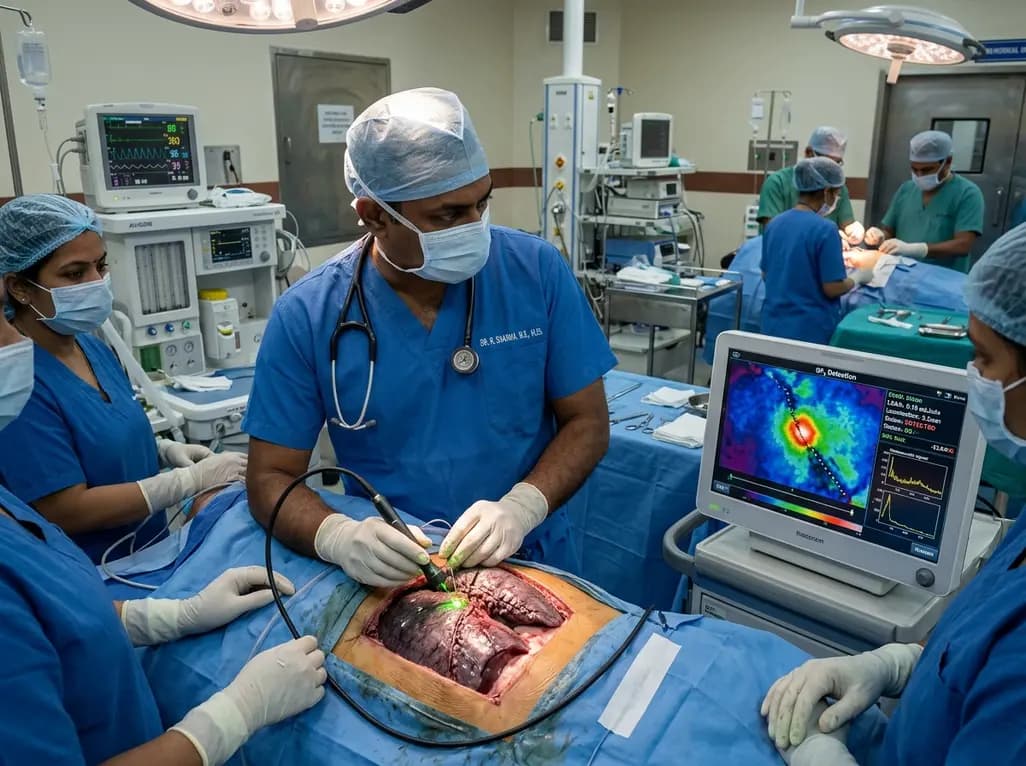
Prolonged postoperative air leaks represent one of the most frequent and troublesome complications following lung resection and tracheobronchial reconstructive surgery. Although modern surgical sealants, reinforced staplers, and refined suture techniques have advanced thoracic care, reliable intraoperative air leak detection remains a persistent technical hurdle. Traditional submersion sealing tests, dye instillation, and spirometric circuit measurements provide only subjective, semi-quantitative, or anatomically imprecise data. Consequently, occult microdefects often go unrecognized until the patient develops pneumothorax, subcutaneous emphysema, or bronchopleural fistula in the postoperative ward. To overcome these long-standing diagnostic boundaries, researchers have developed an innovative optical approach utilizing trace gas spectrometry. By pairing laser photoacoustic spectroscopy with a biologically inert marker, surgeons can now achieve real-time, millimeter-scale localization and quantitative leak rate measurement directly within the surgical field.
Achieving complete aerostasis after pulmonary parenchymal wedge resection, segmentectomy, lobectomy, or airway reconstruction is critical for early chest tube removal and rapid recovery. When an alveolar or bronchial defect persists, patients face protracted hospital stays, heightened infection risks, empyema, and respiratory compromise. For decades, the standard intraoperative aerostasis assessment has relied on filling the hemithorax with warm saline while the anesthesiologist applies positive airway pressure to visualize escaping bubbles. However, this classical water submersion test possesses inherent limitations. It requires adequate anatomical pooling, which proves technically challenging during video-assisted thoracoscopic surgery or robotic thoracic interventions. Furthermore, fluid submersion cannot easily pinpoint leaks within deep interlobar fissures, posterior mediastinal recesses, or obscured bronchial margins. Visual bubble grading also fails to provide objective, standardized metrics regarding volumetric gas efflux, making it difficult for surgeons to determine whether minor parenchymal bubbling warrants additional surgical reinforcement or sealant application.
Photoacoustic spectroscopy offers an extraordinarily sensitive method for identifying gaseous molecules at trace levels. The foundational principle relies on the photoacoustic effect, wherein modulated laser light irradiates specific gas molecules tuned to their unique optical absorption spectrum. When the target molecules absorb this periodic electromagnetic energy, rapid non-radiative relaxation generates local periodic heating and transient thermal expansion. Consequently, this thermal fluctuation produces localized acoustic pressure waves that sensitive micro-transducers can pick up and convert into quantitative electrical signals. In this aerostasis monitoring application, sulfur hexafluoride serves as the photoactive tracer gas. Sulfur hexafluoride features exceptionally strong infrared absorption bands alongside profound chemical and biological inertness. Introducing minimal concentrations of this trace gas into the positive-pressure ventilation circuit allows a handheld or robotic optical sensor probe to detect microscopic gas plumes escaping from defective suture lines with exceptional fidelity.
To establish rigorous proof-of-concept, investigators configured a two-stage validation workflow combining physical benchtop simulation and in vivo surgical validation. The initial benchtop phase utilized a latex-balloon pulmonary analogue ventilated under controlled positive end-expiratory pressure gradients ranging between 490 and 1500 Pascals, incorporating standardized needle punctures. Subsequently, acute in vivo evaluations took place in a dedicated rabbit thoracotomy model undergoing left-sided lateral thoracotomy. Investigators created controlled visceral pleural lacerations and bronchial stump microdefects to mirror real-world operative pathology. During positive-pressure ventilation, sulfur hexafluoride was blended into the inspiratory circuit at a minimal dilution of 0.02 volume percent. The surgical team then hand-scanned a narrow 3-millimeter optical detector probe across the exposed pulmonary surface at a sampling frequency of 10 Hertz. Concurrently, researchers derived a validated mathematical mass-balance model to transform real-time photoacoustic concentration readings into precise defect efflux rates.
The experimental results demonstrated outstanding diagnostic accuracy and robust physiological safety across all test parameters. The photoacoustic sensor successfully detected 100% of the induced defects, identifying all ten visceral pleural lacerations and both bronchial stump lesions without exception. Furthermore, the optical probe achieved peak signal-to-background ratios ranging from 155:1 to 540:1 at practical stand-off scanning distances of 3 to 10 millimeters. Spatial localization proved remarkably tight, yielding a median error of merely 2 millimeters relative to verified anatomical defects. Quantitative efflux rate calculations derived from the mass-balance model aligned closely with theoretical physical predictions within a 14% margin of error. Crucially, continuous ambient environmental monitoring recorded surgical field tracer concentrations between 0.012 and 0.058 parts per million, which is over 13,000 times below established occupational exposure limits. In addition, hemodynamic monitoring confirmed zero alterations in end-tidal carbon dioxide, peak airway pressures, or respiratory compliance during trace gas administration.
Translating this optical sensing technology from animal thoracotomy models into human operating suites holds immense clinical promise for cardiothoracic surgery. As minimally invasive and robotic approaches continue to dominate thoracic oncology, the demand for non-fluid-dependent intraoperative air leak detection tools has grown substantially. Integrating slender photoacoustic scanning probes into thoracoscopic trocars or robotic articulated arms would allow automated, rapid sweeping of parenchymal staple lines and bronchial anastomoses without flooding the hemithorax. Moreover, the quantitative efflux rate data enables surgeons to distinguish benign, low-grade alveolar oozing from high-velocity bronchial leaks that require structural suturing. Before clinical translation, future research must refine the ergonomic probe interface, validate performance across complex atelectatic lung tissue, and adapt the mass-balance scaling framework to adult human tidal volumes. Ultimately, this precision diagnostic platform bridges the gap between intraoperative leak detection and proactive prevention of prolonged postoperative pulmonary complications.
Standard submersion tests rely entirely on subjective visual detection of saline bubbles, which becomes difficult in deep, obscured thoracic spaces or during minimally invasive surgery. In contrast, laser photoacoustic sensing actively identifies trace gas plumes escaping from defective tissues. This approach provides objective, quantitative efflux rates and achieves millimeter-scale spatial localization without requiring fluid filling of the thoracic cavity.
Yes, sulfur hexafluoride is a biologically inert and non-toxic gas routinely utilized in diagnostic lung imaging and ophthalmology. In this surgical application, it is administered at an ultra-dilute concentration of 0.02 volume percent. Experimental data confirmed no alterations in ventilatory mechanics, while ambient operating room concentrations remained over 13,000-fold below established international occupational exposure limits.
The compact design of the optical probe makes it highly adaptable for minimally invasive thoracoscopy and robotic platforms. Because the technology does not require fluid instillation, surgeons can guide the sensor through standard trocar ports to scan parenchymal resection margins and bronchial stumps, providing rapid acoustic feedback even within narrow anatomical working corridors.
Disclaimer: This content is for informational and educational purposes only and does not constitute medical advice, diagnosis, or treatment. Healthcare professionals should exercise their independent clinical judgment. Refer to the latest local and national guidelines for clinical practice.
References

Read summarized clinical updates, watch expert medical content, and earn CME certifications right from your smartphone.
Open your smartphone camera to scan and install.





A novel intraoperative aerostasis monitoring technique using laser photoacoustics and trace sulfur hexafluoride delivers millimeter-scale leak localization in thoracic surgery models, addressing the limitations of conventional bubble tests and providing quantitative assessment of pulmonary suture lines.
4 weeks back
A nationwide English cohort study shows that interstitial lung diseases are no longer rare, with incidence jumping 30% and 200,000 active cases. This analysis highlights clinical implications for diagnosis, multi-disciplinary management, and global health priorities across respiratory and internal medicine.
Today

A nationwide South Korean study shows underreporting of smoking among women dropped from 57.4% to 36.4% between 2008 and 2021. However, over one-third of female smokers still conceal their habit, highlighting the critical role of cotinine verification in clinical risk assessment.
Today

PepsiCo and Monster Beverage have challenged the FSSAI ban on the energy drink label in Indian courts. While companies highlight supply disruptions, regulatory actions spotlight severe cardiovascular and metabolic risks associated with excessive caffeine, sugar, and taurine consumption, especially in adolescents.
Today

A new study evaluates the rheological stability of decellularized peripheral nerve matrix hydrogels under varied storage conditions. Findings show -80°C storage and freeze-drying preserve gelation kinetics and mechanical stiffness, offering key insights for shipping and translational clinical applications.
Today

A Bayesian multilevel meta-analysis reveals that aerobic training combined with moderate carbohydrate restriction modestly lowers HbA1c in type 2 diabetes. However, sparse data and very low certainty leave incremental benefits over exercise or diet alone unproven, highlighting the need for individualized care.
Yesterday
