.webp&w=384&q=75)

Loading, please wait...
Loading, please wait...
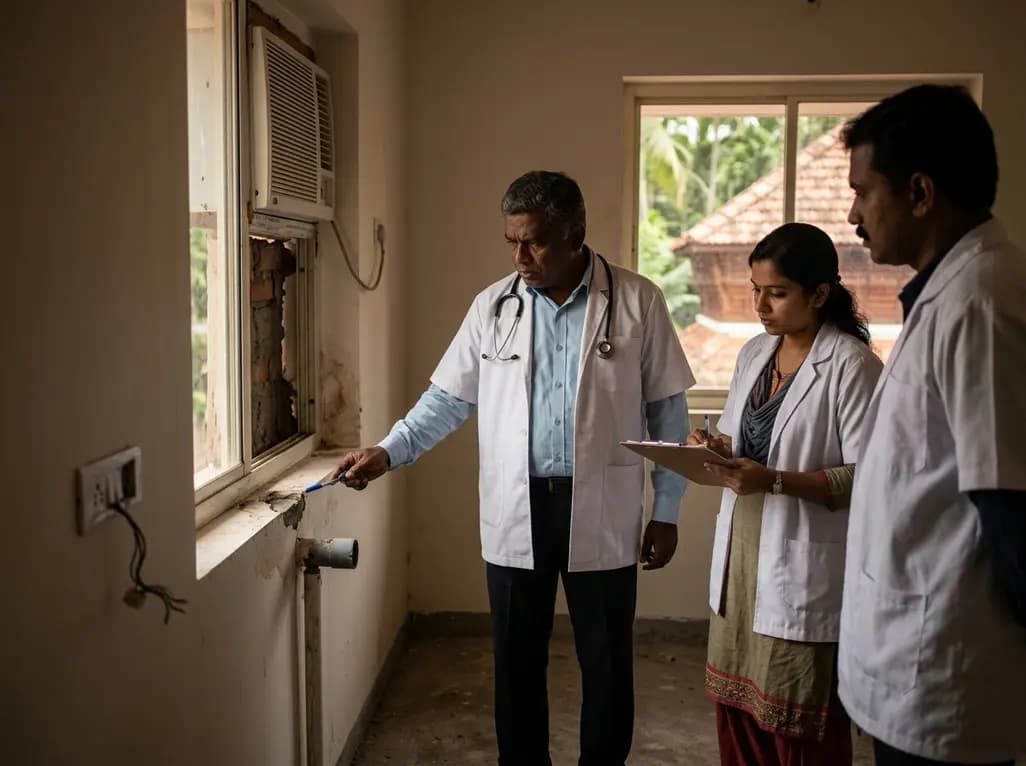
The Government of Kerala recently ordered a high-level probe into widespread irregularities in the construction of hospital isolation wards across the state. Following the Covid-19 pandemic, the state sanctioned a major project worth over Rs 250 crore. This initiative intended to construct modern infectious disease containment units across 88 assembly constituencies. However, recent official reviews revealed severe structural flaws and unhygienic conditions in completed facilities. Consequently, health authorities found these specialized units completely unsuitable for admitting and treating vulnerable patients. For medical professionals, functional hospital isolation wards serve as the primary defensive barrier against fatal contagion. Therefore, understanding the engineering breakdowns and clinical consequences of this project remains vital for healthcare administrators and clinicians nationwide.
State Health Minister K Muraleedharan recently addressed the legislative assembly regarding substantial project delays and quality failures. Originally, the state planned 88 units to fortify grassroots defenses against seasonal viral outbreaks and emerging pathogens. Specifically, each isolation ward received an estimated budget of approximately Rs 1.8 crore to guarantee turnkey clinical readiness. The state tasked a Thrissur-based agency with basic civil construction at Rs 1.38 crore per unit. Meanwhile, the Kerala Medical Services Corporation Limited managed procurement of critical medical equipment worth Rs 44 lakh per site. Nevertheless, the executing agencies completed only 55 facilities over several years. Furthermore, contractors handed over 33 units to local hospitals, while another 22 units awaited operational assistance. Despite these substantial financial investments, the health minister announced that not a single completed facility can house sick patients safely. Legislative leaders subsequently characterized the structural collapse as an egregious administrative failure. Accordingly, the state constituted a specialized inquiry committee led by the Principal Secretary of Health. This expert panel must examine contractor non-compliance, financial discrepancies, and structural lapses before authorities initiate blacklisting procedures or legal action against defaulting personnel.
Onsite engineering assessments revealed astonishing structural oversights across the newly erected isolation buildings. Most prominently, contractors utilized thin tin-sheet roofing across many 2,400-square-foot units instead of robust concrete architecture. Consequently, these fragile ceilings cannot even bear the mechanical weight of standard ceiling fans. In addition, intense tropical heat turns uninsulated tin structures into stifling ovens during warm summer months. Modern infection containment requires continuous mechanical temperature control and precise airflow regulation. Unfortunately, the finished wards completely lack functional air-conditioning infrastructure, centralized exhaust ducts, and secondary power connections. Moreover, civil contractors left extensive electrical wiring exposed and ignored basic sanitary plumbing networks. Consequently, several handed-over facilities lack operational toilets, hand hygiene sinks, and dedicated sewage lines. Standard biomedical protocols require specialized drainage traps to prevent dangerous pathogen spread into community reservoirs. Instead, these facilities exhibit water seepage, unsealed wall joints, and unfinished masonry floors. Therefore, clinical teams cannot sanitize these interior surfaces using standard chemical disinfectants. Ultimately, such severe infrastructure defects render the physical spaces completely unusable for modern clinical care. Thus, the flawed architecture violates fundamental engineering requirements established for public health defense.
Effective containment of respiratory pathogens demands strict adherence to established national infection prevention guidelines. National bodies like the National Centre for Disease Control provide explicit technical benchmarks for airborne infection isolation rooms. Specifically, proper isolation wards must maintain continuous negative air pressure relative to surrounding corridors. This differential pressure gradient guarantees that contaminated air never escapes into common clinical zones when personnel enter rooms. Furthermore, ventilation systems must deliver a minimum of twelve complete air changes per hour. Exhaust air must either undergo high-efficiency particulate air filtration or vent directly outdoors far from public pathways. In contrast, poorly sealed structures permit stagnant air pools and unpredictable drafts. Additionally, dedicated isolation spaces must incorporate well-designed anterooms to facilitate donning and doffing personal protective equipment. Clinicians also require smooth, non-porous floor and wall coatings that resist repeated decontamination with sodium hypochlorite solutions. When basic civil amenities like plumbing and ceiling ventilation fail, clinicians cannot enforce standard droplet precautions. Consequently, substandard structural environments rapidly compromise institutional biosecurity during virulent airborne outbreaks. Thus, architectural compliance represents an indispensable clinical safeguard rather than a mere administrative formality. Accordingly, hospital administrators must treat ventilation architecture as a core life-support system.
Housing infectious individuals within unfinished or unventilated facilities creates severe occupational and environmental hazards. Inadequate ventilation dramatically multiplies the airborne concentration of pathogenic droplet nuclei. Consequently, treating patients in sealed tin-roofed chambers without air-conditioning exposes attending physicians and nurses to enormous viral loads. Moreover, extreme ambient heat inside tin sheds induces rapid physical exhaustion and heat stress among staff wearing bulky protective equipment. When frontline providers experience debilitating discomfort, adherence to strict barrier nursing protocols inevitably deteriorates. Similarly, the lack of operational toilets poses dangerous cross-contamination hazards. Patients with enteric or respiratory infections must share distant general facilities, which risks widespread hospital-acquired infections. Furthermore, incomplete electrical networks jeopardize the reliable operation of critical diagnostic machines, infusion pumps, and oxygen delivery systems. If backup power sources fail during emergencies, acute respiratory distress patients face life-threatening consequences. Therefore, utilizing substandard buildings invites severe medical malpractice liability and compromises patient safety. Ultimately, hospital administrators must recognize that substandard isolation structures endanger staff members far more than they protect the community. Hence, health systems cannot sacrifice engineering rigor during emergency procurement phases. In addition, clinicians must formally refuse to deploy clinical teams into compromised physical environments that lack safety certifications.
The unfolding controversy in Kerala underscores the vital need for robust regulatory oversight in public health infrastructure projects. Specialized health infrastructure requires technical engineering supervision distinct from standard commercial construction. Public procurement agencies, such as the Kerala Medical Services Corporation Limited, must implement multi-stage quality verifications before releasing funds. Specifically, independent biomedical engineers and hospital infection control committees should conduct rigorous structural audits prior to building handovers. Furthermore, public health departments must mandate clear architectural compliance certificates before inaugurating any patient treatment center. When contractors cut corners or utilize unapproved materials, government bodies must enforce immediate contractual penalties and administrative blacklisting. In addition, transparent third-party auditing prevents the wasteful diversion of valuable emergency health budgets. Kerala has encountered recurring biological threats, including devastating Nipah virus flare-ups, seasonal dengue surges, and pandemic coronavirus spikes. Therefore, regional preparedness depends entirely upon durable, certified, and fully equipped isolation capacity. Moving forward, public healthcare systems must integrate clinical stakeholders into the design, construction, and commissioning stages of every hospital project. Accordingly, establishing stringent accountability mechanisms guarantees that public health expenditures translate into genuine clinical resilience during future pandemics. Consequently, state authorities must view infrastructure vigilance as an essential component of clinical governance.
Q1: Why did the Kerala government order an investigation into newly built isolation wards?
The Kerala government ordered an expert investigation because completed isolation wards, constructed at approximately Rs 1.8 crore each, were found completely unfit for clinical care. A submission in the state assembly revealed major structural defects, missing sanitation facilities, and uninstalled equipment across dozens of constituencies. Consequently, an expert team led by the Principal Secretary of Health is investigating execution lapses, contractor accountability, and financial irregularities across the Rs 250-crore project.
Q2: What essential engineering specifications must a functional hospital isolation ward possess?
Functional airborne isolation facilities require negative atmospheric pressure gradients, sealed building envelopes, and dedicated heating, ventilation, and air conditioning systems delivering at least twelve air changes per hour. Furthermore, they demand high-efficiency particulate air filtration, dedicated anterooms for protective gear changes, and continuous backup power. Additionally, reliable running water, private negative-pressure ensuite washrooms, and seamless scrubbable antimicrobial wall surfaces are strictly necessary to maintain infection prevention standards and safeguard healthcare staff.
Q3: How do defective isolation ward facilities threaten patient safety and hospital infection control?
Defective isolation wards jeopardize patient safety by concentrating airborne viral particles in unventilated rooms, vastly increasing microbial transmission risk among healthcare professionals. Without operational washrooms, patients cross-contaminate common hospital corridors, potentially sparking deadly hospital-acquired outbreaks. Furthermore, inadequate power supplies disable life-saving monitors and oxygen delivery systems, leaving critically ill individuals vulnerable during respiratory emergencies. Consequently, non-compliant facilities amplify public health risks rather than controlling infectious epidemics effectively.
Disclaimer: This content is for informational and educational purposes only. It does not constitute medical advice or replace professional judgment. Refer to the latest local and national guidelines for clinical practice.
References

Read summarized clinical updates, watch expert medical content, and earn CME certifications right from your smartphone.
Open your smartphone camera to scan and install.





An expert health department inquiry in Kerala is examining severe construction lapses in newly built isolation wards across 88 assembly constituencies. Structural deficiencies, missing climate control, and sanitation failures render these units unfit for clinical containment, raising grave patient safety concerns.
Today
A study reveals that patients with chronic gastritis and inflammatory bowel disease exhibit marked skin resistance drops across specific thoracic dermatomes (T5-T9 and T8-T12), correlating with visceral referred pain severity and offering a non-invasive biomarker.
Today

A landmark biomechanical study demonstrates that sports bra support and running shoe cushioning interact significantly to influence tibial acceleration, breast motion, and comfort in female runners, providing crucial insights for clinical counseling in sports medicine and women's health.
Today

The Delhi High Court declined immediate relief to PepsiCo regarding fresh manufacturing of products using the energy drink label. As regulatory bodies enforce strict standards on caffeinated beverages, medical professionals must evaluate the cardiovascular, metabolic, and pediatric risks linked to excessive intake.
Today

This review explores advances in antibacterial photothermal therapy, highlighting photothermal agents across NIR-I and NIR-II windows. By overcoming biofilm defenses and multidrug resistance without conventional antibiotics, these biomaterial platforms offer transformative options for complex clinical infections.
Today

A landmark Monte Carlo simulation study reveals widespread perchlorate and chlorate exposure through vegetables and drinking water, presenting significant thyroid disruption risks in young children. Learn the physiological mechanisms, dietary drivers, and preventive strategies for clinical practice.
Today
