.webp&w=384&q=75)

Loading, please wait...
Loading, please wait...
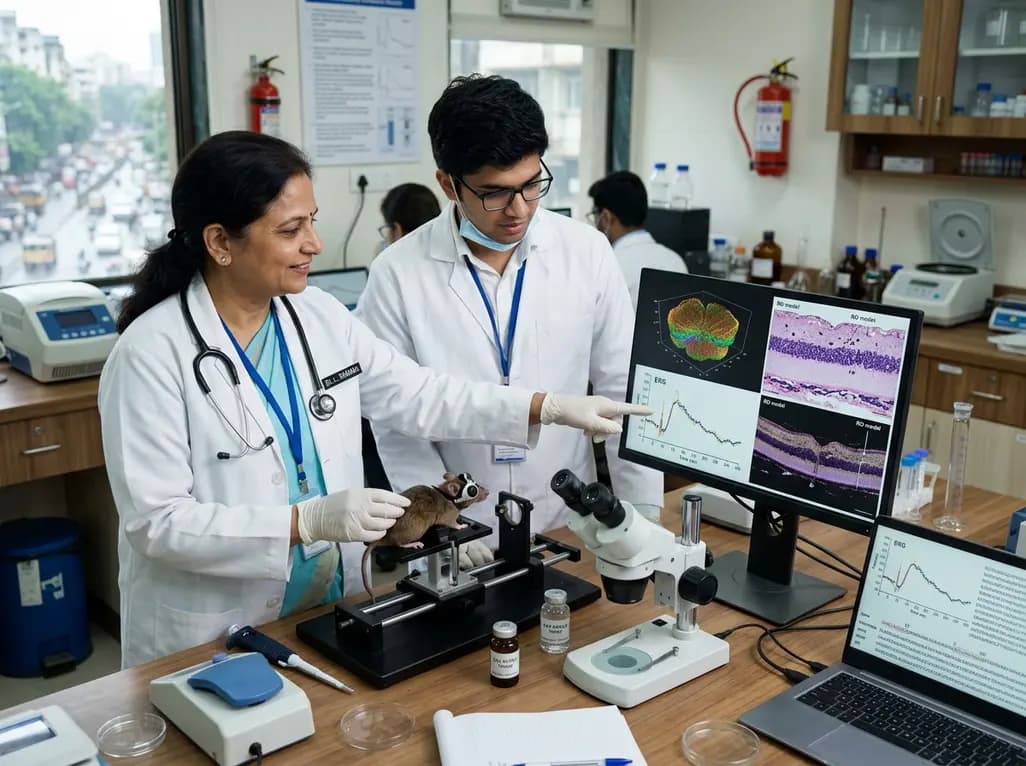
Inherited retinal disorders present substantial diagnostic and therapeutic challenges for modern clinical ophthalmology. Among these rare conditions, KCNV2-associated retinal dystrophy causes early, progressive vision loss through impaired photoreceptor voltage regulation. Recently, researchers developed an innovative mouse model that replicates key human disease characteristics. This breakthrough publication offers vital mechanistic insights and establishes an indispensable translational platform for evaluating novel gene-based therapies.
The KCNV2 gene encodes Kv8.2, an electrically silent voltage-gated potassium channel subunit. In healthy retinal tissue, Kv8.2 co-assembles with Kv2.1 subunits within photoreceptor inner segments. This molecular partnership modulates delayed rectifier potassium currents and maintains appropriate membrane resting potential during phototransduction. Consequently, pathogenic loss-of-function variants disrupt normal potassium ion homeostasis. Photoreceptors subsequently experience chronic membrane depolarization, excessive metabolic stress, and progressive structural degradation. Clinically, affected individuals experience central visual acuity loss, marked photophobia, and impaired color discrimination during early childhood. Furthermore, patients frequently exhibit nyctalopia as rod system dysfunction advances over time. Standard full-field electroretinography demonstrates a pathognomonic phenotype known as cone dystrophy with supernormal rod response. Therefore, unravelling these biophysical disruptions remains vital for creating targeted molecular interventions.
To examine the underlying disease mechanisms in vivo, investigators generated a targeted mutant mouse line. The team utilized CRISPR/Cas9 gene-editing technology to engineer an early stop codon at position E151. Notably, this murine mutation directly mirrors the recurrent E143X nonsense variant frequently identified in human patients. Western blot analysis confirmed the complete absence of the full-length Kv8.2 protein in homozygous mutant retinas. In addition, immunohistochemical investigations verified that truncated protein products failed to form functional potassium channels. This genetic fidelity ensures that the animal model faithfully captures the severe loss-of-function state present in human clinical cohorts. As a result, this newly established mouse line provides an ideal biological system for preclinical therapeutic discovery.
Functional evaluation through electroretinography demonstrated remarkable electrophysiological alignment with human disease manifestations. The Kcnv2 mutant mice exhibited markedly attenuated photopic responses under light-adapted conditions. This finding directly reflects severe primary cone photoreceptor impairment. Furthermore, scotopic testing revealed delayed and significantly reduced rod responses to low-intensity light flashes. However, when researchers exposed dark-adapted retinas to high-intensity flashes, they recorded paradoxically massive rod-driven b-wave amplitudes. This exaggerated electrical response mirrors the supernormal rod phenotype classically observed in affected patients. Thus, the model precisely replicates the unique electrophysiological abnormalities characteristic of human KCNV2 channelopathy. Consequently, these findings validate the model as a reliable benchmark for functional rescue studies.
Detailed histological characterization demonstrated severe morphological degeneration within the mutant neuroretina. Quantitative immunohistochemistry revealed a prominent reduction in cone arrestin-positive cells across retinal sections. Additionally, the thickness of the outer nuclear layer showed progressive thinning compared to wild-type controls. This anatomical loss confirms accelerated apoptotic clearance of both rod and cone photoreceptors. Moreover, mutant retinas exhibited intense upregulation of glial fibrillary acidic protein within retinal Müller glia. This reactive macroglial response highlights widespread cellular distress and ongoing neuroinflammatory activation. Therefore, structural analysis demonstrates that functional potassium channel disruption inevitably leads to permanent photoreceptor loss and retinal remodeling.
The development of this faithful preclinical model opens exciting therapeutic avenues for inherited retinal disease research. Historically, the absence of robust animal models hindered the translational pipeline for KCNV2-targeted therapeutics. Researchers can now systematically evaluate adeno-associated viral vectors designed to deliver functional human KCNV2 cDNA. Furthermore, the model allows researchers to test novel neuroprotective compounds and small-molecule channel modulators in vivo. Investigators can monitor structural preservation and functional recovery through non-invasive optical coherence tomography and electroretinography. Consequently, this murine platform provides the necessary bridge to accelerate preclinical candidates toward human clinical trials.
Accurate identification of rare inherited retinal dystrophies requires vigilant clinical acumen and comprehensive multimodal diagnostic testing. Young pediatric patients who present with unexplained visual decline, nystagmus, and photophobia require urgent referral for electrophysiology. Full-field electroretinography serves as the definitive functional diagnostic tool. Clinicians must carefully evaluate scotopic and photopic traces for delayed dim-flash responses and distinctive supernormal bright-flash b-waves. Moreover, molecular genetic sequencing confirms the pathogenic KCNV2 variant and excludes overlapping retinal degenerations. Early diagnosis prevents unhelpful diagnostic delays, facilitates visual rehabilitation, and enables timely genetic counseling for affected families.
KCNV2-associated retinal dystrophy typically manifests in early childhood with progressive bilateral central vision loss, pronounced photophobia, and impaired color discrimination. Parents often notice children struggling in bright sunlight or experiencing difficulty with fine visual tasks. In addition, night blindness frequently develops as rod dysfunction progresses. Full-field electroretinography and molecular genetic testing confirm the diagnosis, ruling out conditions like achromatopsia and Stargardt disease.
The supernormal rod response represents a distinctive electrophysiological signature caused by disrupted Kv8.2 voltage-gated potassium channel kinetics in photoreceptors. Under dark adaptation, low-intensity light stimuli yield delayed, subnormal b-waves due to impaired baseline hyperpolarization. Conversely, bright flashes elicit an abnormally large, supernormal rod-driven b-wave response. This unique paradoxical response pattern distinguishes KCNV2 retinopathy from virtually all other inherited cone-rod dystrophies in clinical practice.
The Kcnv2 E151X mouse model accurately replicates both the characteristic electrophysiological abnormalities and progressive photoreceptor loss seen in human patients. Because the engineered E151X mutation corresponds directly to the prevalent human E143X nonsense mutation, this model provides an authentic mammalian platform. Investigators can evaluate adeno-associated viral gene replacement constructs, assess vector dosing, and measure functional electroretinographic recovery prior to initiating human trials.
Disclaimer: This content is for informational and educational purposes only and is intended for healthcare professionals. Refer to the latest local and national guidelines for clinical practice.
References

Read summarized clinical updates, watch expert medical content, and earn CME certifications right from your smartphone.
Open your smartphone camera to scan and install.





Researchers have engineered a Kcnv2 E151X mouse model using CRISPR/Cas9 that successfully replicates the structural and electrophysiological hallmarks of KCNV2-associated retinal dystrophy, offering a critical platform for preclinical gene therapy testing.
4 weeks back

Abdominal aortic aneurysm rupture remains a catastrophic vascular emergency. Groundbreaking research reveals that USP53 accelerates aneurysm progression by reprogramming smooth muscle cell metabolism toward aerobic glycolysis, highlighting a promising target beyond conventional diameter-based surveillance.
Today

A pharmacometric and machine learning study reveals that specific vaginal bacteria alter cervical antiretroviral exposure, highlighting the need for precision HIV PrEP strategies.
Today

A nationwide Swedish cohort study shows oral glucocorticoid exposure over 1-2 years strongly predicts overall organ damage in SLE, while cardiovascular risk reflects cumulative doses across 3 years. These findings reinforce early steroid minimization and cautious long-term maintenance.
Today

A scoping review highlights neural mobilization as a promising adjunct in managing cervicogenic headache. Integrating neurodynamics into multimodal physical therapy improves pain, range of motion, and posture, though standardized protocols and larger clinical trials are still needed.
Today

Recent research defines ferro-aging as a conserved iron-lipid axis driving organ decline across primates. Age-related iron dyshomeostasis stimulates ACSL4-mediated lipid peroxidation, promoting cellular senescence. Notably, vitamin C directly inhibits ACSL4, suppressing phospholipid oxidation and multi-organ decay.
Today
