.webp&w=384&q=75)

Loading, please wait...
Loading, please wait...
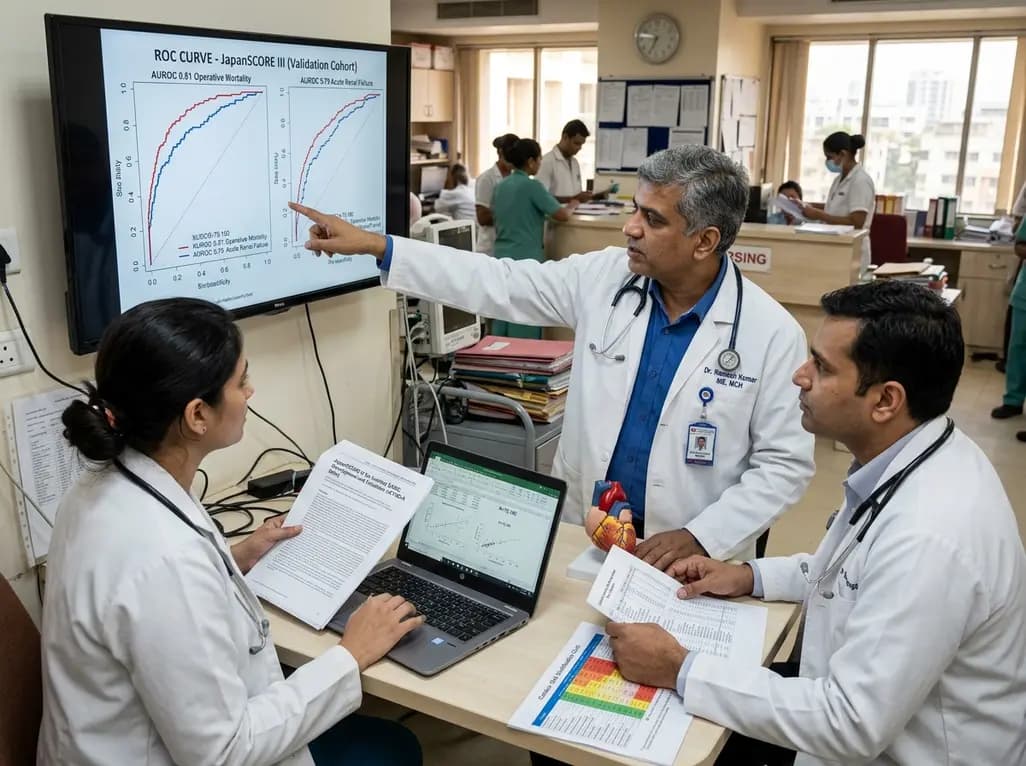
Reliable preoperative evaluation remains essential for surgical decision-making and patient counseling in modern cardiac surgery. In this context, accurate isolated CABG risk assessment empowers surgical teams to quantify procedural hazards and optimize perioperative care pathways. Surgical registries worldwide continually refine their predictive algorithms because patient demographics, surgical techniques, and medical therapies evolve over time. Japan recently introduced JapanSCORE III, an advanced predictive instrument derived from the comprehensive Japan Cardiovascular Surgery Database - Adult section (JCVSD-A). This nationwide study provides crucial insights into modern operative mortality and postoperative complications.
Historically, risk evaluation in coronary revascularization relied on international scoring tools like EuroSCORE II and the Society of Thoracic Surgeons score. However, clinicians often found that Western scoring systems overestimated mortality when applied to East Asian cohorts. Japanese investigators initially addressed this discrepancy by creating JapanSCORE I and subsequently JapanSCORE II. These early scores established benchmark mortality rates across regional cardiovascular centers. Nevertheless, cardiovascular practice has experienced profound transformations over the past decade. Patients presenting for surgical revascularization are now significantly older, frequently exhibit multi-vessel diffuse disease, and carry substantial metabolic comorbidities. Simultaneously, advancements in off-pump techniques, modern arterial grafting strategies, and perioperative critical care have substantially improved patient safety. Consequently, previous iterations no longer mirrored contemporary surgical reality. To address this gap, researchers analyzed 70,180 consecutive patients who underwent isolated CABG across Japan between 2018 and 2023. By establishing a temporal validation framework, the investigators separated the cohort into a development set from 2018 to 2022 and a validation set from 2023. This methodological design ensured that the updated scoring system reflects real-world clinical performance under contemporary operative standards.
To build JapanSCORE III, the research team implemented a least absolute shrinkage and selection operator (LASSO) regression model. LASSO offers major statistical advantages over conventional stepwise regression by penalizing unnecessary coefficients. Therefore, the algorithm prevents model overfitting and enhances predictive precision across diverse clinical settings. Furthermore, the modeling process incorporated modern imaging-based parameters alongside classical demographic and clinical variables. The primary outcome was operative mortality, while secondary endpoints encompassed major postoperative complications. These secondary complications included stroke, reoperation for bleeding or graft failure, prolonged mechanical ventilation, acute renal failure, deep sternal wound infection, gastrointestinal complications, and intensive care unit stay exceeding seven days. In the validation cohort, the operative mortality model demonstrated remarkable discrimination, achieving an area under the curve (AUC) of 0.80. Similarly, the acute renal failure model attained an AUC of 0.80. Additionally, calibration plots confirmed excellent agreement between predicted and observed event rates across all risk deciles. These statistical metrics highlight the robustness of modern machine-learning algorithms in surgical risk prediction.
The nationwide analysis revealed notable epidemiological findings among the 70,180 isolated CABG patients. Specifically, the mean patient age was 69.3 years, and women represented 20% of the entire cohort. Despite an increasing baseline risk profile among surgical candidates, the overall operative mortality remained impressively low at 2.7%. Moreover, the study documented low rates across several catastrophic complications. Postoperative stroke occurred in only 1.8% of patients, while reoperation was required in 1.5%. Acute renal failure developed in 2.0% of cases, and deep sternal wound infection occurred in 1.1%. In addition, gastrointestinal complications affected 1.3% of the surgical population. However, prolonged mechanical ventilation and extended intensive care unit stay presented greater clinical burdens, occurring in 3.7% and 13.2% of patients, respectively. These observations illustrate that while mortality remains tightly controlled, non-fatal morbidities drive resource utilization in cardiac surgery units. Therefore, scoring models must evaluate specific organ complications alongside mortality to assist teams in perioperative planning.
The introduction of JapanSCORE III holds profound implications for heart teams evaluating patients with complex coronary artery disease. Heart team discussions require objective, data-driven estimates of surgical risk to balance coronary artery bypass grafting against percutaneous coronary intervention. When risk scores accurately reflect local outcomes, clinicians can engage in transparent shared decision-making with patients and families. Furthermore, precise risk stratification identifies vulnerable patients who require intensive prehabilitation and tailored anesthetic strategies. For example, patients identified as high risk for acute renal failure can receive targeted nephroprotective bundles, including optimized hydration and hemodynamic maintenance. Similarly, recognizing candidates prone to prolonged mechanical ventilation allows anesthesiologists to implement lung-protective ventilation and early extubation protocols. Quality assurance programs also benefit substantially from updated risk models. Hospital administrators and surgical directors can monitor risk-adjusted mortality rather than unadjusted outcomes. Consequently, institutions can accurately benchmark performance, identify areas for improvement, and maintain high standards of patient safety across all surgical services.
Although derived from Japanese surgical data, the findings of JapanSCORE III provide valuable lessons for global cardiac surgery, particularly across Asian populations. In countries like India, coronary artery disease presents at an earlier age with diffuse multi-vessel involvement and extensive calcification. Indian clinicians frequently utilize the EuroSCORE II or the Society of Thoracic Surgeons calculator for risk estimation. Nevertheless, international studies demonstrate that Western calculators often miscalculate surgical mortality in South Asian patients due to distinct anatomical, genetic, and socioeconomic factors. The success of JapanSCORE III underscores the urgent necessity for regional and national surgical databases across South Asia. Establishing structured national registries enables healthcare systems to calibrate international models or create indigenous predictive tools. Until such models become universally available in low- and middle-income regions, understanding data from Asian cohorts offers useful clinical context. By observing how patient outcomes remain stable despite increasing operative risk, international surgical teams can refine perioperative protocols and enhance surgical quality worldwide.
JapanSCORE III incorporates contemporary surgical data from over 70,000 patients treated between 2018 and 2023. Unlike earlier iterations that relied on standard logistic regression, this updated model utilizes LASSO regression and incorporates modern imaging-based variables. Consequently, it achieves superior discrimination and calibration for operative mortality and acute renal failure, reflecting the latest advancements in coronary revascularization techniques, off-pump surgery, and postoperative intensive care.
The study reported an overall operative mortality of 2.7% across 70,180 isolated CABG procedures. Regarding major complications, postoperative stroke occurred in 1.8%, repeat surgery in 1.5%, and acute renal failure in 2.0% of cases. Deep sternal wound infections and gastrointestinal complications remained infrequent at 1.1% and 1.3%, respectively. However, prolonged mechanical ventilation reached 3.7%, and 13.2% of patients required extended intensive care stays exceeding seven days.
Region-specific calculators are essential because international models like EuroSCORE II and the STS score often miscalculate procedural risk in Asian patients. Differences in baseline cardiovascular genetics, prevalence of diabetes, anatomical vessel caliber, and surgical strategies substantially influence outcomes. Developing population-specific scoring systems like JapanSCORE III ensures accurate risk assessment, promotes realistic patient counseling, supports balanced multidisciplinary heart team deliberations, and facilitates credible institutional quality auditing.
Disclaimer: This content is for informational and educational purposes only and should not be taken as professional medical advice. Always consult a qualified healthcare provider for personal medical concerns. Refer to the latest local and national guidelines for clinical practice.
References
Hayashi S et al. Development and Validation of Risk Models for Outcomes of Isolated Coronary Artery Bypass Grafting - A Nationwide Analysis in Japan. Circ J. 2026 Sep 02. doi: 10.1253/circj.CJ-26-0160. PMID: 42686525.
Miyata H, Motomura N, Tsukihara H, Takamoto S. Risk models including high-risk cardiovascular procedures: clinical predictors of mortality and morbidity. Ann Thorac Surg. 2011;92(5):1699-1706.
Kurazumi H, Mikamo A, Fukamitsu G, et al. Validation of the JapanSCORE versus the logistic EuroSCORE for predicting operative mortality of cardiovascular surgery in Yamaguchi University Hospital. Gen Thorac Cardiovasc Surg. 2012;60(1):15-22.

Read summarized clinical updates, watch expert medical content, and earn CME certifications right from your smartphone.
Open your smartphone camera to scan and install.





JapanSCORE III provides updated isolated CABG risk assessment using nationwide JCVSD-A data from 70,180 patients. Utilizing LASSO regression, the model demonstrates high discrimination for operative mortality and acute renal failure, offering valuable insights for heart teams and surgical risk stratification.
4 weeks back

Chronic eosinophilic pneumonia can present with atypical bronchoalveolar lavage findings and an organizing pneumonia pattern, necessitating surgical lung biopsy.
Today

Discover the crucial distinctions between mesonephric and mesonephric-like proliferations of the female genital tract. Learn the key histomorphologic, immunohistochemical, and molecular differences essential for accurate diagnosis and clinical management.
Today
Kikuchi-Fujimoto disease rarely presents with refractory shock and sinus bradycardia in children. This case report highlights life-threatening hemodynamic instability requiring intensive care, preserved cardiac contractility, and the critical diagnostic role of early excisional lymph node biopsy.
Today

A narrative review investigates whether the articularis genus muscle functions as an independent anatomical entity or blends with the vastus intermedius. We evaluate its morphology, role in retracting the suprapatellar bursa, and direct clinical significance in anterior knee pain and arthroplasty.
Today

A Bayesian multilevel meta-analysis reveals that aerobic training combined with moderate carbohydrate restriction modestly lowers HbA1c in type 2 diabetes. However, sparse data and very low certainty leave incremental benefits over exercise or diet alone unproven, highlighting the need for individualized care.
Today
