.webp&w=384&q=75)

Loading, please wait...
Loading, please wait...

India healthcare affordability remains one of the most critical topics across the national medical landscape today. During his keynote address at the ET Healthcare Leaders Summit, Max Healthcare Chairman and Managing Director Abhay Soi presented a compelling argument regarding systemic solutions. He emphasized that genuine affordability cannot arise merely from suppressing prices or enforcing arbitrary caps. Instead, sustainable progress requires an aggressive expansion of clinical infrastructure and medical capacity. Soi highlighted that pricing reflects substantial input expenditures, including land acquisition, construction, advanced biomedical equipment, and clinical workforce compensation. Therefore, policymakers must separate per capita purchasing power from the tangible operational costs of quality clinical care.
Healthcare leaders often struggle with the conventional notion that cheaper healthcare automatically translates into better accessibility. However, Abhay Soi argued that affordability and healthcare pricing represent fundamentally distinct economic concepts. Specifically, affordability depends directly on individual purchasing power, insurance penetration, and broader economic development. In contrast, hospital pricing directly mirrors the capital-intensive nature of tertiary healthcare delivery. Modern hospitals require continuous investment in diagnostic technologies, life-support facilities, regulatory compliance, and skilled personnel. Consequently, enforcing price suppression without lowering capital expenditures risks strangling future hospital expansion across the country.
Furthermore, limiting hospital revenues weakens the financial viability necessary to attract fresh domestic and international capital. When margins diminish excessively, healthcare organizations cannot reinvest in cutting-edge surgical suites, intensive care units, or community medical centers. Therefore, efforts to enhance affordability should focus on raising citizen purchasing power through robust public health coverage. In addition, strengthening national health insurance mechanisms helps shield vulnerable populations from catastrophic out-of-pocket payments. Ultimately, a balanced approach ensures that hospital operators sustain reliable clinical operations while citizens retain dignified access to world-class treatment modalities.
Beyond pricing debates, the structural shortage of physical hospital capacity poses an existential challenge for Indian medicine. For instance, India currently operates fewer than 100,000 organized private hospital beds nationwide. Although leading hospital chains have announced 30,000 to 40,000 additional beds over the next five years, this expansion remains insufficient. Soi highlighted that this pipeline falls substantially short of escalating national healthcare requirements. In fact, national healthcare metrics reveal a severe deficit when compared to global bed-to-population standards.
Moreover, India's changing demographic profile will inevitably accelerate clinical service utilization over the next fifteen years. Although the nation currently benefits from a young demographic dividend, this substantial population segment is steadily aging. As millions transition into older age brackets, chronic disease burdens and complex degenerative ailments will surge. Consequently, tertiary care institutions will face unprecedented patient loads requiring sustained hospitalizations and advanced interventions. Soi estimated that meeting future consumer expectations might require 800,000 to 900,000 quality private hospital beds. Thus, without massive, immediate physical capacity generation, public and private medical institutions will experience acute bed crises, prolonging waiting times and compromising patient safety.
Concurrently, the modern Indian healthcare consumer expects significantly higher standards of facility design and operational excellence. Over recent decades, Indian citizens have experienced superior physical infrastructure across contemporary airports, modern metro transit systems, and corporate environments. Consequently, patient expectations regarding clinical facilities have shifted dramatically away from overcrowded, outdated corridors. Patients and their families now rightfully demand clean, efficient, and technologically integrated care environments.
However, building state-of-the-art hospitals requires substantial capital expenditure that cannot be recovered through artificially suppressed tariffs. To satisfy these rising aspirations, healthcare institutions must incorporate artificial intelligence workflows, robotic surgical equipment, and advanced infection-control systems. Furthermore, modern quaternary hospitals must maintain accredited diagnostic laboratories, advanced imaging suites, and round-the-clock emergency support. These sophisticated installations demand dependable long-term financing models. Therefore, expanding high-quality healthcare delivery requires an economic ecosystem that actively encourages private institutions to upgrade their facilities. When hospitals modernize successfully, they elevate standards for domestic patients while simultaneously strengthening India’s growing reputation as an international medical value hub.
Physical infrastructure alone cannot deliver healthcare without highly skilled clinical manpower. Soi raised serious concerns regarding the ongoing migration of Indian doctors, specialized nurses, and allied healthcare technicians abroad. Overseas healthcare systems actively recruit Indian clinical talent by offering substantially higher remuneration, superior research funding, and structured working hours. Unfortunately, domestic healthcare administration has long relied on the assumption that clinicians should accept subpar economic rewards solely for social service.
However, relying on altruism alone is economically unsustainable in an interconnected global healthcare market. Clinicians undergo over a decade of rigorous education, enduring heavy debt burdens and personal sacrifices during training. Therefore, healthcare systems must make medical careers financially rewarding and professionally gratifying to retain exceptional clinicians. In addition, hospital providers must create competitive compensation models, transparent career progression pathways, and safer workplace environments. Furthermore, investing in nurse training institutes and residency programs will expand the national talent pipeline. Without addressing clinician compensation, newly constructed hospital towers will lack the specialized physicians and critical care nursing staff needed to operate advanced medical equipment safely.
To bridge the massive supply gap, the healthcare sector must welcome varied sources of investment. Some critics argue that private equity and foreign direct investment inevitably inflate treatment expenses for everyday citizens. Nevertheless, Abhay Soi firmly rejected this view, noting that competitive medical markets prevent individual providers from arbitrarily exercising monopoly pricing power. In open markets, fierce competition among healthcare providers drives service quality, improves efficiency, and curbs excessive pricing tendencies.
Consequently, healthcare policy must facilitate seamless capital inflows from foreign investors, private equity firms, public equity markets, and philanthropy. Simultaneously, public sector financing must increase to establish robust secondary hospitals in underserved tier-two and tier-three regions. Blended financing models can also combine government subsidies with private clinical expertise to de-risk greenfield hospital projects. For instance, providing concessional land and streamlined regulatory clearances encourages private developers to build regional cancer and trauma centers. Ultimately, expanding capital investment across all avenues creates a resilient healthcare ecosystem. By scaling healthcare supply across urban and rural geographies, India can achieve long-term healthcare accessibility without compromising clinical quality.
Q1: Why does Abhay Soi argue that making healthcare cheaper will not solve affordability?
Abhay Soi explains that healthcare affordability and pricing represent fundamentally distinct economic variables. Specifically, affordability depends on patient purchasing power, economic growth, and comprehensive insurance coverage. Meanwhile, hospital tariffs reflect essential input expenditures such as real estate, advanced biomedical technology, consumable supplies, and competitive clinician salaries. Consequently, artificially slashing prices diminishes hospital viability and halts vital capacity expansion, worsening severe access issues for future patients.
Q2: How many hospital beds will India need over the coming decades?
India currently maintains fewer than 100,000 organized private hospital beds, with approximately 30,000 to 40,000 beds planned over the next five years. However, as the population steadily ages and chronic disease prevalence climbs, healthcare demand will rise rapidly. Abhay Soi projects that the country could eventually require 800,000 to 900,000 modern private beds to fulfill national clinical needs and rising patient expectations adequately.
Q3: What role does clinician compensation play in addressing healthcare capacity?
Physical hospital infrastructure cannot function safely without experienced doctors, technicians, and specialized nurses. Currently, overseas institutions attract Indian medical professionals with lucrative compensation packages and structured working environments. Therefore, domestic hospitals must provide competitive economic rewards and clear career progression pathways. Addressing clinical compensation prevents severe brain drain and ensures newly constructed healthcare facilities maintain adequate specialist staffing across essential tertiary departments.
Disclaimer: This content is for informational and educational purposes only. It does not constitute medical advice or replace professional judgment. Refer to the latest local and national guidelines for clinical practice.
References

Read summarized clinical updates, watch expert medical content, and earn CME certifications right from your smartphone.
Open your smartphone camera to scan and install.





Max Healthcare CMD Abhay Soi highlights why addressing healthcare affordability in India demands expanding supply and hospital beds rather than artificially slashing prices. Discover key insights into bed capacity shortages, medical talent economics, capital investment, and future healthcare delivery demands.
last month

A retrospective cohort study of 7,716 ICU patients from the MIMIC-IV database demonstrates that Gradient Boosting Decision Trees significantly outperform traditional SOFA scores in predicting in-hospital mortality among patients with sepsis and diabetes, with SHAP analysis providing clinical interpretability.
Today
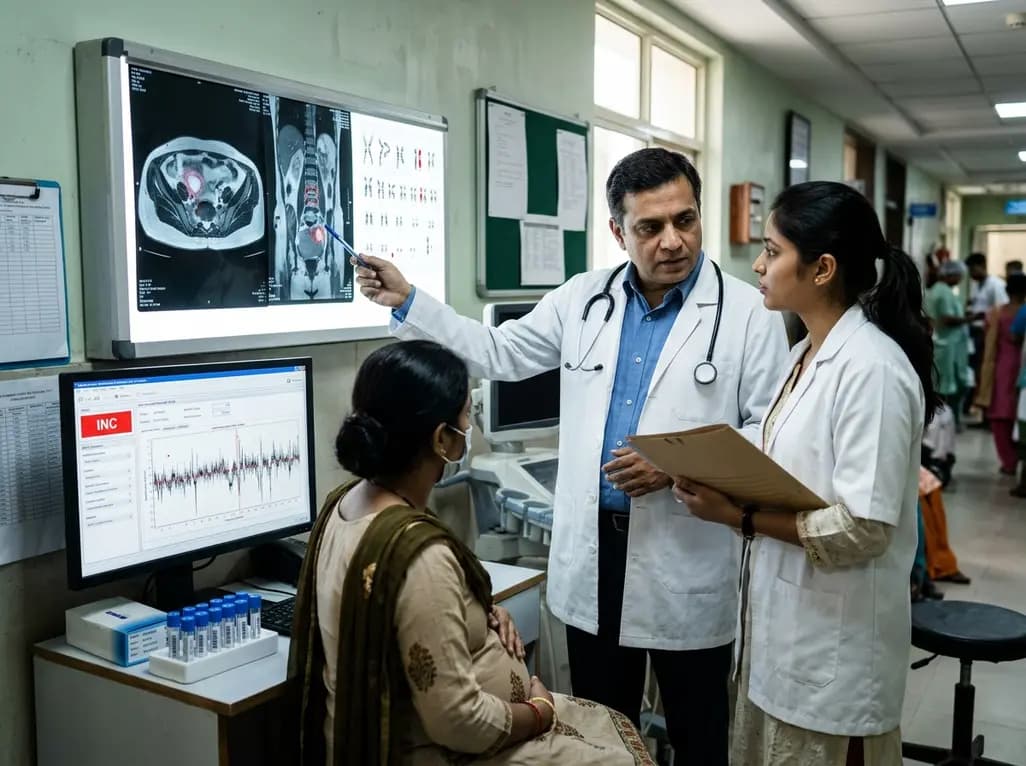
Occult maternal malignancy accounts for 3.82% of persistent unreportable NIPT results with genomic noise. Multiple chromosomal aberrations, notably on chromosome 18, warrant thorough oncological evaluation and whole-body MRI to ensure timely maternal diagnosis while preserving fetal care.
Today
This article reviews the forensic and clinical complexities of acute myocarditis arising on left ventricular hypertrophy in children, highlighting early diagnostic red flags and multidisciplinary postmortem autopsy protocols.
Today

This comparative study evaluates posterior labral tears with and without glenohumeral instability, highlighting distinct demographic patterns, MRI underestimation in stable shoulders, and successful arthroscopic repair outcomes.
Yesterday

A clinical study demonstrates that early intervention with tocilizumab, either as monotherapy or bridged with corticosteroids, achieves significant proptosis reduction and resolves active inflammation in treatment-naive thyroid eye disease.
Yesterday
