

Loading, please wait...
Loading, please wait...
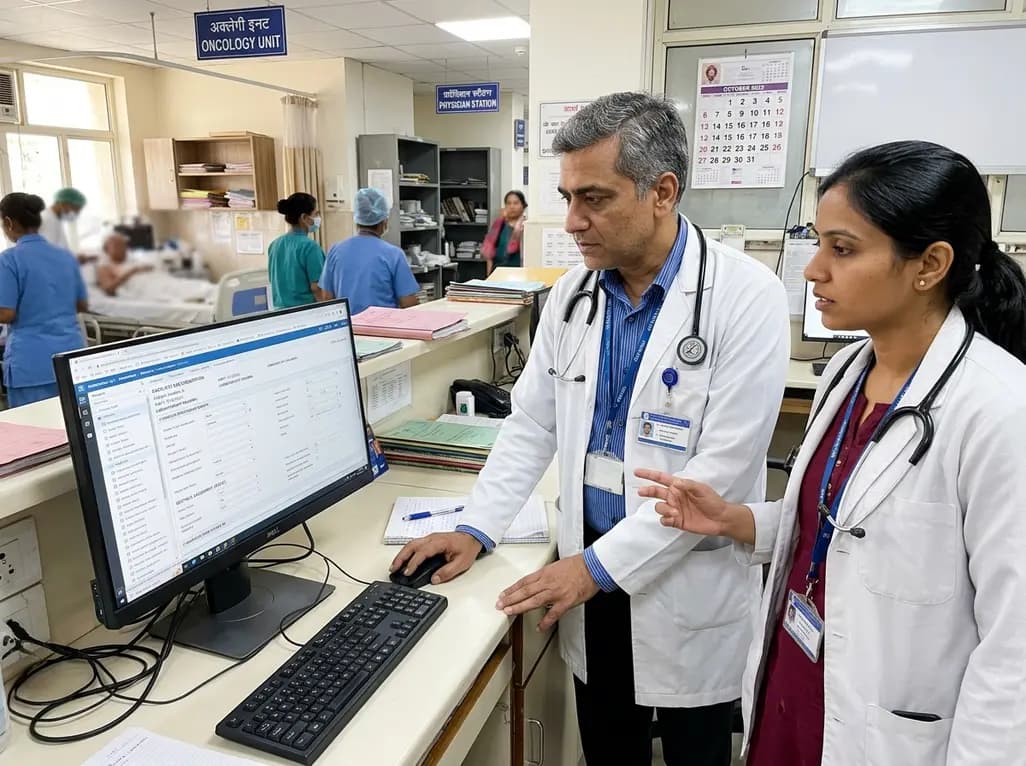
Electronic health record systems anchor modern cancer therapy, yet oncologists frequently battle disorganized clinical narratives. In busy outpatient oncology clinics, clinical notes often suffer from inconsistency and omission of vital treatment data. To overcome these persistent vulnerabilities and improve oncology documentation quality, health institutions are introducing standardized electronic templates. A recent landmark study in JCO Oncology Practice demonstrates that embedding structured data capture forms directly within clinical notes markedly elevates record completeness. Furthermore, standardizing point-of-care documentation aligns clinical workflows with national oncology benchmarks and generates computable real-world evidence for clinical research.
Oncology outpatient clinics produce massive quantities of complex clinical narratives every day. Unfortunately, unstructured electronic health record notes frequently impede timely multidisciplinary decision-making and cross-specialty communication. Historically, oncology progress notes remain lengthy, repetitive, and fragmented across disparate documentation tabs. Consequently, treating oncologists experience substantial cognitive burden when searching for previous regimen toxicities, staging updates, and molecular testing results during rapid consultations. When clinicians rely heavily on unguided free-text narratives or unverified copy-forward practices, critical clinical details frequently vanish. For example, baseline functional assessments, performance status scores, and specific treatment intent often go undocumented in routine care. Furthermore, this documentation gap complicates urgent cross-coverage and care coordination between medical, radiation, and surgical oncologists. As modern cancer care grows increasingly personalized and complex, unstructured summaries no longer satisfy the operational demands of tertiary cancer centers. Therefore, oncology practices urgently require structured informatics solutions that capture vital clinical findings directly during patient encounters. Standardized electronic frameworks eliminate clinical ambiguity, reduce redundant chart navigation, and ensure that every medical record contains actionable, reliable patient data.
To address chronic documentation gaps, clinical informaticians developed a specialized note template featuring an embedded structured data capture form. Crucially, developers aligned discrete fields with established oncology standards, specifically the ASCO Quality Oncology Practice Initiative and Minimal Common Oncology Data Elements. Consequently, oncologists can capture essential disease characteristics and therapeutic details directly during active outpatient visits. Instead of navigating separate EHR windows or disjointed registries, clinicians record cancer stage, histology, genomic biomarkers, and treatment toxicity within their regular progress note. Moreover, this integrated design preserves narrative flexibility alongside structured entry. Clinicians can summarize complex clinical assessments in narrative prose while simultaneously completing mandatory discrete fields. In addition, the standardized format guides providers through critical clinical checkpoints without disrupting personal workflow or increasing cognitive load. As a result, the structured template reduces omission errors and supports comprehensive documentation during rapid clinical consultations. Clinicians spend far less time navigating confusing electronic interfaces and more time focusing directly on patient communication and treatment planning.
Clinical evidence confirms that structured EHR templates dramatically upgrade oncology documentation quality in daily outpatient practice. In a four-year clinical evaluation, investigators reviewed 2,366 encounter notes documented by 41 oncology providers across busy clinics. Overall note completeness increased remarkably from 62.3% in unstructured baseline records to 89.9% when clinicians used the standardized template. Furthermore, template utilization generated significant improvements across nearly all evaluated quality metrics. Clinicians recorded cancer staging, disease status, treatment intent, and regimen-related toxicities with far greater regularity and accuracy. Because the embedded form prompts oncologists for key clinical variables at the point of care, inadvertent omissions decreased substantially across multiple cancer types. In addition, providers maintained consistent documentation quality across successive chemotherapy cycles and long-term surveillance visits. Therefore, structured note templates solve chronic completeness deficiencies without compromising diagnostic depth or clinical nuance. Ultimately, these measurable improvements ensure that multidisciplinary cancer care teams possess dependable longitudinal records to guide critical therapeutic decisions and improve patient safety.
Despite the proven advantages of structured templates, provider adoption rates highlight important behavioral dynamics in clinical health informatics. Across the four-year study, clinicians utilized the standardized template in 38.8% of evaluated clinical encounters. Multivariable analysis revealed that clinician characteristics significantly influenced template uptake and sustained utilization. Specifically, female physicians and clinicians with fewer years since graduation showed significantly higher odds of regular template adoption. In addition, providers working in disease-specific outpatient clinics adopted the structured tool more consistently than general oncology practitioners. Early-career clinicians often adapt to structured digital interfaces with greater ease because of prior training with modern EHR systems. Conversely, experienced clinicians accustomed to traditional dictation habits may hesitate to transition toward rigid entry templates. Consequently, healthcare organizations must implement individualized training, peer workflow coaching, and interface refinements to support broad provider engagement. Addressing specific user concerns and demonstrating clinical efficiency ensures that oncology departments achieve widespread, enduring template adoption across all practice settings.
Beyond immediate patient care benefits, structured EHR templates generate high-value real-world data for oncology research and clinical governance. Conventional real-world evidence initiatives depend on painstaking manual chart reviews, which consume substantial institutional resources and delay clinical discoveries. However, structured templates capture standardized, discrete data points during normal clinical encounters without imposing extra administrative labor on providers. Consequently, researchers can quickly analyze therapeutic efficacy, monitor adverse events, and evaluate real-world outcomes across large patient cohorts. Furthermore, standardized data capture accelerates clinical trial matching by cataloging genomic biomarkers and clinical stages in searchable discrete fields. In high-volume oncology centers across India and other emerging healthcare systems, structured documentation supports robust institutional cancer registries and epidemiologic tracking. Therefore, embedding standardized data collection into routine care bridges the longstanding divide between everyday oncology practice and translational research. Healthcare systems simultaneously streamline clinical governance, enhance clinical audit capabilities, and contribute meaningful real-world insights to the international oncology community.
Structured note templates improve oncology documentation quality by embedding discrete data capture fields directly into clinical notes. In practice, these templates guide clinicians to record essential disease metrics, including cancer staging, biomarker profiles, and treatment responses, at the point of care. Consequently, structured prompts prevent omission errors, standardize terminology across care teams, and raise overall documentation completeness from baseline levels to nearly ninety percent.
Provider adoption of standardized EHR templates correlates significantly with demographic and clinical practice characteristics. Specifically, clinical studies indicate that early-career clinicians, female physicians, and specialists practicing in dedicated disease-specific outpatient clinics adopt structured templates at higher rates. Conversely, clinicians accustomed to unstructured free-text dictation often require targeted workflow optimization, peer modeling, and institutional change management to achieve consistent, routine utilization across complex healthcare systems.
Structured oncology templates capture discrete, computable clinical data points during routine outpatient encounters, directly aligning provider documentation with standardized oncology frameworks. Consequently, clinical researchers can extract high-fidelity real-world evidence without relying on expensive and time-consuming manual chart abstraction. Furthermore, this structured clinical data facilitates rapid patient cohort identification, longitudinal treatment toxicity surveillance, ongoing quality improvement benchmarking, and efficient clinical trial matching across diverse oncology care centers.
Disclaimer: This content is for informational and educational purposes only. It is not intended to substitute for professional medical advice, diagnosis, or treatment. Healthcare professionals must exercise independent judgment. Refer to the latest local and national guidelines for clinical practice.
References

Read summarized clinical updates, watch expert medical content, and earn CME certifications right from your smartphone.
Open your smartphone camera to scan and install.





A clinical study demonstrates that standardized EHR note templates with embedded structured data forms significantly enhance oncology documentation quality, elevating note completeness from 62.3% to 89.9% while capturing computable real-world data.
Today

An NHANES analysis reveals that meeting 24-hour movement guidelines significantly lowers the odds of cardiovascular disease, obesity, hypertension, and diabetes among adults with disabilities, emphasizing the power of combined physical activity, sleep, and limited sedentary time.
Today

A large cohort study demonstrates that fetal growth restriction in a first pregnancy raises maternal cardiovascular risk within five years postpartum, including elevated rates of heart failure, stroke, and myocardial infarction. Clinicians must initiate proactive postpartum screening and cardiovascular prevention.
Today

A new scoping review and expert consensus establish a concise 16-measure performance bundle for hospital cardiology services. Covering clinical processes, outcomes, patient-reported experiences, and structural factors, this framework advances value-based cardiovascular care under universal health coverage.
Today

A paired cadaveric study compared triple and quintuple percutaneous Achilles tendon lengthening. While quintuple hemisection showed numerically greater elongation, differences were not statistically significant.
Today

A study in healthy normal-weight adults reveals that moderate weight loss preserves the thermic effect of food while shifting postprandial metabolism toward enhanced lipid oxidation and reduced carbohydrate oxidation.
Today
