.webp&w=384&q=75)

Loading, please wait...
Loading, please wait...

Transcatheter aortic valve replacement has transformed the management of severe aortic stenosis across all surgical risk profiles. However, as clinicians treat younger and lower-risk cohorts, managing structural deterioration and device dysfunction has become an essential clinical priority. Planning a successful TAVR failure reintervention requires clear insight into how initial valve design influences failure patterns and clinical outcomes.
The international EXPLANTORREDO-TAVR registry examined 382 patients requiring secondary procedures after index transcatheter aortic valve replacement. Specifically, researchers evaluated whether balloon-expandable valves and self-expanding valves exhibited different modes of dysfunction. The investigation revealed distinct pathophysiological differences between the two valve platforms.
Patients with failed balloon-expandable valves presented predominantly with structural valve deterioration, observed in nearly three-quarters of cases. In contrast, self-expanding valves demonstrated structural valve deterioration in less than half of failing prostheses. Furthermore, significant prosthesis-patient mismatch occurred twice as frequently in failed balloon-expandable devices. Conversely, paravalvular leak occurred more than twice as often in self-expanding prostheses.
These varying failure mechanisms directly influenced clinical timelines. Because structural deterioration develops progressively, balloon-expandable devices exhibited a significantly longer interval to failure, averaging nearly forty-two months. Conversely, early hemodynamic compromise from paravalvular leak prompted earlier intervention in self-expanding devices, which showed a median time to revision of under twenty months. Therefore, clinicians must consider index valve mechanics when tracking structural integrity during routine postoperative surveillance. Consequently, systematic multimodality echocardiographic surveillance provides the earliest clues to platform-specific degradation, enabling timely intervention before severe cardiac decompensation occurs.
Despite divergent mechanisms and timelines, the overall reintervention strategy remained remarkably balanced between valve designs. Approximately fifty-four percent of patients received redo-TAVR, whereas forty-six percent underwent surgical explantation in both cohorts. Thus, the index valve design itself did not dictate whether an interventional or surgical approach was ultimately pursued.
Instead, procedural selection depended heavily on patient anatomical suitability, operative risk, and concomitant cardiovascular pathology. For instance, surgical explantation was frequently selected when patients required concomitant aortic root enlargement, ascending aortic repair, or mitral valve intervention. Indeed, more than half of the surgical explantation cohort required concomitant procedures during the operation. Moreover, surgeons performed root replacement in a higher proportion of failed self-expanding valves, reflecting deeper device anchoring and tissue incorporation within the aortic root.
Conversely, redo-TAVR offered an effective, less invasive option for patients facing prohibitive surgical risk or severe frailty. However, transcatheter reintervention demands meticulous anatomical evaluation to avoid acute coronary compromise. Interventional teams must evaluate sinus of Valsalva dimensions, coronary take-off heights, and predicted neo-skirt geometry. Therefore, patient-specific anatomy rather than index valve type remains the primary determinant of procedural selection.
When operators selected redo-TAVR, cross-platform valve deployment emerged as the preferred interventional technique. Specifically, nearly sixty percent of failed balloon-expandable valves received a self-expanding prosthesis, whereas fifty-nine percent of failed self-expanding valves received a balloon-expandable device. This reciprocal pattern reflects deliberate operator strategy to optimize hemodynamic performance and minimize procedural hazards.
Implanting a self-expanding device within a failed balloon-expandable valve provides supra-annular leaflet function, which significantly lowers post-procedural transvalvular gradients. This hemodynamic advantage proves especially beneficial in small aortic annuli, where residual gradient elevation could hasten repeat valve failure. Furthermore, the higher frame of a self-expanding valve can seal residual paravalvular regurgitation effectively.
Conversely, deploying a balloon-expandable prosthesis within a failed self-expanding valve allows precise vertical placement. Balloon expansion anchors securely against the rigid nitinol frame, which prevents device embolization or malposition. Additionally, the shorter stent height of a balloon-expandable device reduces the risk of sequestering coronary sinus blood flow. Nonetheless, operators must confirm coronary patency using detailed pre-procedural computed tomography simulations. Thus, tailored cross-platform deployment provides distinct mechanical advantages when carefully planned.
A critical finding from the registry is that initial valve platform did not compromise short-term or mid-term survival. Thirty-day mortality rates remained statistically equivalent, recording 8.7 percent in the balloon-expandable group and 8.0 percent in the self-expanding group. Similarly, one-year mortality rates showed no meaningful divergence, measuring 24.3 percent and 21.5 percent, respectively.
Moreover, multivariable risk-adjusted analysis demonstrated equivalent three-year cumulative mortality between both valve platforms. When researchers stratified patients by reintervention approach, neither redo-TAVR nor surgical explantation showed survival differences based on the initial device type. However, procedural modality itself substantially impacted clinical recovery and mortality curves.
As anticipated, patients undergoing surgical explant faced considerably higher early procedural mortality than those treated percutaneously. Surgical explantation represents a high-risk operation involving complex tissue dissection, prolonged cardiopulmonary bypass, and frequent annular reconstruction. In contrast, redo-TAVR achieved lower early mortality, but its long-term success requires careful surveillance to detect late structural deterioration. Consequently, heart teams can confidently select the most anatomically appropriate reintervention strategy without worrying that the original device platform adversely prejudices long-term patient survival.
The dramatic expansion of transcatheter therapies into younger, low-risk populations makes lifetime management planning mandatory during the initial procedure. Because younger individuals possess longer life expectancies, many will inevitably outlive their first transcatheter bioprosthesis. Therefore, cardiologists must envision potential second and third interventions prior to implanting the index valve.
Heart teams must anticipate how the initial stent frame will interact with future devices. Balloon-expandable frames offer short profiles that facilitate coronary re-access, yet smaller initial sizes risk severe patient-prosthesis mismatch during subsequent interventions. Self-expanding platforms yield superior initial hemodynamic effective orifice areas, but their taller frames increase technical complexity during subsequent redo-TAVR and surgical explantation.
Furthermore, multidisciplinary collaboration between interventional cardiologists and cardiac surgeons is essential to optimize long-term clinical pathways. In addition, routine post-implantation surveillance protocols should incorporate annual echocardiographic assessments to identify structural leaflet degradation or paravalvular regurgitation before irreversible ventricular dysfunction develops. By integrating anatomical risk assessment, lifetime sequencing strategies, and shared decision-making, clinical teams can safely navigate transcatheter valve failure and deliver durable cardiovascular care.
Failed balloon-expandable valves typically require reintervention much later than self-expanding valves, averaging nearly forty-two months compared to under twenty months. This difference occurs because balloon-expandable valves fail primarily due to progressive structural valve deterioration, which evolves slowly over years. Conversely, self-expanding valves more commonly require revision due to significant paravalvular leak or malposition, which causes acute or early hemodynamic compromise, necessitating prompt interventional or surgical correction.
Cross-platform deployment optimizes post-procedural hemodynamics and minimizes anatomical complications. Deploying a self-expanding valve within a failed balloon-expandable prosthesis utilizes supra-annular leaflet mechanics, preventing elevated transvalvular gradients in smaller root dimensions. Conversely, deploying a short balloon-expandable valve within a failed self-expanding frame ensures precise radial fixation and avoids high stent profiles. This strategy helps maintain coronary artery clearance, mitigates sinus sequestration risks, and provides dependable anchoring within the existing framework.
Registry findings confirm that initial valve design does not significantly affect mortality following reintervention. Both balloon-expandable and self-expanding cohorts demonstrated statistically comparable thirty-day, one-year, and risk-adjusted three-year survival rates. Instead of valve type, patient survival is predominantly determined by overall baseline surgical risk, patient frailty, procedural urgency, and the selection of redo-TAVR versus surgical explantation, rather than whether the original failing transcatheter prosthesis was balloon-expandable or self-expanding.
Disclaimer: This content is for informational and educational purposes only... Refer to the latest local and national guidelines for clinical practice.
References

Read summarized clinical updates, watch expert medical content, and earn CME certifications right from your smartphone.
Open your smartphone camera to scan and install.





Findings from the EXPLANTORREDO-TAVR registry demonstrate that initial valve choice influences the mode and timing of transcatheter valve failure, but reintervention strategy and long-term survival remain comparable between balloon-expandable and self-expanding valves.
last month
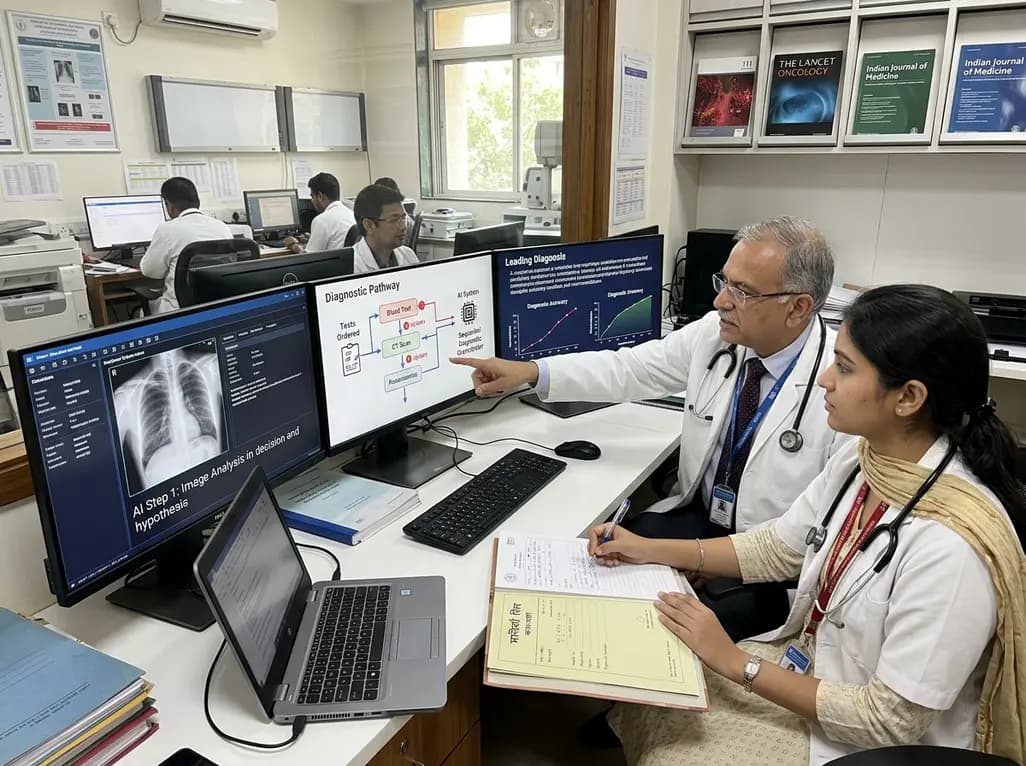
A breakthrough peer-reviewed study demonstrates that a sequential AI diagnosis system can mirror real-world clinical reasoning. By ordering stepwise tests and updating hypotheses dynamically, this multi-agent orchestrator achieved superior diagnostic accuracy while reducing investigative costs.
Today

A prenatal case highlights severe glutaric acidemia type II presenting as bilateral hyperechoic cystic kidneys at 18 weeks. Whole-exome sequencing revealed a novel homozygous ETFDH frameshift variant, demonstrating the power of rapid genetic testing in fetal renal anomalies.
Today

Review how tailored exercise programs benefit frail older patients with heart failure. Explore pathophysiological mechanisms, individualized training prescriptions, and strategies to overcome adherence barriers in clinical practice.
Yesterday

This comparative study evaluates posterior labral tears with and without glenohumeral instability, highlighting distinct demographic patterns, MRI underestimation in stable shoulders, and successful arthroscopic repair outcomes.
Yesterday

A clinical study demonstrates that early intervention with tocilizumab, either as monotherapy or bridged with corticosteroids, achieves significant proptosis reduction and resolves active inflammation in treatment-naive thyroid eye disease.
Yesterday
