.webp&w=384&q=75)

Loading, please wait...
Loading, please wait...
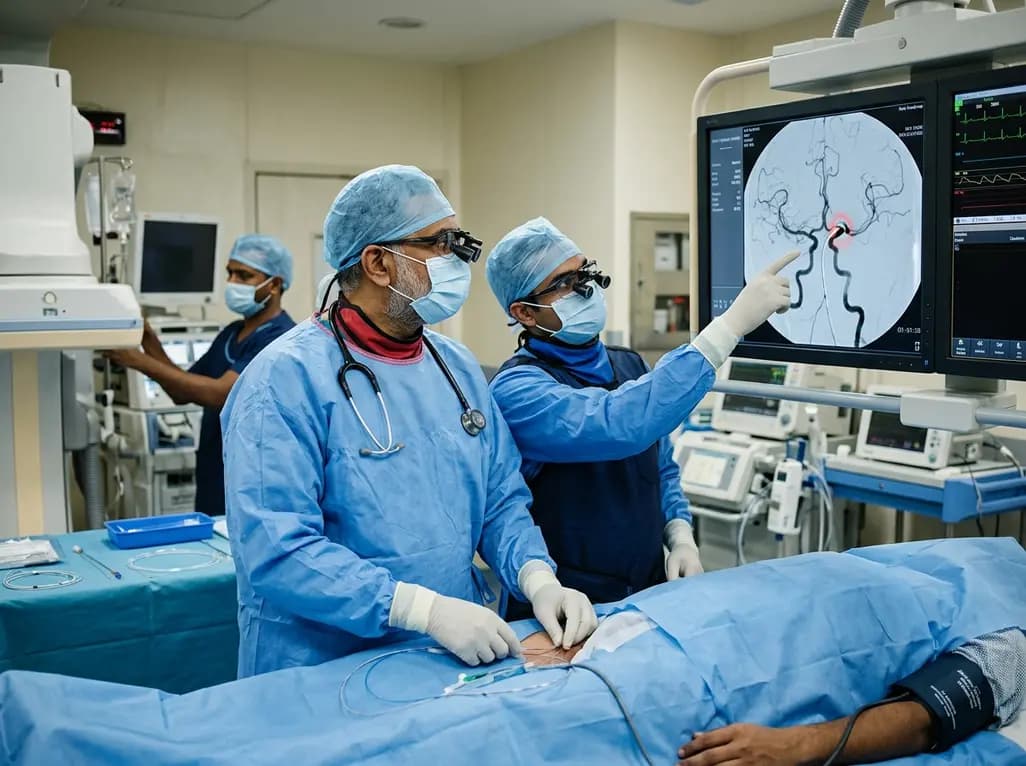
Acute ischemic stroke caused by severe intracranial stenosis presents a formidable management dilemma for neurointerventionalists and stroke teams worldwide. While endovascular thrombectomy represents the established standard of care for acute large vessel occlusions, non-occlusive critical narrowing lacks clear consensus. Patients harboring critical luminal narrowing often suffer from acute hypoperfusion, microembolism, and progressive neurologic deterioration. However, physicians historically treated non-occlusive intracranial atherosclerosis with standard medical therapy alone because past trials raised procedural safety concerns. Recent clinical data now offer novel insights into whether urgent revascularization improves patient recovery in this vulnerable subpopulation. Specifically, clinicians must determine if prompt endovascular recanalization outweighs procedural risks in non-occlusive presentations.
Historically, landmark randomized trials such as SAMMPRIS and CASSISS discouraged upfront endovascular stenting for symptomatic intracranial atherosclerotic disease. However, those trials evaluated subacute and chronic disease stages rather than emergent hyperacute stroke presentations. In the acute setting, severe hypoperfusion threatens tissue survival in the ischemic penumbra before collateral pathways stabilize. Consequently, clinicians frequently observe early neurological worsening despite aggressive medical stabilization. Standard medical treatment, comprising antiplatelets, statins, and blood pressure control, may fail to restore immediate cerebral perfusion. Therefore, investigators recently evaluated whether immediate angioplasty or stenting alters functional trajectories within the critical 24-hour therapeutic window. Modern microcatheters, self-expanding stents, and submaximal balloon dilatation techniques have significantly lowered procedural complication rates. As a result, neurointerventionalists are revisiting acute revascularization for patients with refractory flow limitation. Furthermore, recent retrospective evidence provides compelling support for expanding endovascular indications beyond complete arterial occlusions.
A comprehensive multicenter study conducted across seven comprehensive stroke centers in China evaluated 242 acute ischemic stroke patients. All enrolled participants presented within 24 hours of symptom onset with imaging-confirmed severe intracranial stenosis of 70% to 99%. Among the cohort, 96 patients received immediate angioplasty or stenting, while 146 patients received standard medical treatment alone. The investigators analyzed the primary endpoint using the distribution of modified Rankin Scale scores at 90 days. Notably, patients undergoing immediate endovascular intervention achieved significantly superior functional recovery compared to the medical cohort. Multivariable adjusted models revealed a common odds ratio of 2.73 favoring endovascular therapy for a shift toward better functional status. In addition, after inverse probability of treatment weighting, the odds ratio remained robust at 2.50. Thus, prompt mechanical restoration of luminal diameter translated directly into measurable clinical gains. Moreover, these functional benefits persisted after controlling for baseline stroke severity, collateral status, and vascular risk factors.
Safety considerations remain paramount whenever clinicians perform intracranial endovascular procedures in the acute phase of cerebral ischemia. In this multicenter evaluation, researchers closely tracked rates of symptomatic intracranial hemorrhage within 24 hours and 90-day all-cause mortality. Reassuringly, immediate angioplasty or stenting did not lead to a statistically significant increase in symptomatic hemorrhage rates compared to standard therapy. Furthermore, overall 90-day mortality rates remained comparable between both treatment groups. Periprocedural vessel rupture, acute in-stent thrombosis, and reperfusion injury represent known technical hazards during acute interventions. However, modern neurovascular tools and meticulous perioperative antiplatelet regimens successfully minimized catastrophic technical adverse events. Consequently, the study demonstrated that emergency intracranial angioplasty is feasible and safe when executed by experienced neurointerventional teams. Nevertheless, clinicians must carefully select candidates using advanced perfusion neuroimaging to avoid reperfusion injury in large core infarctions.
These findings carry profound clinical implications for emergency stroke triage and decision-making protocols. When encountering acute ischemic stroke with severe non-occlusive narrowing, clinicians must rapidly evaluate hemodynamic stability and penumbral tissue volume. If non-invasive computed tomography or magnetic resonance angiography identifies critical stenosis with hypoperfusion, urgent endovascular consultation is warranted. Additionally, physicians should assess whether patients demonstrate progressive clinical fluctuation under standard medical therapy. Immediate revascularization provides definitive relief of critical focal hypoperfusion, thereby rescuing threatened brain tissue. Furthermore, emergency angioplasty prevents secondary platelet aggregation and impending complete arterial thrombosis at the plaque site. Therefore, stroke care pathways should incorporate standardized protocols to evaluate high-grade non-occlusive lesions without delay. Multidisciplinary collaboration between emergency physicians, stroke neurologists, and interventionalists remains essential to streamline door-to-needle and door-to-puncture times.
Although these findings provide compelling real-world evidence, clinicians must contextualize them alongside existing practice guidelines. Current international guidelines still emphasize intensive medical management as the primary therapy for symptomatic intracranial atherosclerotic disease. However, clinicians recognize that hyperacute presentation represents a uniquely distinct physiological state compared to stabilized chronic stenosis. Prospective randomized controlled trials are urgently needed to confirm these retrospective observations and establish definitive treatment algorithms. Meanwhile, operators should exercise caution, considering individual lesion anatomy, tortuosity, and vessel diameter before attempting urgent angioplasty. Submaximal balloon angioplasty or judicious stenting strategies may offer optimal safety in fragile intracranial vessels. In conclusion, immediate angioplasty or stenting appears highly promising for acute stroke patients with severe intracranial atherosclerosis, marking an essential evolution in acute neurovascular care.
Immediate angioplasty or stenting significantly improves 90-day functional recovery in acute ischemic stroke patients with severe non-occlusive stenosis presenting within 24 hours. Multivariable analyses demonstrate more than a twofold increase in favorable functional shift compared to standard medical treatment alone without significantly increasing symptomatic intracranial hemorrhage.
The SAMMPRIS trial evaluated subacute and chronic secondary prevention rather than hyperacute stroke presentations within 24 hours of onset. In hyperacute stroke, immediate revascularization salvages critically hypoperfused penumbra tissue, whereas delayed elective stenting in stabilized patients previously presented higher periprocedural complication rates without acute tissue salvage benefits.
Investigators assessed symptomatic intracranial hemorrhage within 24 hours and all-cause mortality within 90 days across both cohorts. The study found no statistically significant differences in symptomatic hemorrhage or mortality rates between immediate endovascular intervention and standard medical therapy, confirming acceptable procedural safety in high-volume centers.
Disclaimer: This content is for informational and educational purposes only and does not constitute formal medical advice, diagnosis, or treatment recommendations. Clinical decisions should always rely on individualized patient evaluations, specialist consultations, and institutional protocols. Refer to the latest local and national guidelines for clinical practice.
References
Chen X et al. Effectiveness of Immediate Angioplasty or Stenting on Functional Outcomes in Acute Ischemic Stroke With Severe Intracranial Stenosis. Neurology. 2026 Jul 14. doi: 10.1212/WNL.0000000000218157. PMID: 42269124.
Gao P, Wang T, Wang D, et al. Effect of Stenting Plus Medical Therapy vs Medical Therapy Alone on Risk of Stroke and Death in Patients With Symptomatic Intracranial Stenosis: The CASSISS Randomized Clinical Trial. JAMA. 2022;328(6):534-542.
Chimowitz MI, Lynn MJ, Derdeyn CP, et al. Stenting versus Aggressive Medical Therapy for Intracranial Arterial Stenosis. N Engl J Med. 2011;365(11):993-1003.

Read summarized clinical updates, watch expert medical content, and earn CME certifications right from your smartphone.
Open your smartphone camera to scan and install.





A multicenter study demonstrates that immediate angioplasty or stenting significantly improves 90-day functional recovery in acute ischemic stroke patients presenting with severe non-occlusive intracranial stenosis within 24 hours of symptom onset without escalating serious safety hazards.
last month

Abdominal aortic aneurysm rupture remains a catastrophic vascular emergency. Groundbreaking research reveals that USP53 accelerates aneurysm progression by reprogramming smooth muscle cell metabolism toward aerobic glycolysis, highlighting a promising target beyond conventional diameter-based surveillance.
Today

A pharmacometric and machine learning study reveals that specific vaginal bacteria alter cervical antiretroviral exposure, highlighting the need for precision HIV PrEP strategies.
Today
A nationwide Swedish cohort study shows oral glucocorticoid exposure over 1-2 years strongly predicts overall organ damage in SLE, while cardiovascular risk reflects cumulative doses across 3 years. These findings reinforce early steroid minimization and cautious long-term maintenance.
Today
A scoping review highlights neural mobilization as a promising adjunct in managing cervicogenic headache. Integrating neurodynamics into multimodal physical therapy improves pain, range of motion, and posture, though standardized protocols and larger clinical trials are still needed.
Today

Recent research defines ferro-aging as a conserved iron-lipid axis driving organ decline across primates. Age-related iron dyshomeostasis stimulates ACSL4-mediated lipid peroxidation, promoting cellular senescence. Notably, vitamin C directly inhibits ACSL4, suppressing phospholipid oxidation and multi-organ decay.
Today
