.webp&w=384&q=75)

Loading, please wait...
Loading, please wait...
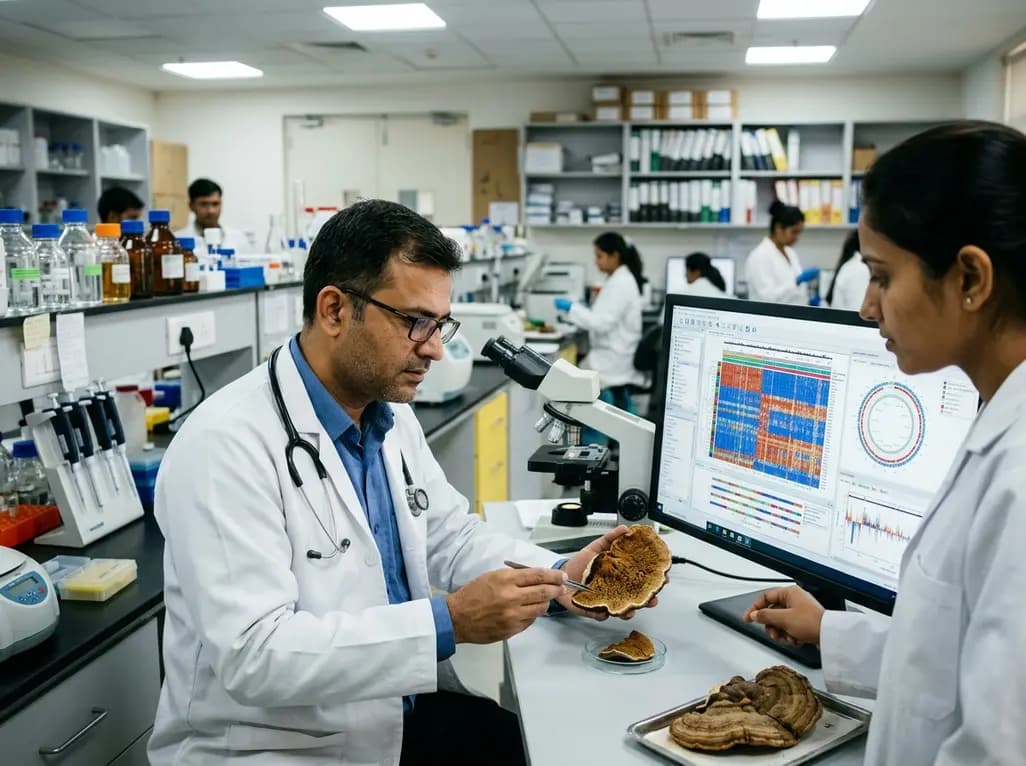
The medicinal polypore Agarikon (Laricifomes officinalis, historically classified as Fomitopsis officinalis) occupies a legendary status in global ethnopharmacology. For centuries, traditional healers utilized this rare bracket fungus to treat respiratory infections, inflammatory disorders, and chronic pulmonary ailments. However, overharvesting and old-growth habitat loss have severely endangered wild populations. Consequently, modern medical researchers have sought sustainable scientific avenues to understand its potent pharmacological properties. A landmark genomic study has now established the complete hybrid de novo nuclear and mitochondrial genome assembly of L. officinalis. This milestone uncovers the molecular blueprints that drive its therapeutic actions. Therefore, clinicians, pharmacologists, and researchers gain unprecedented insight into its bioactive secondary metabolite pathways. Furthermore, this genetic map bridges historical botanical wisdom with contemporary anti-infective drug development.
Researchers successfully assembled the nuclear genome of L. officinalis to an exceptional degree of accuracy. Specifically, the nuclear sequence spans 28.76 megabases across 66 contigs, showing a GC content of 51.96%. In addition, the assembly achieved a BUSCO completeness score of 99.4%, which confirms outstanding sequence coverage and reliability. The investigators also decoded the complete core mitochondrial genome, which measures 197.67 kilobases. Through structural and functional annotation, the team predicted 8,717 genes, including 8,604 protein-coding genes. Moreover, the genetic analysis identified both matA and matB mating type loci, definitively establishing a tetrapolar mating system. Thus, these baseline metrics provide a crucial genetic reference for the entire Polyporales order. As a result, scientists can now accurately explore the evolutionary lineage and reproductive biology of this endangered medicinal fungus.
Beyond structural baseline data, the annotated genome highlights remarkable enzymatic machinery dedicated to therapeutic compound production. Most notably, researchers identified 287 dedicated genes organized across 27 candidate biosynthetic gene clusters. These specialized clusters encode key enzymes driving triterpenoid and polyketide biosynthetic cascades. Triterpenoids, particularly lanostane-type derivatives and eburicoic acid variants, represent major bioactive constituents in L. officinalis. In addition, polyketide synthases facilitate the assembly of structurally diverse secondary metabolites, including chlorinated coumarins. Consequently, these genetic findings elucidate the precise molecular pathways responsible for the synthesis of bioactive compounds. Therefore, synthetic biologists can harness these sequence data to replicate bioactive molecules in industrial bioreactors without harvesting fragile wild mushrooms.
Historical ethnopharmacological records document the efficacy of L. officinalis in combating severe pulmonary diseases, including historical tuberculosis. Contemporary preclinical assays corroborate these traditional observations. For instance, purified extracts and isolated lanostane triterpenoids exhibit significant in vitro antibacterial, antiviral, and anti-inflammatory activity. Furthermore, specific chlorinated coumarin derivatives isolated from mycelial cultures display pronounced inhibitory actions against resistant microbial pathogens. The genomic elucidation of rate-limiting biosynthetic enzymes offers practical pathways for pharmaceutical optimization. In addition, these metabolic pathways provide novel chemical templates to address emerging antimicrobial resistance. Thus, integrative pharmacology can evaluate standardized polypore extracts and derivative scaffolds for modern respiratory and anti-infective therapeutic protocols.
To establish taxonomic precision, investigators performed a comprehensive maximum likelihood phylogenomic analysis using protein sequences from 730 shared BUSCO genes. Consequently, the analysis rigorously confirmed the unique taxonomic placement of L. officinalis within the Polyporales lineage. In addition to clarifying taxonomy, this reference genome serves as an indispensable tool for conservation genetics. Because L. officinalis depends almost exclusively on mature coniferous forests, wild populations remain highly vulnerable to habitat fragmentation. Therefore, population genomic screenings can evaluate genetic diversity across isolated fungal strains. Moreover, understanding strain-level variation allows conservationists to protect critical germplasm while enabling biopharmaceutical developers to select high-yield metabolic strains for laboratory-scale cultivation.
The successful sequencing of L. officinalis represents a transformative paradigm for natural product drug discovery. Traditionally, complex natural compounds faced significant manufacturing bottlenecks due to scarce botanical biomass and complex chemical syntheses. However, annotated genomic maps permit metabolic engineers to express fungal biosynthetic pathways in heterologous host organisms, such as yeast. Consequently, researchers can produce therapeutic quantities of pure triterpenoids and novel polyketides sustainably. Furthermore, this genetic clarity facilitates rigorous pharmacokinetic and safety profiling in clinical pharmacology. As evidence-based complementary medicine expands in clinical practice, standardized fungal metabolites offer promising candidates for adjuvant immunomodulatory and antiviral therapeutic strategies.
Laricifomes officinalis possesses significant therapeutic potential due to its abundant specialized secondary metabolites. Specifically, the fungus produces unique lanostane-type triterpenoids, chlorinated coumarins, and bioactive polysaccharides. Consequently, preclinical investigations have demonstrated marked antimicrobial, antiviral, anti-inflammatory, and immunomodulatory activities against challenging pathogens. Furthermore, modern genomic profiling enables researchers to identify specific biosynthetic pathways, thereby facilitating targeted biopharmaceutical synthesis, standardized drug formulation, and therapeutic validation for clinical infectious disease applications.
The annotated nuclear genome reveals 27 candidate biosynthetic gene clusters that govern secondary metabolite synthesis. Consequently, researchers can now isolate and manipulate key enzymatic pathways responsible for complex triterpenoids and polyketides. In addition, this genetic blueprint bypasses the need to harvest slow-growing, endangered wild fruiting bodies from old-growth forests. Therefore, biotechnology platforms can utilize metabolic engineering and synthetic biology techniques to produce scalable, high-purity therapeutic compounds for novel antibacterial and antiviral agent development.
Laricifomes officinalis faces severe population decline due to deforestation, climate changes, and prolonged growth cycles. Therefore, high-resolution genomic data provide crucial population genetics markers to monitor wild diversity and lineage health. Furthermore, mapping the mating type loci illuminates fungal reproductive mechanisms in distinct forest ecosystems. Ultimately, comprehensive genomic characterization supports ex situ conservation banks, sustainable laboratory cultivation, and biotechnological metabolite production without further depleting fragile wild forest ecosystems.
Disclaimer: This content is for informational and educational purposes only, and does not constitute medical advice or treatment recommendations. Always consult a qualified healthcare provider for clinical decisions. Refer to the latest local and national guidelines for clinical practice.
References

Read summarized clinical updates, watch expert medical content, and earn CME certifications right from your smartphone.
Open your smartphone camera to scan and install.





High-quality genomic sequencing of the endangered medicinal polypore Agarikon (Laricifomes officinalis) uncovers 27 biosynthetic gene clusters and metabolic pathways, paving the way for novel antiviral, antibacterial, and triterpenoid therapeutic developments in integrative pharmacology.
last month

PZL-26, a selective small-molecule inhibitor of LONP1, reveals essential roles of this mitochondrial protease in complex I biogenesis, translation, and oxidative phosphorylation. These findings provide critical mechanistic insights for developing targeted anticancer therapies against proteostasis-dependent tumors.
Today
A nationwide South Korean study shows underreporting of smoking among women dropped from 57.4% to 36.4% between 2008 and 2021. However, over one-third of female smokers still conceal their habit, highlighting the critical role of cotinine verification in clinical risk assessment.
Today

PepsiCo and Monster Beverage have challenged the FSSAI ban on the energy drink label in Indian courts. While companies highlight supply disruptions, regulatory actions spotlight severe cardiovascular and metabolic risks associated with excessive caffeine, sugar, and taurine consumption, especially in adolescents.
Today
A recent investigation analyzes whether cervical disc arthroplasty effectively restores or merely preserves physiological range of motion, providing critical biomechanical insights for treating hypomobile cervical segments.
Today

A Bayesian multilevel meta-analysis reveals that aerobic training combined with moderate carbohydrate restriction modestly lowers HbA1c in type 2 diabetes. However, sparse data and very low certainty leave incremental benefits over exercise or diet alone unproven, highlighting the need for individualized care.
Yesterday
