.webp&w=384&q=75)

Loading, please wait...
Loading, please wait...

The United States State Department has pledged an additional $267 million to support international containment efforts in central Africa. This substantial commitment aims to curb an escalating viral emergency centered primarily in the Democratic Republic of the Congo. Because the current crisis has emerged as the second most lethal occurrence on record, global health agencies are mobilizing massive resources. A robust, rapid Ebola outbreak response remains essential to prevent widespread regional transmission and protect international healthcare security. Consequently, multilateral partners are intensifying surveillance, diagnostic logistics, and bedside care.
Senior American officials announced this critical funding pledge on the sidelines of the United Nations General Assembly in New York. The financial package increases the total commitment from the administration to $886 million. Specifically, this comprehensive package includes $107 million allocated through the Department of Health and Human Services. However, international public health leaders emphasize that overall requirements remain substantial. Authorities actively seek to mobilize at least $2 billion from international donors to halt transmission completely.
The present outbreak was first detected in May and has expanded rapidly across several provinces. As a result, the crisis now ranks as the deadliest filovirus epidemic since the catastrophic 2014 to 2016 West Africa event. Furthermore, regional conflict and geographical isolation severely complicate containment logistics. Frontline healthcare teams frequently face damaged infrastructure and displaced populations. Therefore, sustained foreign financing is necessary to maintain continuous field operations and supply vital clinical resources.
International aid focuses primarily on halting community transmission directly at the epidemic source. According to State Department officials, the capital injection will directly finance modern treatment facilities and specialized isolation centers. In addition, the funds support rapid diagnostic mobile laboratories and personal protective equipment for field personnel. Effective deployment of an aggressive Ebola outbreak response requires unbroken supply chains for essential medical countermeasures. Consequently, aid agencies are securing bulk deliveries of protective ensembles, intravenous fluids, and targeted therapeutics.
Moreover, health authorities are expanding localized genomic surveillance to monitor viral mutations in real time. Community engagement teams also receive vital support to rebuild trust with vulnerable populations. In past outbreaks, mistrust often led individuals to delay presentation at medical facilities. Therefore, partnering with local leaders significantly accelerates symptom reporting and contact tracing. When teams detect cases early, they can isolate patients rapidly and administer life-saving supportive therapies immediately.
Ebola virus disease is a severe, frequently fatal filovirus infection characterized by sudden onset and rapid clinical deterioration. Initially, infected patients present with nonspecific constitutional signs such as abrupt fever, profound malaise, myalgia, and severe headache. Subsequently, patients develop gastrointestinal manifestations, including persistent vomiting, watery diarrhea, and severe abdominal cramping. Because these early features mimic malaria, typhoid, and dengue, clinical differentiation remains difficult. Thus, clinicians must maintain a high index of suspicion when evaluating travelers with unexplained fever.
Laboratory confirmation requires reverse transcription polymerase chain reaction testing performed under strict biosafety conditions. Rapid antigen detection tests can offer preliminary guidance in remote outbreak zones. However, negative rapid tests cannot definitively rule out early infection. In later stages, endothelial disruption and coagulopathy trigger diffuse microvascular leakage. Patients experience severe mucosal hemorrhage, petechiae, disseminated intravascular coagulation, and multiorgan failure. Consequently, clinicians must recognize these hematologic shifts promptly to anticipate impending hypovolemic shock.
Strict infection prevention and control practices remain the cornerstone of filovirus containment within healthcare environments. Transmission occurs through direct contact with blood, secretions, organs, or other bodily fluids of infected persons. Furthermore, contaminated surfaces and indirect contact with soiled bedding present serious exposure risks. Healthcare workers must strictly implement universal contact and droplet precautions during patient management. Specifically, practitioners must wear impermeable coveralls, double gloves, fluid-resistant respirators, face shields, and boot covers.
Currently, early and aggressive supportive care dramatically reduces overall case fatality rates. Clinicians must administer titrated intravenous fluids to balance massive gastrointestinal fluid losses. In addition, healthcare teams must routinely monitor serum electrolytes, correcting potassium and calcium abnormalities before arrhythmias emerge. For eligible variants, clinicians administer human monoclonal antibodies that neutralize viral glycoproteins. Meanwhile, clinicians aggressively manage secondary bacterial infections with broad-spectrum empirical antibiotics. Diligent bedside monitoring and early organ support improve patient outcomes substantially.
Although the epicenter remains in central Africa, international transit routes require constant vigilance across global health systems. Indian medical practitioners and emergency physicians must maintain strict preparedness protocols for arriving international travelers. For example, authorities in India enforce self-declaration forms and fever screening at major ports of entry. Clinicians should consistently obtain comprehensive travel histories for all febrile patients presenting to acute care clinics. If an individual reports travel to affected central African regions within the past 21 days, teams must implement immediate isolation.
Furthermore, acute care facilities must review standard operating procedures for suspected viral hemorrhagic fevers. Staff members must receive regular training in safe donning and doffing techniques for high-level personal protective gear. Hospital administrators must also verify designated negative-pressure isolation suites and secure waste-disposal protocols. When clinicians suspect a filovirus infection, they must immediately alert national public health authorities. In this manner, rigorous local alertness directly reinforces international biosafety and safeguards global public health.
Q1: What are the early clinical signs of Ebola virus disease?
Early symptoms typically manifest abruptly between 2 and 21 days following exposure. Patients frequently present with sudden high fever, debilitating fatigue, generalized muscle aches, headache, and sore throat. Shortly thereafter, individuals develop prominent gastrointestinal complaints, including intractable vomiting, nausea, and watery diarrhea. Because these manifestations closely resemble other common tropical infections like malaria, clinicians must evaluate recent travel histories carefully to ensure prompt diagnosis and isolation.
Q2: How is the Ebola virus transmitted among humans?
Ebola virus spreads primarily through direct human-to-human contact involving broken skin or mucous membranes and infected bodily fluids. These fluids include blood, vomit, feces, saliva, urine, sweat, and semen. In addition, individuals can contract the virus by touching contaminated surfaces, medical instruments, or clothing. The virus does not transmit through airborne droplet nuclei over long distances. Consequently, rigorous barrier nursing, hand hygiene, and full personal protective equipment provide reliable defense.
Q3: What immediate measures should Indian hospitals take if an Ebola case is suspected?
Hospitals must immediately isolate the patient in a dedicated negative-pressure room with private sanitary facilities. Attending healthcare staff must wear complete personal protective equipment before entering the room. Furthermore, clinicians must notify local and national public health surveillance authorities without delay. Diagnostic blood samples require triple-packaging containment protocols for shipment to designated reference laboratories. Supportive fluid rehydration and hemodynamic monitoring must begin immediately under strict biohazard precautions.
Disclaimer: This content is for informational and educational purposes only. It does not constitute medical advice or replace professional judgment. Refer to the latest local and national guidelines for clinical practice.
References

Read summarized clinical updates, watch expert medical content, and earn CME certifications right from your smartphone.
Open your smartphone camera to scan and install.





With the US pledging an additional $267 million to contain the deadly Ebola outbreak in central Africa, global health agencies are intensifying clinical and diagnostic interventions. Learn about the transmission dynamics, critical care protocols, and infection control measures vital for frontline physicians.
Today
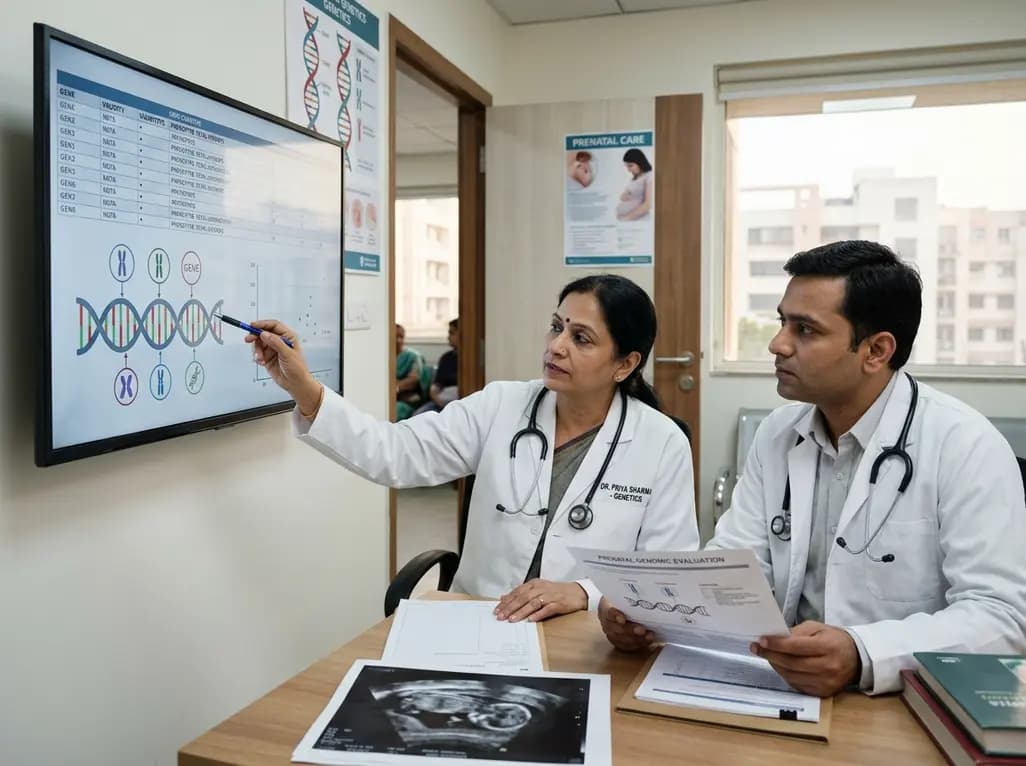
The ClinGen Prenatal Gene Curation Expert Panel evaluated 63 disease relationships across 61 genes, establishing clinical validity for severe fetal phenotypes like hydrops and stillbirth to enhance prenatal genomic interpretation and clinical care.
Today

To curb crushing healthcare expenses, Karnataka's Food Safety and Drugs Administration has formally petitioned central authorities to institute a dedicated National List of Essential Medical Devices under the DPCO framework, establishing uniform price ceilings across twenty-four vital clinical categories.
Today

New research reveals that HOXD13 regulates primary cilia signalling and genomic stability in distal synovial fibroblasts, uncovering why conditions like rheumatoid arthritis target specific joints.
Today

Clinical guidelines rely heavily on isolated biomarkers like IGF-1 and HbA1c. However, portal insulin delivery fundamentally gates hepatic growth hormone sensitivity. This physiological continuum unites type 1 and type 2 diabetes, obesity, cirrhosis, and acromegaly, challenging conventional treatment strategies.
Today
