

Loading, please wait...
Loading, please wait...
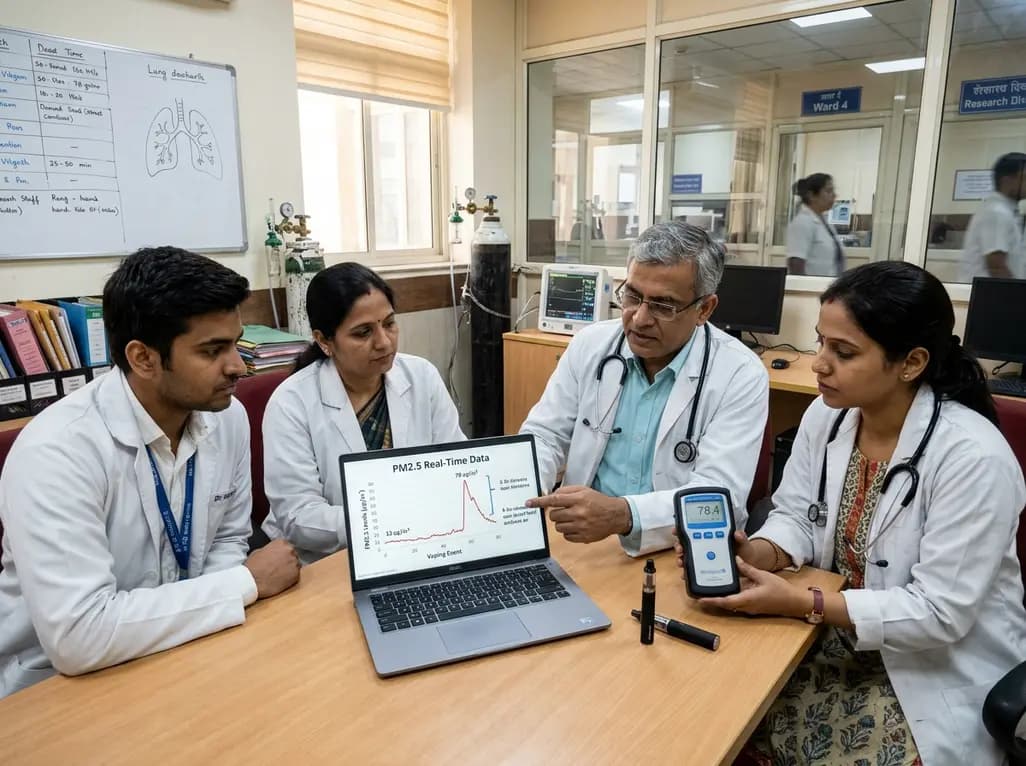
The escalating prevalence of vaping poses serious environmental and respiratory hazards across the globe. Recent investigations into e-cigarette indoor air quality demonstrate that secondhand electronic aerosols drastically increase airborne particulate matter. Many individuals mistakenly view vaping emissions as harmless water vapor. However, objective aerodynamic assessments indicate that electronic nicotine delivery systems disperse significant quantities of respirable liquid droplets and chemicals. In enclosed spaces, these emissions concentrate rapidly, threatening non-vaping bystanders.
To quantify aerosol emissions accurately, investigators utilized an AirBeam3 portable optical particle counter during a controlled observational trial. They measured particulate matter across different fractions, specifically PM1, PM2.5, and PM10, under varying ambient conditions. The researchers recorded outdoor baselines during a round-trip pedestrian walk along both low-traffic and heavy-traffic urban roadways. Subsequently, they evaluated atmospheric contamination inside a public bar where three patrons engaged in active e-cigarette use.
The observational data revealed an alarming deterioration of environmental safety inside the hospitality establishment. While outdoor street measurements reflected typical urban vehicular emissions, indoor vaping created profound pollutant surges. Specifically, the average indoor PM2.5 concentration reached 28.8 µg/m³, while peak concentrations reached 84.7 µg/m³. These findings confirmed that indoor vaping elevated fine particulate pollution 6.5 times higher than the low-traffic street. Furthermore, the indoor air showed 3.1 times higher PM2.5 concentrations than the busy, heavy-traffic thoroughfare. Consequently, enclosed vaping environments generate localized particulate densities that rapidly outstrip outdoor vehicular pollution.
Understanding the aerodynamic profile of vaping emissions explains why these emissions pose severe hazards to respiratory health. E-cigarettes vaporize an e-liquid composed primarily of propylene glycol, vegetable glycerin, nicotine, and concentrated synthetic flavorings. As the heated vapor cools upon exhalation, it condenses immediately into an aerosol containing billions of ultra-fine liquid droplets. These droplets fall predominantly within the PM1 and PM2.5 aerodynamic size ranges.
Because these particles remain extremely small, they display prolonged suspension times in stagnant indoor air. Standard indoor ventilation systems often fail to clear these micro-droplets efficiently. In addition, physical Brownian motion causes the particles to diffuse uniformly throughout closed spaces. Therefore, non-smoking occupants inevitably inhale these suspended aerosols through regular tidal respiration. Unlike larger outdoor dust particles, PM2.5 bypasses upper airway filtration mechanisms such as nasal vibrissae and mucous trapping. As a result, the inhaled particles deposit deeply into terminal bronchioles and alveolar clusters, triggering cellular stress and inflammatory reactions.
Clinical research demonstrates that secondhand aerosol inhalation induces measurable pathological changes within the pulmonary parenchyma and vascular endothelium. When fine particles penetrate deep alveoli, alveolar macrophages engulf them, initiating an acute oxidative stress response. Consequently, this inflammatory cascade provokes local bronchoconstriction, reduced ciliary motility, and epithelial hyperpermeability. Patients with underlying reactive airway disease frequently experience immediate wheezing, dry coughing, and dyspnea after entering vaped spaces.
Moreover, particulate penetration extends beyond the respiratory tract into systemic microcirculation. Ultra-fine particles cross the delicate alveolar-capillary membrane, triggering autonomic imbalance and arterial stiffness. Studies link passive aerosol exposure with impaired flow-mediated endothelial dilation, platelet hyperactivation, and transient blood pressure spikes. For individuals with coronary artery disease or hypertension, these sudden hemodynamic shifts elevate the probability of acute cardiovascular events. Furthermore, toxicological evaluations identify volatile aldehydes, heavy metals such as nickel and lead, and free radicals within the exhaled plume. Hence, passive inhalation exposes bystanders to verified cardiotoxic elements.
Secondhand e-cigarette aerosols present heightened risks for susceptible demographic cohorts, especially infants, young children, and pregnant women. Because pediatric patients have higher baseline respiratory rates relative to their body weight, they inhale substantially greater volumes of pollutants per minute. Additionally, their developing airways possess narrower calibers and immature immunological defenses. Consequently, passive aerosol inhalation correlates with increased pediatric asthma exacerbations, recurrent bronchitis, and school absenteeism.
Furthermore, expectant mothers exposed to indoor vaping absorb systemic nicotine and chemical solvents that cross the placental barrier. Fetal exposure to nicotine restricts uteroplacental blood flow, which may compromise fetal lung development and birth weight. Similarly, elderly individuals with chronic obstructive pulmonary disease or congestive heart failure exhibit pronounced symptom deterioration when exposed to indoor vaping. Thirdhand aerosol deposition also represents an underappreciated clinical hazard. Chemical residues settle onto indoor upholstery, carpets, and tabletops, where they react with ambient nitrous acid to form carcinogenic nitrosamines. Toddlers who touch contaminated surfaces face continuous oral and dermal toxicant uptake.
In India, clinicians must interpret these findings within the framework of national public health legislation. The Government of India enacted the Prohibition of Electronic Cigarettes Act (PECA) in 2019, completely prohibiting the production, import, sale, and advertisement of e-cigarettes. Nevertheless, illicit electronic nicotine devices circulate through informal grey markets and internet vendors, especially among urban youth. Therefore, physicians and pulmonologists must remain vigilant during routine medical histories.
Medical practitioners should actively inquire about both active vaping habits and passive indoor aerosol exposure during outpatient consultations. When patients present with unexplained dry cough, subacute bronchospasm, or persistent pharyngeal irritation, doctors should explore potential domestic or occupational exposure. In addition, healthcare professionals must dispel the prevalent misconception that electronic aerosol consists merely of water vapor. Clinicians should educate families that indoor vaping compromises domestic air quality just as severely as combustible cigarettes. Furthermore, professional societies must advocate for the complete inclusion of electronic delivery systems in public smoking bans, ensuring comprehensive indoor protection for all citizens.
Although electronic cigarettes do not generate carbon monoxide or complex tar from combustion, they still emit significant levels of fine particulate matter. Vaping exhales dense aerosol droplets composed of propylene glycol, vegetable glycerin, nicotine, and thermal decomposition byproducts. These particles pollute indoor spaces rapidly, elevating PM2.5 concentrations several times above clean baseline air. Therefore, while chemically distinct from tobacco smoke, e-cigarette aerosol still degrades indoor atmospheric purity and poses physiological risks to bystanders.
Standard commercial ventilation and air conditioning units cannot completely remove ultrafine e-cigarette particles from indoor air. Because vaping aerosol consists of microscopic droplets measuring under one micrometer, these particles remain suspended for hours and disperse evenly throughout rooms. While high-efficiency particulate air filters capture some airborne matter, opening windows or running basic fans merely dilutes the toxicants. Consequently, prohibiting indoor vaping entirely remains the only guaranteed method to eliminate secondhand aerosol exposure.
Under the Prohibition of Electronic Cigarettes Act of 2019, the manufacture, import, sale, transport, and storage of electronic cigarettes are illegal throughout India. While local clean air rules traditionally focused on combustible tobacco, utilizing electronic vaping devices in public indoor areas violates existing national health frameworks. Clinicians should inform patients that vaping in enclosed spaces breaches regulatory statutes and exposes bystanders to hazardous fine particulate pollution without their informed consent.
Disclaimer: This content is for informational and educational purposes only... Refer to the latest local and national guidelines for clinical practice.
References

Read summarized clinical updates, watch expert medical content, and earn CME certifications right from your smartphone.
Open your smartphone camera to scan and install.





A real-world study reveals that e-cigarette vaping elevates indoor PM2.5 levels up to 6.5 times above street concentrations. Learn about particulate matter risks, secondhand aerosol exposure, and public health implications for clinicians in India.
Today

The GendAge weight loss study investigates how sex hormones, age, and menopausal status modulate caloric restriction response. By comparing metabolic adaptations across younger and older cohorts, this controlled feeding trial aims to refine precision dietary guidance for effective obesity management.
Today

Medical experts caution that GLP-1 receptor agonists offer metabolic support rather than a curative answer for polyendocrine metabolic ovarian syndrome. Clinicians must evaluate glycemic markers, reproductive plans, and lifestyle interventions while discouraging unsupervised medication use among female patients.
Today

Recent research highlights how endoplasmic reticulum and mitochondrial interactions at contact sites regulate ferroptosis in cardiovascular diseases. This article explores lipid peroxidation, organelle crosstalk, and potential therapeutic strategies for ischemic heart disease and heart failure.
Today

A systematic review demonstrates that teriparatide significantly improves healing in medication-related osteonecrosis of the jaw (MRONJ), especially when combined with surgical and non-surgical therapies. This review explores clinical evidence, biological mechanisms, and treatment protocols for clinicians.
Today
An updated meta-analysis shows that 37% of patients remain euthyroid after stopping thyroid hormone therapy, with success rising to 41% in subclinical hypothyroidism. Clinicians can safely consider supervised deprescribing in selected individuals using structured monitoring.
Today
