.webp&w=384&q=75)

Loading, please wait...
Loading, please wait...

Modern refractive techniques offer robust solutions for patients seeking spectacle independence. However, correcting non-myopic refractive errors continues to pose unique technical hurdles. Clinicians widely recognize that corneal refractive surgery for hyperopic and mixed astigmatism demands greater precision than standard myopic corrections. A comprehensive systematic review and meta-analysis published in Seminars in Ophthalmology synthesizes contemporary clinical evidence across multiple laser platforms. This updated evaluation provides essential insights into visual acuity, refractive stability, and safety parameters for clinicians treating challenging cylindrical errors.
Treating hyperopia combined with cylinder presents distinct optical and anatomical considerations. Unlike myopic ablations that flatten the central cornea, hyperopic ablations require peripheral tissue removal to steepen the central optical zone. Consequently, surgeons must employ larger ablation zones and transition zones to prevent abrupt curvature gradients. When astigmatism coexists, the ablation profile transforms into an asymmetrical, complex geometric pattern. This intricate geometry alters corneal biomechanics more dramatically than spherical treatments. Furthermore, mixed astigmatism involves orthogonal meridians with opposing refractive signs, where one focal line falls in front of the retina and the other falls behind it. Historical laser platforms frequently generated substantial optical aberrations, higher regression rates, and unpredictable healing responses in these eyes. Therefore, standardizing laser algorithms to manage cross-cylinder or bitoric profiles became a primary goal for modern keratorefractive platforms. Recent technological innovations have sought to reduce these biomechanical challenges, providing more uniform corneal remodeling and lower rates of postoperative regression.
Over the past decade, technological innovations have transformed excimer and femtosecond laser capabilities. Modern platforms integrate high-speed multidimensional eye tracking that compensates for active cyclotorsional movement. Because cyclotorsion significantly degrades astigmatic correction, precise rotational alignment remains critical during treatment delivery. In addition, advanced corneal refractive surgery platforms incorporate wavefront-guided, wavefront-optimized, and topography-guided ablation profiles. These customized algorithms smooth the corneal periphery and preserve physiological asphericity, thereby mitigating induced spherical aberration. Furthermore, contemporary femtosecond lasers create larger, highly uniform corneal flaps with predictable side-cut angles. This consistency minimizes epithelial ingrowth and flap-related biomechanical instability. Recent literature also documents the expanding utility of small incision lenticule extraction for non-myopic indications. Although lenticule extraction for hyperopia requires larger optical zones and intricate centration strategies, continuing software refinements have improved lenticular morphology. As a result of these hardware and software advancements, refractive surgeons can approach complex cylindrical errors with greater procedural confidence.
The systematic review and meta-analysis compiled data from 23 clinical studies encompassing 3,561 eyes undergoing laser-assisted in situ keratomileusis, photorefractive keratectomy, or small incision lenticule extraction. Across these cohorts, baseline cylindrical error averaged 2.45 diopters. Postoperative evaluations demonstrated significant improvements in uncorrected distance visual acuity across all surgical modalities. Specifically, laser in situ keratomileusis maintained the highest volume of evidence and showed consistent efficacy in achieving target refractions within rapid recovery timelines. Surface ablation through photorefractive keratectomy delivered comparable long-term visual clarity, although visual recovery required a longer postoperative period. Lenticule extraction platforms showed promising efficacy for hyperopic astigmatism, though they remain less widely adopted than excimer-based modalities. Importantly, pooled analyses demonstrated a substantial reduction in residual astigmatism across all cohorts, yielding a mean residual cylinder of 0.47 diopters. Consequently, modern keratorefractive surgery successfully converts the vast majority of patients with complex astigmatism into uncorrected functional vision.
Predictability represents a crucial metric when evaluating refractive success in compound hyperopic and mixed astigmatic cohorts. The meta-analysis revealed that a high proportion of eyes achieved spherical equivalent refractions within ±0.50 diopters and ±1.00 diopters of the emmetropic target. Moreover, standardized vector analyses, including surgically induced astigmatism and correction index calculations, revealed excellent alignment with targeted treatment axes. Modern active eye-trackers substantially reduced axis misalignment, preventing undercorrection in steep meridians. Nevertheless, slight cylindrical undercorrection occasionally persisted in eyes presenting with severe baseline astigmatism above 4.00 diopters. Refractive stability also showed marked improvements compared to earlier surgical eras. Excimer ablations using large optical transition zones demonstrated stable refractive metrics through 12 to 24 months of postoperative follow-up. While physiological epithelial remodeling causes minor late regression in high hyperopes, the degree of regression remained clinically manageable and significantly lower than historical averages.
Safety parameters evaluated across the included trials demonstrated an overall favorable risk profile. The loss of two or more lines of corrected distance visual acuity occurred in fewer than two percent of treated eyes. Transient dry eye disease remained the most common postoperative complaint following flap-based procedures, but symptoms typically resolved within six months under standard topical therapy. In photorefractive keratectomy cohorts, postoperative corneal haze represented a recognized risk, particularly when treating higher degrees of hyperopia. However, the routine intraoperative application of mitomycin-C effectively reduced clinically significant stromal haze formation. In addition, flap-related complications such as microstriae or epithelial ingrowth occurred infrequently due to femtosecond laser flap creation. Ectasia risk was thoroughly addressed through rigorous preoperative topography screening. Overall, the aggregated evidence confirms that modern corneal laser treatments exhibit exceptional safety metrics when surgeons observe strict biomechanical cutoffs and preserve adequate residual stromal beds.
Achieving optimal refractive outcomes requires meticulous preoperative diagnostic evaluation and patient counseling. Refractive specialists must conduct comprehensive cycloplegic refractions to unmask latent hyperopia, as underdiagnosed accommodative tone will compromise postoperative satisfaction. Additionally, clinicians should evaluate corneal tomography using elevation maps, pachymetry profiles, and anterior-posterior curvature indices to exclude subtle keratectasia. Pupillometry under scotopic conditions provides essential guidance for sizing the ablation zone, ensuring that the effective optical zone covers the scotopic pupil and minimizes nighttime visual disturbances. Furthermore, surgeons must educate patients regarding the physiological dynamics of hyperopic healing, explaining that initial slight overcorrection often stabilizes into clear distance vision over several weeks. Through detailed structural screening, precise cyclotorsional compensation, and personalized profile selection, clinicians can maximize visual outcomes for patients with hyperopic and mixed astigmatism.
Modern corneal refractive procedures demonstrate high predictability for mixed astigmatism. Utilizing advanced eye tracking and bitoric ablation algorithms, contemporary excimer platforms reliably correct orthogonal meridians simultaneously. Most treated eyes achieve residual astigmatism below 0.50 diopters, providing sharp uncorrected distance visual acuity and significant spectacle independence.
Hyperopic ablations remove tissue in the mid-periphery to steepen the central cornea. This peripheral ablation creates curvature gradients that trigger compensatory epithelial hyperplasia and stromal remodeling during healing. Although modern large transition zones significantly reduce this response, mild late regression can still occur in patients with high baseline hyperopia.
Cyclotorsion control compensates for rotational eye movement that occurs when a patient transitions from an upright to a supine position. Because even a slight rotational misalignment markedly degrades cylindrical correction, active static and dynamic cyclotorsion tracking ensures precise laser delivery along the intended astigmatic axis.
Disclaimer: This content is for informational and educational purposes only and should not be considered medical advice. Healthcare professionals should make clinical decisions based on their independent clinical judgment and individualized patient assessments. Refer to the latest local and national guidelines for clinical practice.
References
González-Cruces T et al. Visual and Refractive Outcomes of Corneal Refractive Surgery for Hyperopic and Mixed Astigmatism: A Systematic Review and Meta-Analysis. Semin Ophthalmol. 2026 Aug 29. doi: 10.1080/08820538.2026.2724546. PMID: 42667270.
Fereydouni F et al. Visual and refractive outcomes of photorefractive keratectomy in hyperopia and hyperopic-astigmatism: A systematic review and meta-analysis. Photodiagnosis Photodyn Ther. 2025;49:104604.
Song J et al. Small Incision Lenticule Extraction (SMILE) Versus Laser Assisted Stromal In Situ Keratomileusis (LASIK) for Astigmatism Corrections: A Systematic Review and Meta-analysis. Am J Ophthalmol. 2023;247:181-199.

Read summarized clinical updates, watch expert medical content, and earn CME certifications right from your smartphone.
Open your smartphone camera to scan and install.





A comprehensive systematic review and meta-analysis evaluates the visual and refractive outcomes, safety, and predictability of corneal refractive surgery procedures including PRK, LASIK, and SMILE for hyperopic and mixed astigmatism.
4 weeks back
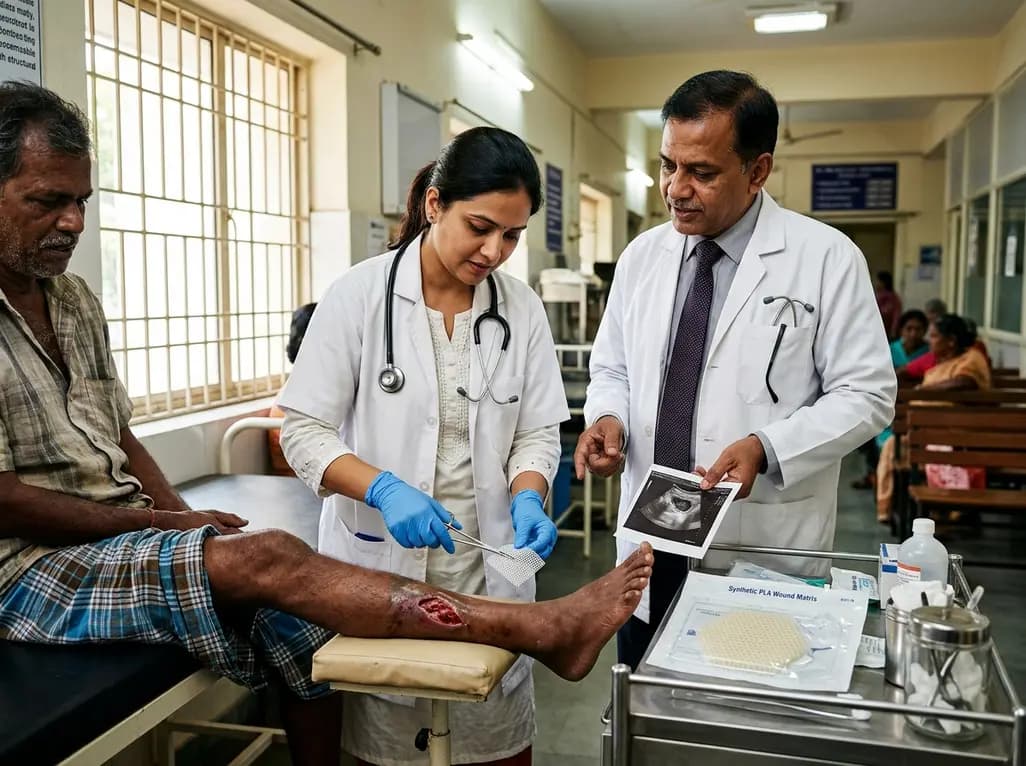
A recent clinical case series highlights the synthetic polylactic acid matrix as an innovative local therapy for refractory pyoderma gangrenosum. The bioresorbable scaffold demonstrated complete ulcer closure and favorable scar quality across chronic wounds, presenting a viable regenerative modality.
Today

A nationwide South Korean study shows underreporting of smoking among women dropped from 57.4% to 36.4% between 2008 and 2021. However, over one-third of female smokers still conceal their habit, highlighting the critical role of cotinine verification in clinical risk assessment.
Today

A scientific statement highlights the crucial role of nutrition in managing chronic heart failure. It emphasizes GLIM-based screening, individualized dietary patterns like the Mediterranean diet, appropriate protein and energy intake, avoiding unnecessary fluid restriction, and targeted iron supplementation.
Today

A new study evaluates the rheological stability of decellularized peripheral nerve matrix hydrogels under varied storage conditions. Findings show -80°C storage and freeze-drying preserve gelation kinetics and mechanical stiffness, offering key insights for shipping and translational clinical applications.
Today

A qualitative meta-synthesis highlights the complex interplay between gender dysphoria, minority stress, and eating disorders in transgender and gender-diverse individuals. Clinicians must recognize these distinct drivers to offer supportive, gender-affirming, and interdisciplinary eating disorder care.
Today
