.webp&w=384&q=75)

Loading, please wait...
Loading, please wait...
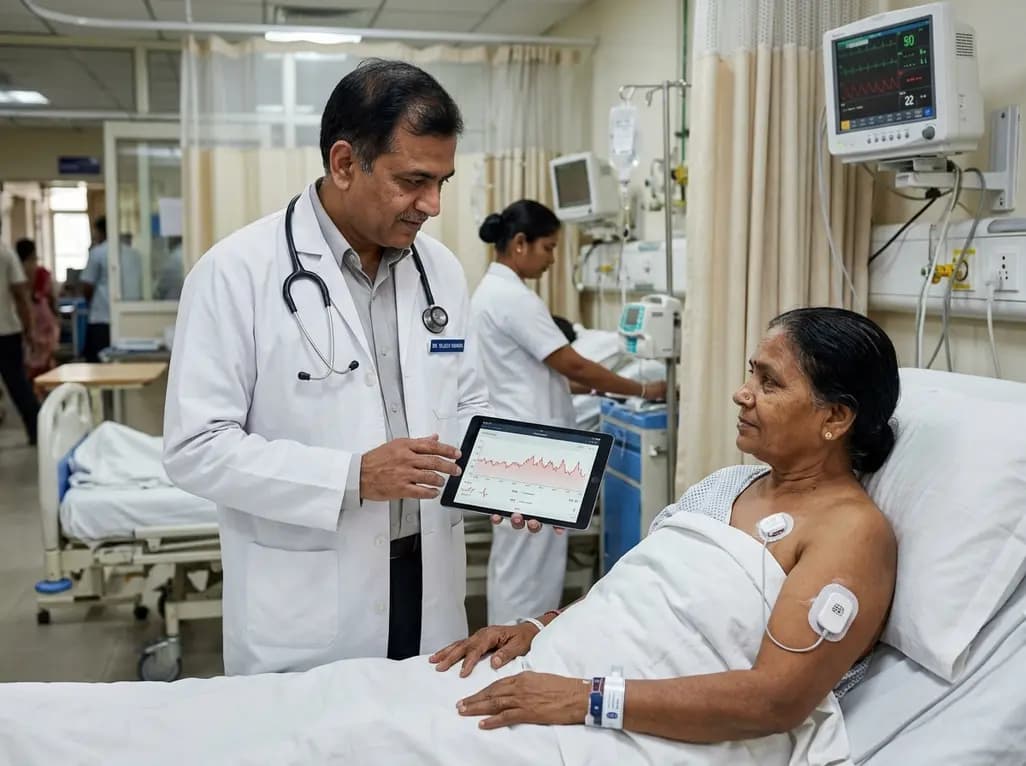
Hospital-acquired infections represent a substantial clinical and financial burden across acute care settings worldwide. Fever frequently serves as the earliest cardinal indicator of systemic infection, making timely thermal surveillance vital for patient outcomes. In modern inpatient care, continuous temperature monitoring using non-invasive wearable sensors offers an unprecedented opportunity to replace intermittent spot-check thermometry. However, transforming high-frequency physiological data streams into timely bedside interventions remains challenging. A landmark scoping review by Liu and colleagues mapped the global clinical implementation and data analytics maturity of wearable thermometry in acute care facilities. Consequently, understanding the translational barriers between sensor data capture and bedside medical decision-making is essential for hospital clinicians and health informatics leaders.
Conventional nursing workflows in acute medical wards rely primarily on intermittent spot-check vital sign measurements performed every four to eight hours. Unfortunately, episodic thermometry often misses rapid spikes in body temperature or transient fever spikes that occur between scheduled rounds. This diagnostic delay can postpone blood culture collection and delay targeted antimicrobial administration in deteriorating patients. Wearable sensors provide continuous real-time physiological tracking, capturing subtle circadian changes, early temperature trajectories, and thermal patterns that precede overt sepsis. Moreover, continuous tracking eliminates measurement variability caused by different nursing techniques or varying manual thermometer models. Clinicians can detect occult bacteremia hours earlier by monitoring upward thermal deviations. Furthermore, early detection enables timely fluid resuscitation and diagnostic workups before organ dysfunction develops. Studies indicate that early automated fever alerts substantially reduce sepsis-related complications in immunocompromised oncology patients and post-surgical populations. Therefore, adopting automated surveillance fundamentally shifts inpatient infection management from reactive treatment to proactive clinical stabilization.
The scoping review identified 18 distinct wearable devices deployed across acute medical and surgical wards. Investigators placed sensors across multiple anatomical sites, primarily targeting the axilla, anterior chest wall, upper arm, and wrist. Axillary and chest patches demonstrated superior correlation with core body temperature compared to distal extremity monitors. Specifically, peripheral skin sensors on the wrist often experience thermal dissipation caused by environmental fluctuations, vasoconstriction, or patient movement. Most advanced devices utilize wireless protocols, including Bluetooth Low Energy and hospital Wi-Fi networks, to broadcast data streams directly to central nursing stations. In contrast, several early-stage studies relied on periodic batch uploads, manual cable downloads, or delayed synchronization routines. Batch transmission prevents timely clinical intervention during acute clinical crises. Additionally, skin adhesion, biocompatibility, and comfort determine patient compliance during extended hospital admissions. Medical-grade hydrogels and silicone adhesives minimize skin irritation while preserving sensor contact during ambulation. As wearable hardware continues to evolve, non-invasive epidermal patches will likely become the standard hardware profile for inpatient temperature tracking.
To understand how clinical teams interpret wearable data, researchers classified analytical techniques into descriptive, diagnostic, predictive, and prescriptive tiers. The scoping review revealed that 19 studies utilized descriptive analytics to summarize fever onset, peak temperature magnitude, and fever episode duration. Meanwhile, six studies applied diagnostic analytics to correlate temperature variations with specific etiologies, distinguishing infectious fevers from non-infectious inflammatory states. Furthermore, nine investigations evaluated predictive analytics, leveraging machine learning classifiers to forecast impending febrile episodes hours before clinical observation. Notably, none of the reviewed publications reached prescriptive analytics, which would automatically suggest tailored interventions such as diagnostic blood cultures or antibiotic modifications. This analytical deficit highlights a major gap in modern digital health translation. Inpatient teams currently receive raw graphs without integrated clinical decision support. Consequently, health systems must partner with medical informaticians to build validated algorithms that contextualize temperature trends alongside white blood cell counts and hemodynamic parameters. Bridging this analytical divide will turn passive monitoring into actionable therapeutic guidance.
Continuous physiological sensing introduces immense volumes of raw data, which inevitably include artifacts from patient movement, sensor detachment, or external temperature changes. Unfiltered sensor noise generates severe alarm fatigue among bedside nurses, undermining technological acceptance in acute wards. The review discovered that data preprocessing strategies varied widely across clinical studies. Some research teams utilized simple physiological boundary thresholds, whereas others implemented sophisticated machine learning outlier detection and firmware signal quality metrics. Regrettably, seamless integration into electronic health records (EHR) remains exceptionally rare. Only seven studies displayed wearable temperature streams within bedside dashboards or nursing monitors, and merely one study activated automated EHR alerts. Hospital IT infrastructure often struggles with proprietary wireless architectures and non-standardized sensor outputs. Interoperability protocols like Fast Healthcare Interoperability Resources (FHIR) are essential to pipe continuous streams cleanly into hospital records. Without automated EHR synchronization, bedside clinicians must manually cross-reference auxiliary displays, creating workflow friction. Thus, standardized data cleaning pipelines and robust interoperability standards remain critical prerequisites for hospital-wide deployment.
According to the World Health Organization maturity framework adapted in the review, most wearable implementations remain confined to early clinical research or preliminary feasibility testing. Only three reviewed programs advanced to routine clinical workflows, and none achieved multicenter hospital enterprise integration. To advance beyond pilot projects, healthcare institutions must construct structured implementation roadmaps. Hospital leadership must first evaluate ward infrastructure, wireless bandwidth, and cybersecurity protocols to protect sensitive patient metrics. Concurrently, nurse leaders and clinical champions must establish explicit escalation pathways that define clinical actions when sustained thermal rises occur. Clear clinical protocols prevent alert dismissal and ensure timely blood cultures and antibiotic initiation. Additionally, hospitals must address device disinfection, charging cycles, and cost considerations to sustain ward-scale utilization. Training programs must educate resident physicians and nursing personnel on distinguishing true physiological pyrexia from sensor dislodgement artifacts. By methodically aligning clinical workflows, data engineering, and staff education, hospitals can harness wearable thermometry to improve sepsis survival and optimize antimicrobial stewardship.
Continuous temperature monitoring detects subtle thermal elevations hours before conventional intermittent checks identify overt pyrexia. Episodic nursing vitals taken every four to eight hours often miss rapid temperature spikes. Continuous wearable sensors track continuous physiological trajectories, alerting clinicians to impending systemic bacteremia earlier. This critical time window enables healthcare teams to collect blood cultures promptly, start targeted antimicrobials, and administer intravenous fluids before life-threatening septic shock develops, thereby significantly reducing inpatient mortality rates.
Axillary and chest placements provide the most reliable continuous temperature measurements because they closely approximate core body temperatures. In contrast, distal sites such as the wrist or forearm remain vulnerable to environmental temperature fluctuations, peripheral vasoconstriction, and motion artifacts. Consequently, medical-grade adhesive axillary or thoracic patches deliver superior diagnostic fidelity in acute hospital wards, ensuring that clinical algorithms analyze accurate physiological signals rather than peripheral thermal dissipation or ambient room interference.
Most commercial wearable devices utilize proprietary data architectures and dedicated wireless hubs that cannot communicate directly with existing hospital electronic health records. Without automated software integration, wearable data cannot populate patient charts or trigger standard clinical decision support alerts. Bedside clinicians must consult secondary screens, adding administrative burden and exacerbating workflow fragmentation. Implementing standardized communication frameworks such as FHIR is essential to achieve secure, real-time data ingestion into routine hospital electronic systems.
Disclaimer: This content is for informational and educational purposes only... Refer to the latest local and national guidelines for clinical practice.
References

Read summarized clinical updates, watch expert medical content, and earn CME certifications right from your smartphone.
Open your smartphone camera to scan and install.





A scoping review evaluates continuous temperature monitoring using wearable devices in acute care hospitals. While wearables improve early fever detection, clinical integration remains limited by gaps in EHR interoperability, data presentation, and predictive analytics.
last month

As monsoon seasons elevate arboviral disease threats, Tamil Nadu has initiated an ICMR-monitored evaluation of the tetravalent dengue vaccine in Tenkasi district. Clinicians emphasize clinical monitoring, public prevention, and high-quality early pediatric care to reduce disease morbidity across endemic regions.
Today

Leucine Rich Bio has introduced South Asia's first comprehensive vaginal microbiome test, BugSpeaks. By profiling microbial dysbiosis, pathogens, and antimicrobial resistance, this next-generation diagnostic platform provides clinicians with deeper insights into recurrent infections, fertility, and reproductive health.
Today

Review how tailored exercise programs benefit frail older patients with heart failure. Explore pathophysiological mechanisms, individualized training prescriptions, and strategies to overcome adherence barriers in clinical practice.
Today

This comparative study evaluates posterior labral tears with and without glenohumeral instability, highlighting distinct demographic patterns, MRI underestimation in stable shoulders, and successful arthroscopic repair outcomes.
Today

A clinical study demonstrates that early intervention with tocilizumab, either as monotherapy or bridged with corticosteroids, achieves significant proptosis reduction and resolves active inflammation in treatment-naive thyroid eye disease.
Today
