.webp&w=384&q=75)

Loading, please wait...
Loading, please wait...
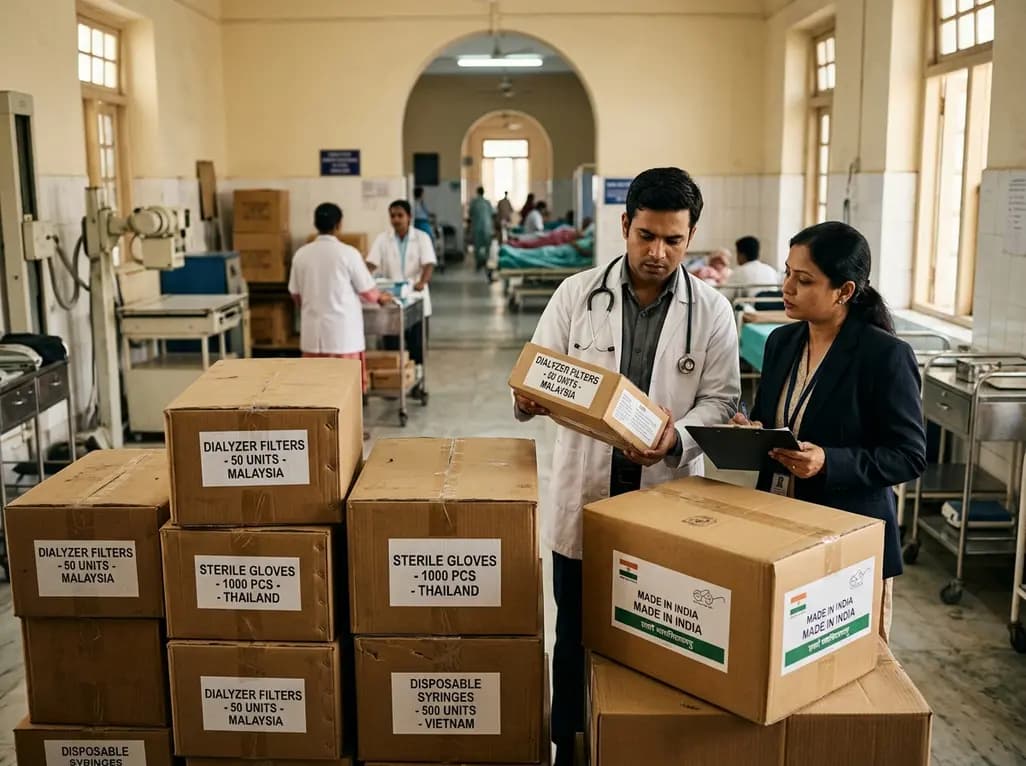
The surge in medical device imports into India has raised serious concerns among healthcare stakeholders and domestic manufacturers. Recently, the Directorate General of Trade Remedies initiated an anti-dumping probe targeting dialyser shipments from China and Malaysia. Consequently, domestic producers face significant market distortion due to low-cost products entering under regional trade agreements. During the FY25-26 fiscal year, imports from Association of Southeast Asian Nations member countries expanded by 14 percent, reaching nearly 13,000 crore rupees. This rapid inflow affects crucial healthcare sectors, including renal care, diagnostic radiology, and essential surgical disposables. Manufacturers of syringes, medical gloves, consumables, and imaging equipment report growing difficulty in recovering capital investments. Consequently, domestic suppliers struggle to sustain domestic operations despite aligning with national self-reliance goals. As low-cost items flood Indian healthcare markets, industry leaders urge immediate regulatory interventions to safeguard quality and economic viability. Addressing these trade imbalances remains vital for establishing long-term healthcare security across Indian medical institutions.
The rapid growth of medical device imports directly influences India's healthcare infrastructure and domestic manufacturing capacity. Over recent years, public policies encouraged indigenous manufacturing to reduce reliance on foreign supply chains. Specifically, government initiatives like the Production Linked Incentive scheme incentivized companies to build high-tech manufacturing facilities. However, unchecked low-cost imports threaten these capital-intensive investments. Indian companies have built substantial production capabilities across various medtech categories, including diagnostic imaging, renal care, and surgical supplies. Despite adhering to stringent international quality standards, local manufacturers face severe pricing pressure. Foreign manufacturers often export surplus goods at artificially low prices, undercutting domestic price points. Therefore, Indian companies find it increasingly difficult to compete fairly within their own domestic market. When local factories operate below capacity due to predatory import pricing, long-term research and development efforts suffer. Consequently, healthcare providers risk becoming reliant on unstable foreign supply chains for critical clinical supplies. Maintaining robust domestic manufacturing is essential for ensuring uninterrupted clinical care and stabilizing healthcare costs across clinical specialties.
Renal care represents one of the most critical sectors impacted by foreign trade distortions. Over the past two years, dialyser imports from Malaysia and China doubled to 256 crore rupees. Dialysers are essential medical consumables used in hemodialysis procedures for end-stage renal disease patients. Domestic manufacturers have built adequate production capacity and high-quality standards to fulfill national demand independently. However, artificial price depression caused by dumped dialysers restricts domestic market growth. Industry experts point out that dumped products leave minimal margin for local firms to invest in advanced research. Furthermore, nephrology clinics and dialysis centers must maintain reliable access to high-quality dialysers. When low-cost products dominate the market, clinicians express valid concerns regarding long-term quality control and patient safety standards. If local producers exit the market due to financial losses, healthcare systems could face severe supply shortages. Therefore, trade authorities are closely examining import pricing to prevent unfair trade practices from harming domestic renal care infrastructure. Sustaining indigenous dialyser production ensures steady supply chains and supports equitable healthcare delivery across Indian renal units.
A major driver behind the domestic medtech crisis involves trade rerouting through regional free trade agreements. Under current trade frameworks, goods originating from ASEAN member states enjoy zero-tariff access into India. However, industry leaders report that Chinese manufacturers increasingly route products through neighboring countries like Malaysia and Vietnam to exploit duty-free privileges. This practice circumvented standard customs tariffs and flooded Indian markets with subsidized devices. As a result, companies that invested heavily under the government's Production Linked Incentive scheme face severe financial headwinds. The PLI framework aimed to foster local self-reliance and reduce vulnerable import dependencies in critical medtech segments. Nevertheless, local firms now hesitate to commit additional capital toward expansion projects when artificially cheap imports undermine domestic sales. Industry forums are actively urging the government to tighten rules of origin and renegotiate trade provisions. Tightening documentation requirements will ensure that only genuinely manufactured ASEAN products benefit from zero-duty entry. Protecting local investments remains imperative for sustaining India's broader medtech manufacturing ecosystem.
In addition to advanced medical equipment, basic disposable items face severe market erosion. Products such as surgical gloves, disposable syringes, and imaging consumables experience heavy price undercutting from imported goods. Public hospital procurement procedures frequently prioritize contracts based strictly on the lowest financial bid. Consequently, domestic manufacturers who invest in high quality controls and indigenous raw materials are frequently outbid by subsidized foreign imports. For example, surgical glove manufacturers report that raw material tariff structures currently favor finished imports over locally processed components. Similarly, radiology departments relying on advanced imaging equipment face high costs for imported sub-components like X-ray tubes and flat-panel detectors. Unchecked low-cost component imports impede local original equipment manufacturers from scaling up indigenous assembly lines. To address these systemic hurdles, industry experts advocate for revised public procurement guidelines that evaluate quality and local content alongside price. Balancing cost considerations with manufacturing sustainability helps Indian medical facilities procure reliable, high-grade medical consumables without compromising patient care quality.
Addressing trade imbalances requires a comprehensive strategy involving regulatory policy, tariff restructuring, and institutional reform. Trade experts recommend initiating targeted anti-dumping duties on verified dumped product categories to restore fair market pricing. Additionally, reevaluating tariff structures on essential imported components will help domestic manufacturers lower overall production costs. Implementing stricter origin verification mechanisms prevents foreign exporters from exploiting regional free trade agreements improperly. Furthermore, institutional healthcare buyers should incorporate preference frameworks for locally manufactured medtech products in public procurement tenders. Promoting quality-centric evaluation criteria over strict lowest-cost bidding encourages domestic manufacturers to maintain top-tier clinical standards. Encouraging public-private partnerships will also accelerate technology transfers and indigenous innovation in high-value segments like diagnostic imaging. By establishing a balanced regulatory environment, India can protect its domestic medtech ecosystem while maintaining affordable healthcare access. Ultimately, safeguarding domestic manufacturing guarantees supply chain resilience, fosters technological autonomy, and elevates patient care standards across the entire national healthcare network.
Q1: Why is an anti-dumping probe being conducted on dialyser imports into India?
The Directorate General of Trade Remedies initiated the anti-dumping probe after domestic manufacturers reported severe pricing suppression. Imports of dialysers from China and Malaysia doubled over two years, reaching 256 crore rupees. Domestic producers argue that artificially depressed import prices severely undermine local investments in manufacturing, research, and quality compliance. The investigation aims to determine whether dumping has occurred and establish fair protective duties for the domestic medtech industry.
Q2: How do free trade agreement rules affect local medical device manufacturing?
Free trade agreements allow zero-duty import access for products originating from member nations. However, industry experts note that foreign manufacturers often reroute products through ASEAN countries to claim these duty-free benefits. This influx of cheap devices undercuts domestic companies that invested under national schemes like the Production Linked Incentive program. Industry stakeholders are urging trade authorities to tighten rules of origin to prevent trade exploitation and protect local manufacturing capacity.
Q3: What challenges do domestic manufacturers face in public procurement tenders?
Public sector medical procurement tenders traditionally award contracts based primarily on the lowest bid price. Consequently, domestic manufacturers who maintain higher quality standards and face inverted tariff structures struggle to compete against subsidized foreign imports. Products like surgical gloves, syringes, and imaging equipment often lose tender contracts to low-cost imports. Industry advocates recommend revising procurement frameworks to give weight to domestic content and quality parameters alongside financial cost.
Disclaimer: This content is for informational and educational purposes only. It does not constitute medical advice or replace professional judgment. Refer to the latest local and national guidelines for clinical practice.
References

Read summarized clinical updates, watch expert medical content, and earn CME certifications right from your smartphone.
Open your smartphone camera to scan and install.





India's medtech industry faces severe headwinds as low-priced imports of dialysers, syringes, gloves, and X-ray devices surge from ASEAN nations. An anti-dumping probe into Chinese and Malaysian dialyser imports highlights concerns over trade rerouting and fair competition for local PLI-backed manufacturers.
last month

Explore how patient retention in hospitals relies on clinical trust and longitudinal continuity rather than aggressive commercial conversion. Healthcare leaders highlight evidence-based care, post-discharge adherence, and operational accountability as the true drivers of sustainable patient lifetime value.
Today

A multicentre RCT in China shows that the PAICS AI system significantly boosts sonographer sensitivity in detecting fetal intracranial malformations by 8.7% without compromising specificity, offering promising diagnostic support for prenatal neurosonography.
Today

A recent study highlights the utility of two-dimensional speckle tracking echocardiography in assessing right atrial mechanics in OSAHS. Progressive reductions in reservoir and conduit strain, coupled with elevated contraction strain, signal early right heart remodeling correlated with apnea severity.
Today

A premature neonate developed upper limb compartment syndrome after uterine rupture extruded the arm through a scar defect. Conservative management with continuous monitoring yielded complete functional recovery and normal limb growth at 10-year follow-up, highlighting non-operative safety in selected cases.
Yesterday

The Supreme Court questioned FSSAI's phased warning approach, urging single-phase implementation for foods exceeding limits in any nutrient of concern. Backed by ICMR-NIN recommendations, the proposed red hexagonal warnings target added sugar, salt, and fat to combat India's escalating chronic disease epidemic.
Today
