.webp&w=384&q=75)

Loading, please wait...
Loading, please wait...
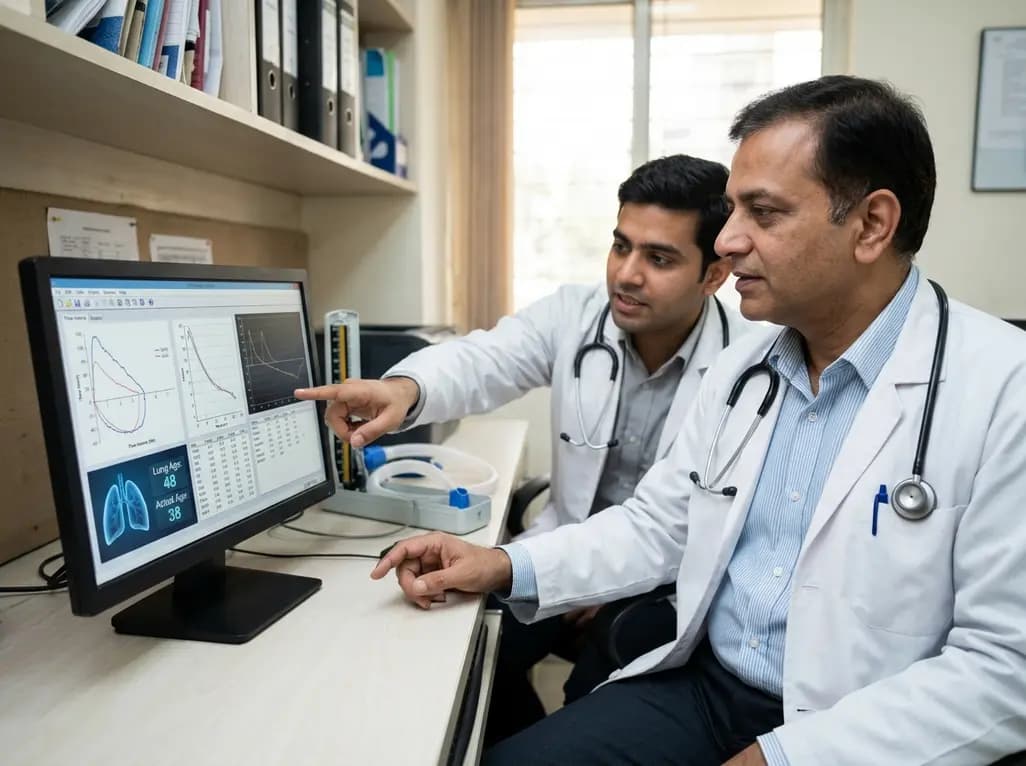
A recent study published in JMIR AI suggests that machine learning can accurately determine a patient's biological sex and estimate their physiological lung age from pulmonary function tests (PFTs). This lung age prediction approach provides a more intuitive understanding of respiratory health compared to traditional metrics. Consequently, clinicians may soon use these artificial intelligence models to enhance patient communication and monitoring.
Researchers from the Mayo Clinic analyzed retrospective data from 6,392 healthy adults across three regions. They developed gradient-boosted machine models to analyze various PFT parameters, including time-series features. The goal was to determine if artificial intelligence could go beyond standard interpretation to reveal underlying biological patterns related to aging and sex.
The most advanced model achieved a mean absolute error of only 5.55 years in predicting chronological age. Moreover, the sex classification model demonstrated exceptional performance with an area under the curve (AUC) of 0.981. Key predictors for these models included peak expiratory flow, height, and residual volume as a percentage of total lung capacity. Therefore, these findings suggest that AI can extract highly specific physiological markers from routine lung tests.
Although the models tended to overestimate age in younger individuals and underestimate it in older adults, they consistently followed chronological trends. This suggests that physiological lung age could become a valuable biomarker for monitoring lung aging and overall wellness. Furthermore, the ability to predict biological sex with 91.7% sensitivity highlights the profound anatomical differences captured by PFT data.
In conclusion, the integration of AI into pulmonary diagnostics offers a promising pathway for personalized medicine. However, further validation in diverse patient populations is necessary before widespread clinical adoption. Ultimately, this technology could revolutionize how we interpret lung function and manage chronic respiratory conditions.
AI models analyze complex patterns within PFT data, such as airflow volume and capacity. They compare these metrics against large datasets to determine how closely a person's lung function matches specific age groups, resulting in a lung age prediction.
Lung age offers an easy-to-understand metric for patients. This can potentially increase motivation for smoking cessation or adherence to respiratory treatments by making the impact of lung health more tangible.
Currently, these AI models are designed to supplement traditional interpretation. They provide additional context regarding physiological aging rather than replacing standard clinical diagnosis.
Disclaimer: This content is for informational and educational purposes only. It is not intended as a substitute for professional medical advice, diagnosis, or treatment. Always seek the advice of your physician or other qualified health provider with any questions you may have regarding a medical condition. Refer to the latest local and national guidelines for clinical practice.
References
Johnson PW et al. Estimating a Physiological Lung Function Score and Biological Sex Using Pulmonary Function Tests and Machine Learning: Retrospective Study. JMIR AI. 2026 Jun 01. doi: 10.2196/89060. PMID: 42224015.
Topalovic M, et al. Artificial intelligence for interpreting pulmonary function tests. Eur Respir J. 2019;53(3):1801703. doi: 10.1183/13993003.01703-2018.
American Thoracic Society. Standardizing PFT Interpretation. 2022.

Read summarized clinical updates, watch expert medical content, and earn CME certifications right from your smartphone.
Open your smartphone camera to scan and install.





Mayo Clinic researchers developed AI models to predict lung age and sex from PFT data, achieving high accuracy and offering a new way to assess lung health....
4 months ago

Recent epidemiological data reveals a dramatic surge in summer heat mortality driven by human-induced climate warming. This analysis explores the pathophysiological impacts on cardiac and renal systems, diagnostic dilemmas in death certification, and essential emergency cooling protocols for acute clinical care.
Today

Odisha has established India's first state-level clinical protocol specifically tailored for pregnant women with sickle cell disease. Developed with NHM and UNICEF, the framework provides structured antenatal screening, crisis mitigation, standardized referral pathways, and specialized interdisciplinary care.
Today

India is advancing preventive healthcare by integrating genomics, artificial intelligence, and quantum technologies. With the SANGAM programme sequencing one million Indian genomes, clinicians can unlock personalized therapies, detect cardiometabolic risks early, and curb the burden of diabetes and heart disease.
Today

A randomized controlled trial demonstrates that an eight-week dual-task training intervention significantly improves static and dynamic postural control over standard balance exercises in individuals with chronic ankle instability, addressing critical neurocognitive deficits during athletic and daily activities.
Today

A retrospective cohort study of 7,716 ICU patients from the MIMIC-IV database demonstrates that Gradient Boosting Decision Trees significantly outperform traditional SOFA scores in predicting in-hospital mortality among patients with sepsis and diabetes, with SHAP analysis providing clinical interpretability.
Today
