.webp&w=384&q=75)

Loading, please wait...
Loading, please wait...

Digital technologies increasingly shape psychiatric practice and outpatient mental health care. Recently, generative models and conversational companions have prompted intense debate among behavioral specialists. Integrating AI in schizophrenia care presents a delicate challenge, given the vulnerabilities tied to psychotic illness. While automated tools offer continuous accessibility, researchers have rarely investigated the direct viewpoints of patients and their families. A qualitative study by Gonzalez Chong and colleagues at a New York medical center addresses this gap. By examining stakeholder perspectives, this landmark research reveals vital guidance for clinicians.
The primary theme identified in the study, 'Available When No One Else Is', illustrates how automated companions could bridge critical support gaps. Patients with schizophrenia spectrum disorders frequently experience severe emotional distress during late-night hours. During these quiet crises, human clinicians and informal caregivers are often unreachable. Consequently, participants recognized that an automated conversational agent could offer an immediate, accessible presence between outpatient clinic visits.
Patients appreciated having access to a supportive tool that never sleeps, judges, or grows exhausted. Similarly, family caregivers noted that round-the-clock digital availability could reduce emotional exhaustion and caregiver burden. Many caregivers carry constant worry when supporting relatives who battle persistent hallucinations and profound anxiety. Furthermore, patients noted that interacting with software could minimize the shame associated with sharing persecutory fears. By providing a low-friction outlet for neutral self-disclosure, software might defuse acute panic. Clinicians also recognized that consistent between-visit engagement could capture early warning signs of behavioral relapse. Therefore, perpetual accessibility represents the most praised feature of conversational software, provided that developers implement strong clinical safety guards.
Despite acknowledging potential benefits, stakeholders raised deep questions regarding operational purpose, captured under the theme 'What Would It Do?'. Participants struggled to conceptualize how an algorithm could interact productively with individuals experiencing altered perceptions. Specifically, patients and caregivers expressed uncertainty about whether the proposed tool served as a passive scheduling aid, a digital wellness journal, or a synthetic conversational friend.
Moreover, healthcare providers voiced substantial clinical skepticism about real-world effectiveness. Clinicians questioned whether conversational software could accurately interpret disorganized syntax, tangential thought processes, or poverty of speech. If algorithms fail to decode idiosyncratic expressions, they may generate confusing responses that worsen thought alienation. In addition, providers expressed logistical concerns regarding EHR workflow integration. Without distinct triage rules, digital tools might send excess clinical alerts that overwhelm care teams. Meanwhile, service users worried about encountering repetitive, canned phrases that lack personal meaning. Consequently, the research highlights that mental health systems must define explicit, realistic operational scopes before introducing conversational interventions. Transparent communication about functional limitations helps patients form healthy expectations and prevents premature disengagement.
Trust served as the primary clinical concern across all focus groups, reflected in the third theme, 'How Can I Trust It?'. In psychotic disorders, mistrust is rarely an abstract ethical query; instead, it frequently entangles with core psychopathology. Many individuals with schizophrenia endure persecutory ideation, ideas of reference, and fears of external surveillance. Therefore, introducing opaque algorithmic interfaces without explicit privacy standards poses direct clinical risks.
During discussions, patients questioned who controlled their private entries, whether tech companies monetized their data, and whether clinical teams monitored every interaction. Furthermore, participants worried that digital tools could covertly manipulate their thoughts. Clinicians shared these critical concerns, observing that conversational agents can generate fabricated claims or validate ungrounded assumptions. If an automated system affirms delusional beliefs, it damages reality testing and escalates psychological distress. To navigate these challenges, developers must implement strict data governance, secure local storage, and transparent privacy agreements. Clinicians must also address technological fears openly during consultations. Open dialogue demystifies algorithmic functions, reassuring patients that digital aids respect their autonomy rather than compromising their confidentiality.
The fourth theme, 'A Tool, Not a Therapist', established unequivocal boundaries regarding technology's clinical position. Participants firmly agreed that artificial intelligence must serve as a supplementary resource rather than an alternative to human care. The therapeutic alliance forms the cornerstone of psychiatric management, and stakeholders recognized that software cannot replicate genuine human presence.
Specifically, service users emphasized that clinical recovery depends on empathy, shared human understanding, and mutual trust. Software cannot express authentic emotional compassion, nor can it provide the interpersonal validation necessary to alleviate severe social isolation. Caregivers also voiced significant apprehension that healthcare administrators might substitute automated systems for human appointments to reduce operational costs. Such cost-cutting measures could isolate marginalized patients who need intensive personal support. Providers strongly validated these concerns, insisting that clinical responsibility and diagnostic oversight must remain firmly with licensed psychiatrists. Thus, technology should primarily handle structured administrative and psychoeducational support. Automating routine tasks frees valuable clinical time, allowing psychiatrists to invest more energy into deep therapeutic conversations with patients.
The final core theme, 'Keep It Low-Risk', defined permissible real-world applications for digital assistants. Stakeholders reached consensus that conversational software should never manage acute psychiatric emergencies, de-escalate severe agitation, or provide unmonitored therapy. Instead, participants favored safe, structured utilities such as medication scheduling, lifestyle habits tracking, calendar prompts, and guided breathing exercises.
Moreover, clinical institutions must institute clear safety protocols before deploying digital tools. Systems must possess automated mechanisms to detect acute crisis signals, such as suicidal ideation or violent impulses, and immediately connect the patient to emergency human responders. In countries like India, where psychiatric specialist availability remains constrained, low-risk digital companions can support community health workers and outpatient clinics. However, health professionals must ensure that digital interventions do not widen health disparities among individuals with limited digital literacy. Clinicians must routinely evaluate how patients interact with these technologies, remaining vigilant for emerging paranoia or unhealthy reliance. Ultimately, maintaining low-risk boundaries allows modern medicine to harness computational innovation safely while safeguarding vulnerable patients from unintended harm.
The safest applications include low-risk organizational tasks such as medication reminders, appointment scheduling, and basic lifestyle tracking. Stakeholders firmly reject autonomous psychotherapy or emergency de-escalation. Digital tools should strictly support outpatient routine management and reinforce psychoeducation while maintaining immediate, reliable protocols that transfer care to human clinicians during crises.
Schizophrenia involves vulnerabilities like persecutory delusions, ideas of reference, and impaired reality testing. Consequently, opaque data systems or conversational hallucinations can trigger paranoia or deepen delusional convictions. If software provides uncritical validation of irrational beliefs, patients may experience clinical worsening. Therefore, transparent data practices and strict conversational guardrails are critical.
Psychiatrists should introduce digital companions with complete transparency regarding data ownership, privacy, and algorithm boundaries. Clinicians must explicitly clarify that digital tools serve as adjuncts rather than replacements for human clinical visits. Open discussions demystify technology, reduce paranoid fears, prevent unrealistic therapeutic expectations, and preserve the doctor-patient relationship.
Disclaimer: This content is for informational and educational purposes only and should not be considered medical advice. Always consult a qualified healthcare professional regarding any medical condition or treatment. Refer to the latest local and national guidelines for clinical practice.
References

Read summarized clinical updates, watch expert medical content, and earn CME certifications right from your smartphone.
Open your smartphone camera to scan and install.





An exploratory study examines stakeholder perspectives on AI in schizophrenia care. Patients, caregivers, and providers view AI chatbots as promising adjuncts for between-visit support, but emphasize the need for transparency, data privacy, low-risk use cases, and maintaining the human therapeutic alliance.
Today
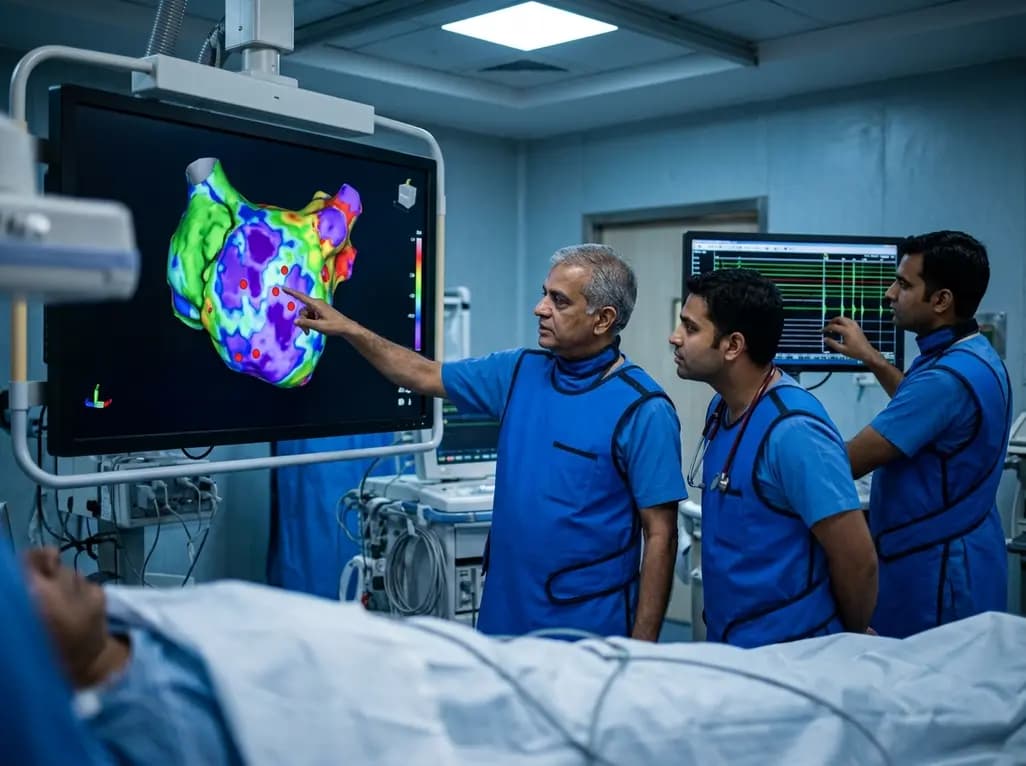
A study of 1,428 AF ablation patients reveals that over 60% of left atrial non-PV triggers arise within low-voltage areas, with anterior and roof triggers colocalizing entirely within fibrotic substrate. Identifying and ablating these sites is critical for long-term arrhythmia freedom.
Today

A comprehensive meta-analysis of over 278,000 women demonstrates that maternal atopic dermatitis significantly increases risks of premature rupture of membranes and low birth weight. Discover essential clinical insights on disease mechanisms, serial antenatal growth monitoring, and safe therapeutic interventions.
Today

A pioneering study highlights the first United States experience using the FARAPOINT focal pulsed-field ablation catheter for refractory ventricular tachycardia. The catheter achieved complete acute non-inducibility across tested patients without procedural complications, marking a milestone in ventricular ablation.
Today

A biomechanical study shows that augmenting thin fascia lata grafts with a reinforced polyester patch doubles ultimate tensile strength and stiffness, matching the performance of thick grafts for superior capsule reconstruction while reducing donor-site morbidity.
Today

A cross-sectional study reveals that elevated METS-IR is independently associated with higher myopia odds in adolescents, showing biological synergy with obesity and highlighting the need for metabolic screening in pediatric eye care.
Today
